Roadsides: is scalping just management on the cheap?

Following its objections to roadworks scalping valuable vegetation from the Fryers Ridge, FOBIF has written to the Environment Minister asking for clarification of policy on vegetation management of roadsides.

The letter reads, in part:

“Forest managers have told us that, though this method of vegetation management is not ‘ideal’, budgetary restraints prevent them from using more labour intensive methods—like selective removal of obstructive vegetation, or moderate grooming. Further, there seems to be a common assumption in the Department that ‘priority to safety’ means absolute disregard for environmental values, when it should mean: careful management of vegetation to maintain sight lines and encourage sensible driver behaviour.

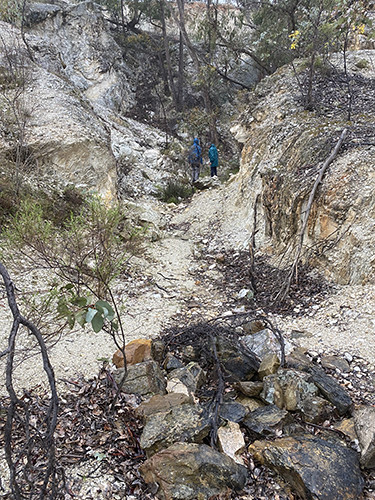
Fryers Ridge, July 2015: the road is the strip in the background. Managers plead that budget restrictions mean that 'scalping'--scouring the earth--is the only option they have in managing roadside vegetation.

Fryers Ridge, July 2015: the road is the strip in the background. Managers plead that budget restrictions mean that ‘scalping’–scouring the earth–is the only option they have in managing roadside vegetation.

“Our group is fully aware of the necessity to maintain proper fire access roads, and to manage adjacent vegetation to minimise the likelihood of accidents. We believe, however, that this should be done with minimum of disturbance to  environmental values. We assume that Victoria adheres to the common principle ‘avoid, minimise, mitigate and lastly offset’ in its road management policy?

“Given that managers often justify crude practices by appealing to budget limitations, we have four questions:

  1. What is the Department’s [and the Government’s] policy on roadside scalping?
  2. What is the Department’s 2015-6 budget for a. Forest management and b. conservation reserve management, compared to the same figures of 2005-6?
  3. Do the native vegetation clearance regulations which have been the subject of recent community consultation apply to the Department’s own managers?
  4. Is there any monitoring of the effects of roadside clearing on the environment?”

As this post is being written, controversy sputters over the destruction of 900 ancient river red gums as part of improvements to the Western Highway: seemingly another exercise by government in which ‘safety’–or in this case, speed–sweeps aside any other considerations.

Posted in News | 3 Comments

Does frequent fire damage the soil?

A study presented at Melbourne University Burnley on August 5 offered strength to an argument that’s been going around for a long time: that high frequency severe fire damages soil. The argument has often relied on common sense and anecdotal evidence, but until now there’s been little rigorous analysis of the facts. This study remedies the deficiency:

‘[The] study investigated the effects of 27 years of repeated low-intensity prescribed burning in dry sclerophyll eucalypt forests in south-eastern Australia, focusing particularly on litter and soil Carbon and nitrogen (N). Four prescribed fire treatments designed as factorial combination of two fire seasons (autumn and spring) and two fire frequencies (high frequency – burning in 3-yr cycle and low frequency – burning in 10-yr cycle) and un-burnt Control were studied…

Severe management burn: a Melbourne University study has shown that such an exercise, repeated at 3 year intervals, causes severe soil damage.

Severe management burn: a Melbourne University study has shown that such an exercise, repeated at 3 year intervals, does ‘reduce key indicators of soil productivity’.

‘This study provides empirical evidence that high frequency prescribed fire does indeed reduce key indicators of soil productivity, and therefore that longer burning interval (c. 10 years) may be required to maintain a long-term ecological balance in dry sclerophyll eucalypt forests or similar forest ecosystems.’

Studies like this are a sobering reminder that long term damage to the forest is built into a major part of the current fire defence system: namely, the Asset Protection Zone, which under current policy is set to be burned every three years. For a long time managers have conceded that these areas of land are ecological sacrifice zones.

In theory the detail of the research can be found through a webinar at : https://unimelb.zoom.us/j/611678161            but we found the link difficult to access.

Posted in Fire Management | Comments Off on Does frequent fire damage the soil?

Presentation on local butterflies

Julie Whitfield of Bendigo is an environmental consultant with a passion for butterflies, and she will be guest speaker at Newstead Landcare’s next meeting, Thursday 20th August.

As a recipient of a prestigious Winston Churchill Fellowship Julie recently had the pleasure of exploring conservation projects for butterflies in the USA and the UK with the dream of bringing these models back to Victoria to apply with our local groups.

Julie will provide a presentation on these experiences and on the butterfly species likely to occur in the Newstead area, and their role in local ecosystems.

Mount Alexander Shire has a few populations of the extremely rare Eltham Copper Butterfly which has an extraordinary relationship with a particular ant species and Sweet Bursaria shrubs. Julie will introduce you to this marvel as well as to some of our more common local butterflies.

All are welcome to attend the talk on Thursday 20th August at 8 pm at Newstead Community Centre (gold coin donations appreciated). No need to book in – just come along, discover and be inspired!

Julie Whitfield in action

Julie Whitfield in action

Posted in News | Comments Off on Presentation on local butterflies

Bright winter sunshine, obscure corners

A bitterly cold morning didn’t deter FOBIF walkers from tackling some obscure corners of the Columbine and Salters Creeks valleys on Sunday. The corners turned out to be even more obscure than intended when a navigation error by walk leader Bernard Slattery landed the group in an unexpected approach to Salters Creek. Well, as the great Paddy Pallin might have said, in this country you’re ‘never quite lost’, and we all emerged triumphant and on time.

The walk included a look at one of Doug Ralph’s favourite haunts: Charlie Sanger’s hut, near Columbine Creek. As usual, we provided perfect winter weather for the occasion.

Lunch at Salter's Creek

Lunch at Salters Creek

Walkers at the Sanger hug. Photo by Noel YOung

Walkers at Sanger’s hut site. Photo by Noel Young

Bernard addressing the group at Sanger's hut site.

Bernard addressing the group at Sanger’s hut site.

Posted in News | Comments Off on Bright winter sunshine, obscure corners

The scalping of Fryers Ridge [1]

Visitors to the Fryers Ridge this past week have been stunned to find that major works on the verges of the Ridge Road have scoured the earth bare, virtually eradicating a large part of one of the region’s most significant wildflower areas.

The road runs along the top of the ridge, dividing the Fryers Flora reserve from the State Forest.

The works have been designed to eliminate blind bends, and facilitate access in the event of fire: according to DELWP: ‘the works were completed by the Department tractor …to clear the road verges of vegetation as a recent roads inspection showed that the verges were overgrown and had a traffic near miss a while ago.’

Fryers Ridge Road, near the Irishtown Track: in places the road is twice as wide as the Midland Highway

Fryers Ridge Road, near the Irishtown Track, July 6: in places the road is wider than the Midland Highway

The roadside verge has been ‘scalped’ along many hundreds of metres, and in addition earth has been scraped and piled up as much as 10 metres into the bush.

These works are a perfect example of a problem FOBIF has had with DELWP managers for many years.

In discussion with Department and Parks officers on the road on Friday July 10th we were amazed to discover that they did not attach any particular importance to these roadside verges,   because no rare or endangered species had been drawn to their attention there. It seems the area is in a ‘general zone’, which seems to translate as ‘nothing much to see here.’

On Fryers Ridge: for long sections vegetation off the edges of the roadway has been obliterated over hundreds of metres

On Fryers Ridge: for long sections vegetation off the edges of the roadway has been obliterated over hundreds of metres


This is the problem with most road works: for example, a 2012 DSE Document on roadside vegetation management for bushfire risk mitigation states that ‘Bushfire risk mitigation works that are likely to have a significant environmental impact on the road reserve will require a planning permit.’ If the area in question is not seen by managers as special, and is not on their data bases as containing rare species, it seems that road workers aren’t instructed to be particularly careful to look after the area: works are not seen to have a ‘significant environmental impact.’

It seems to us that there’s an underlying assumption in the Department that whatever mess is made in the short term will fix itself in the longer term, because the bush recovers. We were told this in our discussions with managers on Friday: this kind of gouging had been done before, and the bush had come back OK…it may even be improved by this kind of disturbance…so it’s not so bad, is it? Our opinion is that whatever values such areas as this have are there in spite of such works, and every time they are done, especially, say, in drought times, the recovery is less. Here’s a question: Has the Department made any long term assessment of the effects of these kind of works?

Posted in Fire Management, News | 1 Comment

Maybe THIS is the saddest sign in the region?

The sign depicted in our July 5 post may have been trumped by this one, on the Fryers Ridge: ‘DO NOT…remove soil or rock.’ This injunction doesn’t apply to road works.

Sign on Fryers Ridge: it doesn't sit well next to the gouging of the nearby Ridge Road. FOBIF has argued that road works should be planned with careful concentration given to adjacent bushland.

Sign on Fryers Ridge: it doesn’t sit well next to the gouging of the nearby Ridge Road. FOBIF has argued that road works should be planned with careful concentration given to adjacent bushland. The track depicted is not the recently scoured ridge road.


Posted in Fire Management, News | Comments Off on Maybe THIS is the saddest sign in the region?

Is this the saddest sign in our region?

Well, we think it could be a credible nomination, anyway: an eloquent testament to past abuse of the land, painfully slow recovery, and perhaps the under resourcing of our land management bodies.

Near Perkins reef in the Maldon Historic Reserve. The sign speaks volumes about the under resourcing of public land management in Victoria.

Near Perkins Reef in the Maldon Historic Reserve: the sign speaks volumes about environmental history, and the painfully slow rate of recovery from land degradation.


Posted in Nature Observations | 1 Comment

Fire’s off…and on

Several more substantial proposed burns have been removed from the current DELWP Fire Operations Plan. Apart from the Amanda’s Track proposal, which we have previously reported, these include:

Donkey Farm Track [in the Maldon Historic Reserve], Chewton Railway Dam [in the Fryers Forest], Pepper Tree Track [in the Tarilta catchment], and  Zig Zag track [in the Sandon State forest].

Sandon State Forest: the 491 ha management fire in this zone has been deleted from the fire operations plan.

Sandon State Forest: the 491 ha management fire in this zone has been deleted from the fire operations plan. This forest was ‘almost completely denuded of useful timber’ by 1870.


All of these were substantial burns for our area, and we had expressed reservations about them for one reason or another in our submissions to the Fire Operations Plan.

Withdrawal of these burns has been  ‘based on a review of the risk, feedback from community groups and an operational assessment’, according to Andrew Koren, DELWP’s local program manager for planned burning, in a detailed response to FOBIF’s submission to the FOP, received last week.

The Department will proceed with its plans to burn Mount Tarrengower, though how this will be done is still under consideration. The southern slope of the Mountain, around Perkins Reef, was recently burned. Additionally, a new burn is proposed for Fryers Ridge, around the Old Tower Track. Crude track upgrades in this area were done over the last couple of years.

Posted in Fire Management | Comments Off on Fire’s off…and on

Fire risks in the Mount Alexander region: public and private responsibilities

In his response to FOBIF’s fire submission [see above], Andrew Koren made the following observations about fire danger in our region:

‘Communities in Castlemaine, Chewton and surrounds are considered to be at extreme property impact risk from bushfires on days like Black Saturday; based on Phoenix Rapid-fire bushfire simulation. Extreme property impact risk is where many properties in a community  are in the path of numerous simulated bushfires. In these areas, impact by a potentially high-consequence bushfire at some time is almost certain.

‘The simulated property impact risk across the West Central Bushfire Risk Landscape is shown on Map 6 in the West Central Strategic Bushfire Management Plan.

‘As these communities have always been considered at high bushfire risk, DELWP’s fuel management program has not altered in this area. The program continues to build on planned burning from previous years, with planned burns close to both Castlemaine and Chewton for asset protection purposes.

‘With modelling showing that bushfires from up to 50km away can impact on Castlemaine and surrounds under extreme bushfire conditions, proposed planned burning in the Maldon area also provides protection these communities through mitigation of bushfire behaviour.’

FOBIF does not dispute with DELWP on fire behaviour. We are still, however, not at all clear about the management of fire risk on private, as opposed to public land. The risk document quoted above shows ‘priority fuel management areas’ in our region as being largely on private land, as we pointed out in our account of this document last year [see the map in that report]. Andrew Koren says of this:

Continue reading

Posted in Fire Management, News | 1 Comment

Fire: business as usual, for the moment

The State Government is still considering the recommendation by the Inspector General of Emergency Management that the ‘five per cent target’ be replaced by a risk management system. In his response to FOBIF’s fire submission [see above] Andrew Koren made it clear that until the Government makes a decision on the matter, DELWP is running business as usual:

‘The review conducted by Inspector General of Emergency Management ( IGEM) could result in possible changes to DELWP’s fuel management targets and delivery of the program. Any changes that result from IGEM will not be decided upon until later this year. Prior to this, DELWP will continue its operational planning for the 2015/16 financial year under the current target and program. Any changes to the fuel management policy, and targets and resulting operational changes won’t be reflected in the FOPs until 2016/17.

‘Each year of the 2015/16 – 2017/2018 plan contains a planned area of at least 300,000 hectares. This is in excess of the 2015/16 delivery target of 275,000 hectares. This is to allow DELWP flexibility across the state for seasonal weather and fuel conditions. The Murray-Goldfields target for the three years of the FOP is 11,285 hectares. This is a reduction from our previous target of 14,000 hectares.’

Posted in Fire Management | Comments Off on Fire: business as usual, for the moment