Trail bikes [1]: so, what’s the problem?

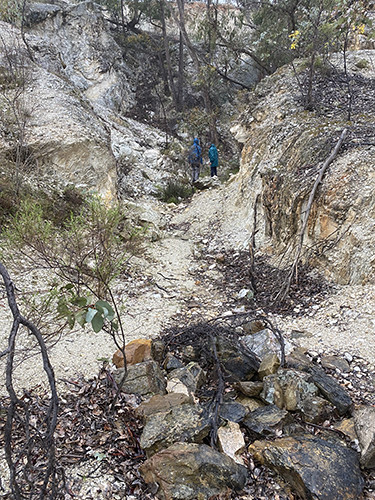
The second successful FOBIF youth walk for 2015 took a circuit from Garfield Wheel to Forest Creek on Sunday September 6. [see our post above].

You can find a good account of the walk by John Ellis on the Chewton.net Facebook page. One interesting feature of this report is that it draws attention to the fact that the quiet bush atmosphere  was a bit degraded by the presence of a couple of trail bike riders circulating close to the wheel and kicking up dust in the nearby cyanide pits. The report provoked angry–well, abusive, actually– responses from Facebook readers keen to defend the riders’ rights to do their thing in the area.

Trail bike riding on registered bikes on formed roads is a perfectly legal activity. So, what’s the problem?

There are two, actually.

The first is noise. This concerns not only bushwalkers, but residents on town margins who find their quiet weekends poisoned by riders circulating, quite legally, on nearby private land. One rider can intrude on the lives of dozens of people.

The second is illegal riding off track on public land. This can cause serious erosion and destruction of important vegetation.

The responses to John Ellis’s Facebook post seem to show that there are some riders who don’t see either of these as anything to worry about–and that, it seems, is the real problem

Land managers and municipalities have wrestled with this stuff for some time. Solutions have been put up, but things appear, on anecdotal evidence, to be getting worse. We look at the solutions below, and ask why they haven’t worked.

Posted in News | Comments Off on Trail bikes [1]: so, what’s the problem?

Nature Photographs in Newstead

The organisers of the upcoming  Alan ‘Curly’ Hartup exhibition have supplied us with the following text:

A wonderful exhibition of nature photographs by leading amateur photographer and longtime resident of Newstead, Alan Jesse Hartup (1915 –2004) will be opened at the Newstead Railways Arts Hub on Saturday October 10th at 3pm.

This exhibition is largely of bird life in Newstead and the surrounding districts, from Alan’s vast array of black and white photographs and colour slides. This selection of 20 works of black and white and prints from colour slides, span over 60 years of Alan’s impressive output. Beginning with his beloved 35m Voigtlander camera, he progressed to the brilliant level of work he achieved with his Mamiya and Rollieflex 2¼ square cameras and his great ability with dark room techniques.

Alan has been represented widely in amateur circles and has been a central figure in promoting, selecting and judging photography in Victoria and interstate. In preparing for this exhibition we have been reminded what a wonderful legacy Alan has left with images of the beauty and richness of our surroundings. He was a man at one with the natural world and one who took a vital interest in our environment and how to care for it. The exhibition was prompted by local field naturalists Geoff Park and Mrs. Joan Butler.

We, members of Alan and Rita’s family, appreciate the opportunity to show his work.

More details can be found in this flyer.

Posted in News | Comments Off on Nature Photographs in Newstead

FOBIF now on Facebook

After a fair bit of consideration, FOBIF has been experimenting with a Facebook page, as a way of varying our approach to informing the public about matters in our region, and maybe of reaching a new audience. The material we publish there will be variations on what we put on this site, and there’ll be links back to here.

We’re launching the page today with a slide show of photos of the late Doug Ralph. The page can be found here or by clicking on the Facebook icon to the right of this post.

If you’re into Facebook, add us to your friends – and add your knowledge and ideas to the material we’ve put out!

Posted in News | 1 Comment

Looking for something to do on Father’s Day?

Try a walk in the bush at the Garfield Water Wheel, Castlemaine, Sunday 6th September, meeting at 9.30 am outside Castlemaine Continuing Education in Templeton Street.

Youth Sustainability Champion, Nioka Mellick-Cooper, is a Year 9 student at the Castlemaine Secondary College. She is leading her fourth youth walk as part of the Friends of the Box-Ironbark Forests bushwalking program, and is generously funded by the Mount Alexander Shire’s Youth Grants. Nioka has received two grants to run her walks program and is looking forward to the Fathers’ Day ramble. See here for the post on the Mount Alexander youth walk which took place earlier this year.

“We took a few wrong turns on the last walk and got a bit lost, but it was all good fun. We hope to see some new people try their hand at bushwalking this time around, with or without your without a dad-type figure in tow.”

The walk will take just over 2 hours and will cover around 4-5km. Previous walks have been in the Muckleford forest, at the Eureka Reef, and Mount Alexander.

Arrive back at the carpark area for a vegetarian BBQ before returning to Castlemaine. All young people will receive a complementary gift pack. Please book a spot by phoning 54724609 or 0431 219 980.

Posted in News | Comments Off on Looking for something to do on Father’s Day?

Childrens walk cancellation

The childrens walk planned for  Sunday August 30 in the Castlemaine Botanical Gardens has had to be cancelled due to ill health. Our apologies for the short notice: we’ll let readers know when alternative arrangements are made.

Posted in News | Comments Off on Childrens walk cancellation

Hot tip: look for butterflies in the mistletoe…

Julie Whitfield gave a rousing talk on local butterflies to Newstead Landcare last Thursday. Those who missed it are recommended as a consolation to log on to a terrific Radio National Off Track program, A world without butterflies in which [among many other things] Whitfield takes a well aimed pot shot at the popular book A very hungry caterpillar. Why shouldn’t a good childrens book also be biologically accurate?

Grey mistletoe [amyema quandang, Barkers Creek, August 2015]: Mistletoes are favoured sources of food for many butterflies, and this particular species has been investigated for the medicinal properties of its leaves.

Grey mistletoe [Amyema quandang, Barkers Creek, August 2015]: Mistletoes are favoured sources of food for many butterflies, and this particular species has been investigated for the medicinal properties of its leaves.

There are about 400 species of butterflies worldwide, of which about 130 can be found in Victoria—and 40-50 in this region. One surprising piece of info in Thursday’s talk was the revelation that the humble mistletoe is a butterfly hotspot…so, if you’re strolling past an accessible patch of this much misunderstood semi parasite, take time to peer in.

Posted in News | Comments Off on Hot tip: look for butterflies in the mistletoe…

Sometimes you wonder: who’s doing the most damage to our bush?

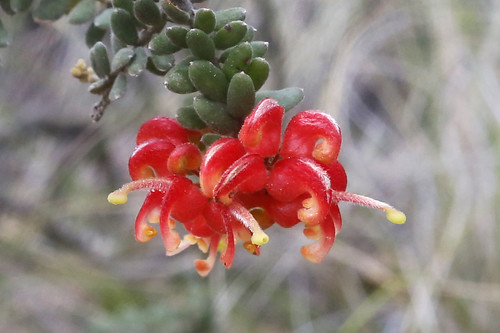
FOBIF has been getting numerous reports of roadside vandalism by both private and public operators. Walkers on FOBIF’s Tarilta excursion noticed more DELWP scouring on the Porcupine Ridge road last week, and this week we found numerous scalped verges on extremely minor tracks in the Fryers Flora reserve, including stretches where patches of Grevillea obtecta [Fryerstown grevillea] have been dozed under]. This plant is listed as ‘rare’ and ‘near threatened’ in Victoria in the Atlas of living Australia.

Survivor: a small bit of Fryerstown Grevillea pokes out of scoured ground. Swathes of the rare plant have been scoured along this and nearby tracks.

Survivor: a small bit of Fryerstown Grevillea pokes out of scoured ground  in the Fryers Flora reserve. Swathes of the rare plant have been gouged out along this and nearby tracks.

With the best will in the world, we can’t see how this kind of work is necessary. A lot of it has nothing to do with ‘sight lines’ or anything else to do with safety: it’s clear in multiple cases that a tree needed to be removed, but instead of getting a chainsaw and cutting it off at the base, the operator has just dozed it into the bush, taking numerous other things with it. This is a crude time and energy saving measure, which, in turn, is a money saving measure.

And there’s the rub: the excuse we’re constantly getting is, ‘we can’t do any better with the money we have.’

We suspect that another reason is that the operators are neither properly briefed nor properly supervised. And we’re getting increasingly cynical about bland fob offs, along the lines, ‘Maybe it could have been better done, and next time…’ On track management, ‘next time’ is rarely better.

On the matter of money, we’ve put that question to the Minister, and we’ll report her answer when we get it.


Posted in Fire Management, News | 1 Comment

Quote of the week

‘As we develop a better understanding of bushfire risk in different localities, we will supplement our investment in planned burning with other works
such as slashing and burning and mowing while aiming for the least impact on people and our ecosystems.’ [Our emphasis]

That’s from one of DELWP’s more recent publications, Bushfire management engagement strategy 2014-8. ‘Aiming for the least impact on…our ecosystems.’ Fire management practices seem to have improved in recent years, but we’re not sure if the ‘least impact’ idea has been communicated to road crews.

Posted in News | Comments Off on Quote of the week

Fire: it’s not just a matter of fuel reduction

Fire officers met the public in a lengthy consultation session on the draft Fire Operations Plan [FOP] through the afternoon and evening of last Tuesday [August 11] in Bendigo.

An excellent link to the relevant documents with comments on the FOP in the Muckleford-Maldon area can be found in the Muckleford Forest Blog. In addition to burns discussed there, FOBIF is most interested in proposed burns in the Taradale, Tarilta and Fryerstown areas.

We've reprinted this map before, but think it's worth another look: the 'priority fuel management areas are in mid grey. Source: Strategic bushfire management plan, West Central bushfire risk landscape.

We’ve reprinted this map before, but think it’s worth another look: the ‘priority fuel management areas are in mid grey, and they’re on private land. It’s not clear how they relate to ‘asset protection’ zones near settlements. Source: Strategic bushfire management plan, West Central bushfire risk landscape.


Aninteresting feature of the consultation was the display of Risk Landscape material. Readers will remember that this is the system most likely to replace the current crude five per cent burning target.

It was clear from discussions with officers that as far as on ground work is concerned, it’s early days with this system. For example: as is clear from the map above, most of the ‘priority fuel load’ areas in our region are on private land: yet we were told on Tuesday that negotiations via the CFA and municipal councils to undertake systematic fuel reductions in these areas are not far advanced: and that nothing had yet taken place on the ground in the Mount Alexander shire.

Continue reading

Posted in Fire Management, News | Comments Off on Fire: it’s not just a matter of fuel reduction

Into the valley

A solid group of FOBIF walkers led by Richard Piesse dropped in to the Tarilta Valley from Porcupine Ridge on Sunday in brisk but fine winter weather. There was good bird watching and plenty of fungi on show, and the valley is showing fair but patchy recovery from DSE’s disastrous 2012 fire exercise.

Taking a break by the Tarilta Creek.

Taking a break by the Tarilta Creek.

The group left the valley via the impressive rock cleft and waterfall ridge [which, unfortunately, rarely sees much water – see first photo below], and wound its way through an isolated subsidiary valley to the Great Dividing Trail.

Click on photos below to enlarge. Photographers are Bernard Slattery and Noel Young.

Noel Young sent us the following observations:

The bird life was fairly active in the area, and I was able to identify the following either by site or call:
Thornbill flocks, White throated Treecreeper, Golden Whistler, White eared Honeyeater, Grey Shrike-thrush, Spotted Pardalote, Long billed Corella, Sulphur crested Cockatoo, Crimson Rosella and Horsfield’s Bronze Cuckoo. 

 Two Black Wallabies crossed the Porcupine ridge road on the way in.

 I didn’t attempt a plant list, but there were several species of wattle flowering, including an unusually common occurrence of A gunni. (Ploughshare), a number of flowering Sundews, and an occasional Hovea and white or pink heath flowers. No flowering orchids were found as far as I know.

Posted in News | 1 Comment