Great lockdown reading 2: the dark side of the golden age

The accidental town doesn’t deal directly with the environmental consequences of the gold rush, but the context of environmental destruction is made clear, and the consequences soberly summed up in a sentence like this:

‘The Pennyweight Flat cemetery is a silent testament to the children sacrificed to the search for gold.’

Pennyweight Flat: ‘a silent testament to the children sacrificed to the search for gold.’

Water was the problem. A five minute excursion into our bushlands today will show that virtually every waterway has been trashed by miners. In the 1850s safe drinking water was hard to find, and dysentery a disastrous result, especially for children. Residents close to Forest Creek feared ‘the insidious creeping sludge discharged from mining operations upstream which was far worse than the occasional flood of water…’  ‘There was general agreement that Forest Creek was little more than a sewer by the time it reached the town…The public water supply … was still from holes in the vicinity of the respective creeks; water the colour of pea soup was purified with ashes, lime or alum…’

Although material like this is covered in Sludge: disaster on Victoria’s goldfields [Peter Davies and Susan Lawrence, 2019] we’re still waiting for an environmental history of this region. It would make great reading, and bring us closer to understanding the true price of gold.

Posted in News | Comments Off on Great lockdown reading 2: the dark side of the golden age

Great lockdown reading 3: Castlemaine’s first environmental conflict

One of the heroes in Marjorie Theobald’s narrative is Gold Commissioner Captain John Bull. The author builds on her previous research on one of the problems he faced:

Decaying puddler, Cobblers Gully: it’s picturesque now, but in its day it was a menace to the health of people and the environment.

‘As concern for the environment as we understand it today did not exist on the goldfields, it comes as a surprise that  in early 1855 Captain Bull took a stand on precisely these grounds. He sent to each puddling machine proprietor an edict that from the 31 March 1855 these machines would be banned from the main creeks in his district. This was necessary, he said, to safeguard the water supply of Castlemaine, the operations of miners using conventional methods, and the health of the creeks and flats generally. The problem was that the end product of the puddling machine process was a murky treacle-like sludge which had begun to pollute the creeks and choke the flats…

‘The reaction of the puddling machine men was swift. They (argued) that they had invested large sums of money in the erection of machinery, that puddling was important to the economy of the goldfields…and that such an edict would effectively shut down all future technological development in the industry…’

In this face off of environmental and community health on the one hand, and the economy on the other, guess who won? Of course, the alleged conflict between the economy and the environment and health is a false one, but it’s tenacious all the same, as we are seeing at this very time…

Posted in News | Comments Off on Great lockdown reading 3: Castlemaine’s first environmental conflict

Oceans of blossom, thousands of questions

The photo below shows fields of Woolly Wattle south of the Wewak Track, east of Porcupine Ridge. The wattle is interesting (and beautiful, of course) for the fact that its blossom can vary from pale yellow to dense lemon colour, often on the same plant.

Also interesting, in this case, are the blackened tree trunks, the result of a management burn in 2010. Before this fire, the burn zone was open woodland, with an understorey of tussock grass and shrubs. Now it’s virtually impenetrable, a dense thicket of Hedge Wattle, Woolly Wattle, eucalypt saplings and other growth.

Oceans of Woolly Wattle (Acacia lanigera) framed by the blackened trunks of eucalypts burned by DELWP in 2010. The message is: fire has a complex biological role in our bushland, and reduction burns sometimes produce rampant regrowth in the medium term.

Compare the above with the photo below taken in the same zone after the 2010 burn. At the time FOBIF was shocked at the severity of the fire, which killed many large trees.

The same zone, November 2010: the intense fire has produced dense regrowth, probably the most impenetrable in the region

The lesson to be drawn from these two photos: fire can regenerate as well as destroy. We don’t know what effect this management exercise has had on the zone, biologically, because we haven’t seen the before/after monitoring…if there is any. From the point of view of fuel reduction, however, it seems to have been counter productive.

This is not an argument against fuel reduction burns. But it is an argument for exercises which are better resourced, better researched and, perhaps, better managed.

Posted in News | 1 Comment

New find in Muckleford Forest!

A small population of a daisy-bush never found in Mount Alexander Shire before (as far as we know) has been discovered in bushland to the north of Newstead. Found growing under Grey Box and Yellow Gum trees, the erect daisy-bush stands 30cm tall with lilac flower-heads approx 10mm diameter. Experts at the Royal Botanic Gardens Herbarium in Melbourne identified it as Olearia floribunda Heath Daisy-bush.

Heath Daisy Bush in the Muckleford Forest near Newstead, photographed by Frances Cincotta


Perhaps why it hasn’t been noticed before is that when the Heath Daisy-bush is not bearing flowers, at a distance you could easily mistake it for two other local species
which are abundant in the same area – Cassinia sifton Coffee Bush/Drooping Cassinia, or Ozothamnus obcordatus Grey Everlasting. These 3 species are all in the daisy family (Asteraceae), but they each have very different flowers so you would never get them mixed up if they were flowering.

Heath Daisy-bush close-up, photographed by Frances Cincotta

Posted in Nature Observations, News | 1 Comment

OK, it’s not a cascade, but it’s the best we can do…

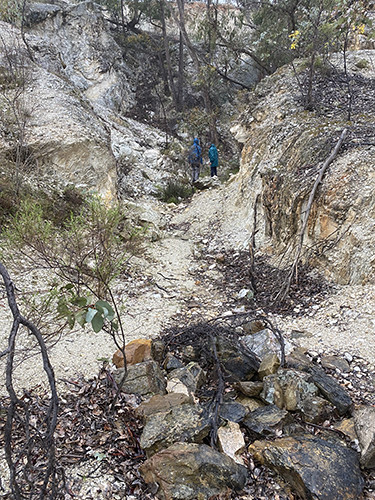
The gouged and eroded gullies of our region are a heritage of the gold rushes, a time when an unknown quantity of topsoil was lost through deforestation and creeks were scoured for gold. There are a few reminders, however, of how creeks might have looked in former times: rock walls and formations suggestive of flowing creeks and permanent pools. One such is pictured below, after last week’s rain: chain of ponds in the Railway Dam catchment. It’s not Niagara, but for the moment it’s the best we can do–and right now it’s rich in mosses, lichens and fungi.

Rock wall with water, Tunnel Hill, April 26: ‘waterfalls’ like this rarely flow, but they are reminders of a time when our waterways were more reliable and abundant.

Posted in Nature Observations | 1 Comment