Where there’s water . . .

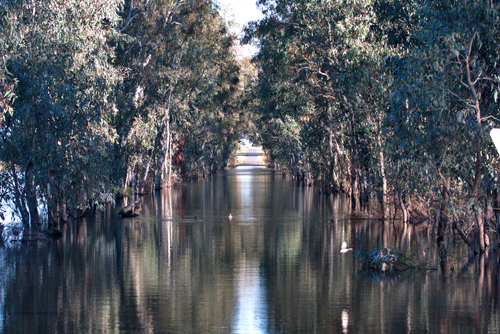
Two FOBIF members went to Walkers Swamp on the Moolort Plains recently. They wanted to observe the abundant wetland birdlife Geoff Park has been documenting on his blog, Natural Newstead, for the past year or so. It was a still and sunny morning so the swamp with its reflections of Red Gums looked at its best.

Walkers Swamp, Moolort Plains. Photo by Bronwyn Silver, 11 August 2011

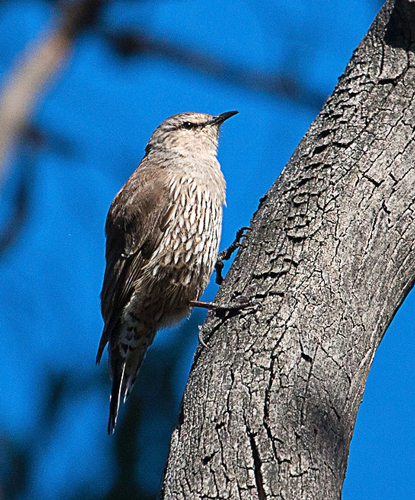
Most of the birdlife was fairly distant but we did manage to capture a White-necked or Pacific Heron Ardea pacifica sunning itself and a Striated Pardalote Pardalotus striatus in a nearby tree.

White-necked or Pacific Heron. Photo by Bronwyn Silver, 11 August 2011

Striated Pardalote. Photo by Damian Kelly, 11 August 2011

Posted in News | Comments Off on Where there’s water . . .

Small birds – how to identify them

At this time of year, the Box-Ironbark forests are alive with birds – you can hear lots of different calls and see movements in the trees – but what are the common birds in the forests?

Throughout the Box-Ironbark forests there are a range of small birds – the “Little Brown Jobs” – that are tricky to identify, but worth the effort as they are fun to watch.

Robins

These birds tend to be on lower vegetation and are easy to see. Their colours help a lot in identifying them, especially the males.

The Scarlet Robin Petroica multicolor is the brightest coloured and can often be seen foraging for insects from low branches.

Scarlet Robin (male), Mount Tarrengower. Photo by Damian Kelly, 27 July 2011

The female has a much less striking plumage.

Scarlet Robin (female) Mount Tarrengower. Photo by Damian Kelly, 27 July 2011

At first glance, the Flame Robin Petroica phoenicea appears a bit like the Scarlet, but its rich flame-coloured breast extends all the way up to the bill, unlike the Scarlet which has black at the throat.

Flame Robin (male), Walmer South Nature Conservation Reserve. Photo by Damian Kelly, 7 August 2011

A more subtly coloured member of this family is the Hooded Robin Melanodryas cucullata. Quite a distinctive colouration.

Hooded Robin, Muckleford, Pullens Track. Photo by Damian Kelly, 7 July 2011

Posted in Nature Observations, News | Comments Off on Small birds – how to identify them

Hurry–season ends soon!

From a few feet away they just look like vivid splashes of various shades of green. Close up, mosses are very different from each other. The Rosalubryum below has characteristic nodding capsules, for example. They’re barely visible to someone standing up–but well worth getting down for a close look:

Rosulabryum sp, Cobblers Gully August 3: the stalk is only one or two centimetres tall, but close up, with its red colour and drooping capsule, it's very distinctive. Photo, Bernard Slattery

The moss itself is also distinctive, shaped like a tiny green rosette:

From a distance the Rosulabryum is just a dark green satin surface. The delicate rosettes are clearer if you get down and peer at them. This moss--with and without capsules-- is prolific along the track in the Walmer South Conservation reserve, where this was taken on August 4. Photo: Bernard Slattery

Now is the time to get out and have a look at the wonderful moss carpets in our bushlands. We had great rain last year, and through the summer, but since March, our rainfall has been about 15% below the long term average. Already some of the mosses are starting to look a bit dry in the early August warmth–so maybe the season won’t last much longer. Of course, with a new burst of rain they can recover remarkably…but why wait?

Posted in Nature Observations | Comments Off on Hurry–season ends soon!

Pollution monitors

Spring is around the corner, with spectacular flowering of Hardenbergia, and emergence of many other flowering plants like Hovea, Daviesia and Hakea.

But by far the most prolific forms of life in the bush at the moment are the mosses and lichens, forming curious carpets and even aerial displays almost everywhere. The pics below show lichens of the Cladonia genus which form part of a group known loosely as squamulose: that is, they don’t cling to the surface, but send out independent, definitely three dimensional bodies off leaf like bases called squamules. Cladonia are normally found in damp, sheltered spots:

Cladonia sp, Smutta's Track: they don't look much from a distance, but have a strange fascination if you get down on your knees for a close up look. Photo: Bernard Slattery

Another three dimensional group are called ‘fruticose’. An example is the Usnea genus, or ‘beard lichens’, which can be seen on dead and even living twigs around our bushlands:

Usnea sp, 'beard lichen', Tarilta gorge July 29, 2011 Photo Bernard Slattery

The microscopic strangeness of these combinations of alga and fungus should not blind us to their importance: they play a crucial role in creating and binding soil. On a more mundane level, lichens are indicators of air quality: they take in nutrients directly from

Continue reading

Posted in Nature Observations | Comments Off on Pollution monitors

Beautiful weeds

The lovely foliage in the picture below belongs to the Cootamundra wattle, Acacia baileyana, which is in prolific flower in our region this month.

Unfortunately, the Cootamundra is a good example of the rule that most weeds are quite beautiful. The problem with weeds isn’t that we don’t like them, it’s that outside of their native environment they become botanical bullies, displacing local plants and creating a less healthy environment.

Acacia baileyana, Poverty Gully Race, July 25 2011: a native of southern NSW, this tree is a weed in our region--but it's not the worst. Photo: Bernard Slattery

The Cootamundra is a minor player on our weed scene, however. The big villains in our part of the world include blackberry, gorse, boneseed, willow, bridal creeper and others in the category ‘Weeds of National Significance.’ Local groups, including FOBIF, Parks Victoria, Landcare and the Friends of Kalimna Park, have been active in trying to combat these pests.

You can find more info about local weeds and ways to fight them in the Catchment Management Authority’s just published North Central Invasive Plants and Animals Strategy 2010-2015.

This document naturally aims at eradication and control. It does acknowledge, however, that some weeds are well and truly out of control, and these cases adopts a policy of trying to protect ‘priority areas’. The only area thus nominated in our region is Mount Alexander State Park.

The document also sensibly puts community involvement as a key goal: it’s important for locals to be able to recognise weeds, and ‘have opportunities to participate as partners in all aspects of invasive species management.’ This is the point we were making in our post of July 20 on broom infestation on Mount Alexander.

The Strategy can be found online at www.nccma.vic.gov.au


Posted in News, Weeds | Comments Off on Beautiful weeds