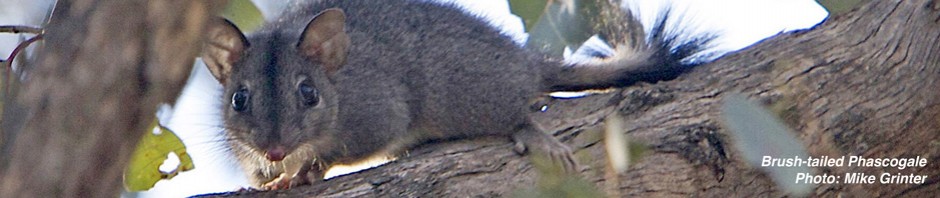
Granite landscapes are characterised by open, rolling country, often with boulders or smooth slabs of rock exposed on hillsides and in paddocks. The soil is deeper, sandier than on Basement rock country and provides good grazing farmland, as well as excellent soils for orchards and vineyards (as discussed in an earlier post on 22nd March 2026 Basement sandstones and mudstones were formed from eroded rock materials being carried by rivers then washed into the ocean and are known as sedimentary rocks).
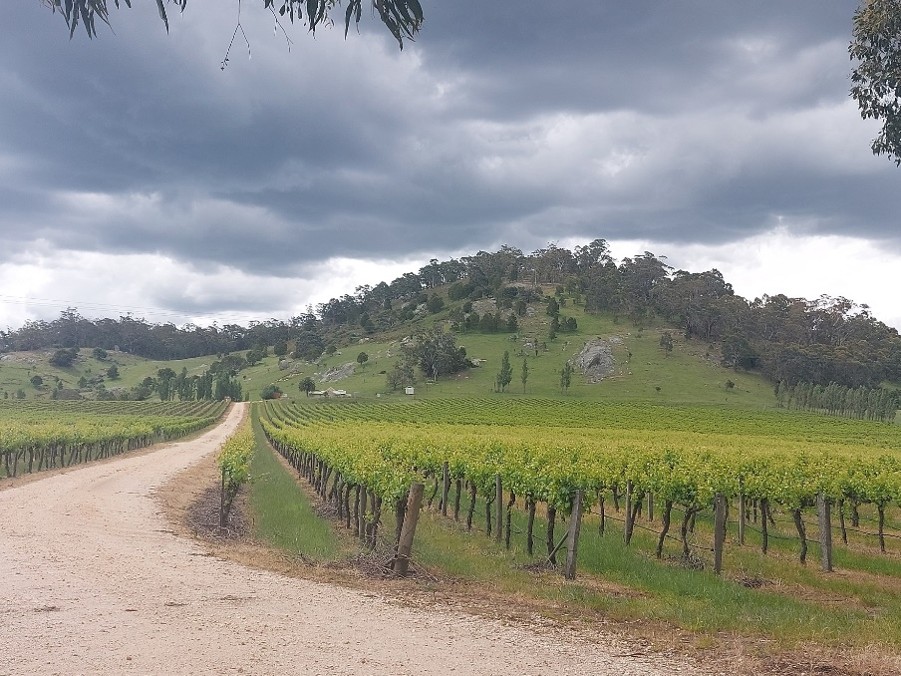
Vineyard in granite country. Faraday-Sutton Grange Road
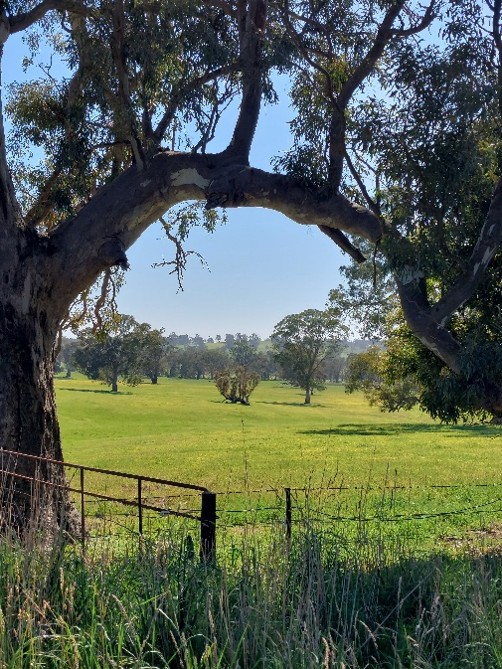
Granite grazing country with red gums. Metcalfe
Some of the most beautiful landscapes in the area are on granite country. Being predominantly grazing land, the old trees have been left in the paddocks, rather than removed as on cropping country.
The most prominent granite feature of the area is Leanganook – Mount Alexander itself, which rises to 745 metres altitude, some 350 metres above the surrounding area.
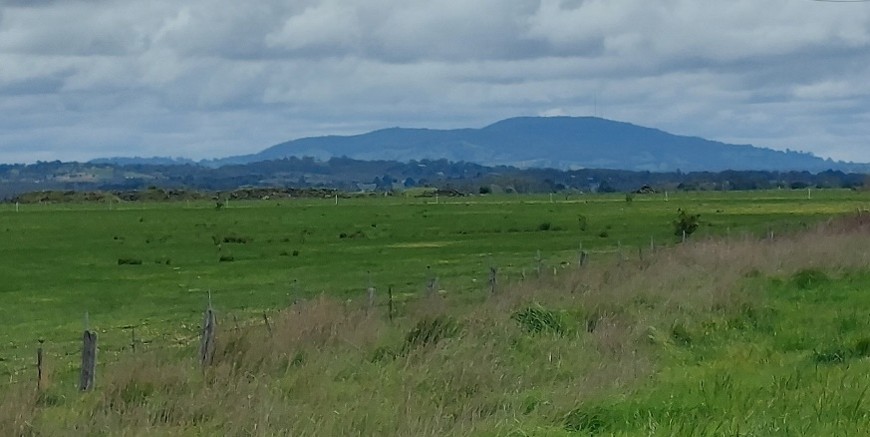
Leanganook/Mount Alexander from south of Taradale
Excursion 1. A short walk in Castlemaine CBD
An easy way to become familiar with the local granite rock is to examine the street drains and masonry of major buildings in the town. A short walk along Lyttleton Street, perhaps returning from a sojourn at the Anticlinal Fold, provides some fine examples of how masons and street builders have made good use of this attractive, durable building stone.
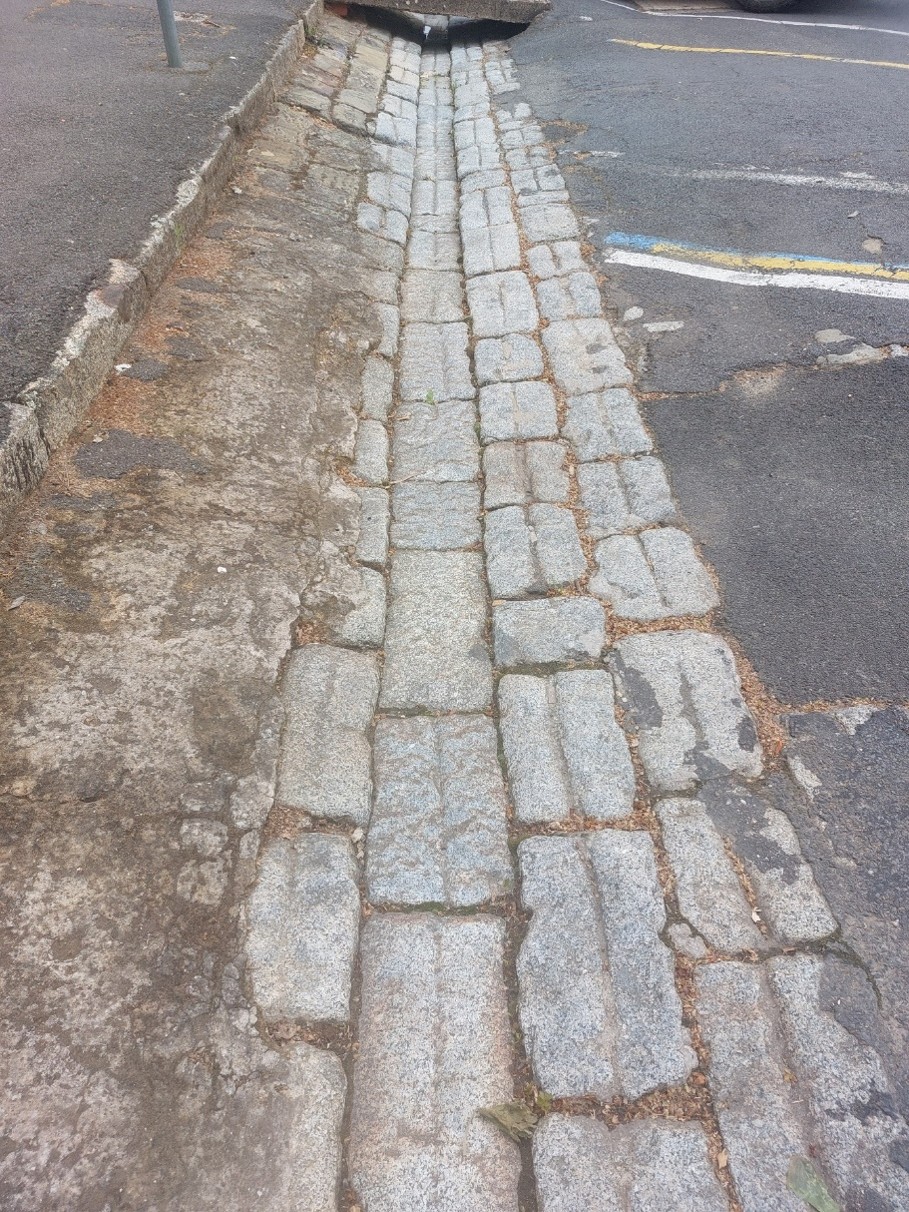
Street drain, Hargraves St. seen from Lyttleton St intersection
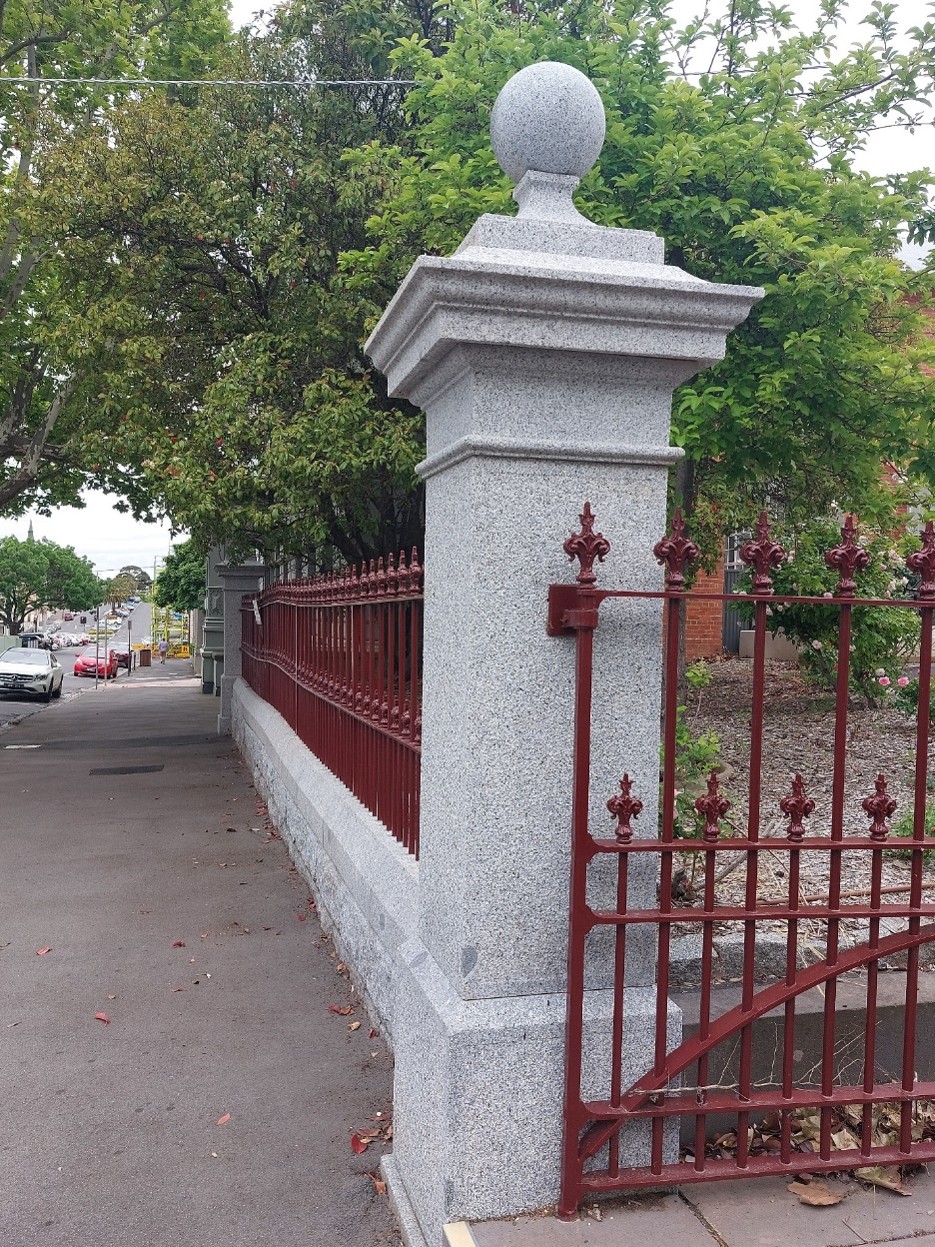
Court House gatepost, Lyttleton Street
With its pale grey, specked appearance the granite is evidently very different from the Basement sandstones and mudstones. Its hardness and lack of layering or structural weakness is shown off in the master craftsmanship of the courthouse gateposts
Next door to the courthouse is another historic building completed in 1890 to house Castlemaine’s School of Mines. It became the Technical School in 1926. Today it serves as the Mount Alexander Shire Council offices. While the building itself is constructed of Basement sandstone blocks, a plaque on the front wall is made of polished granite.
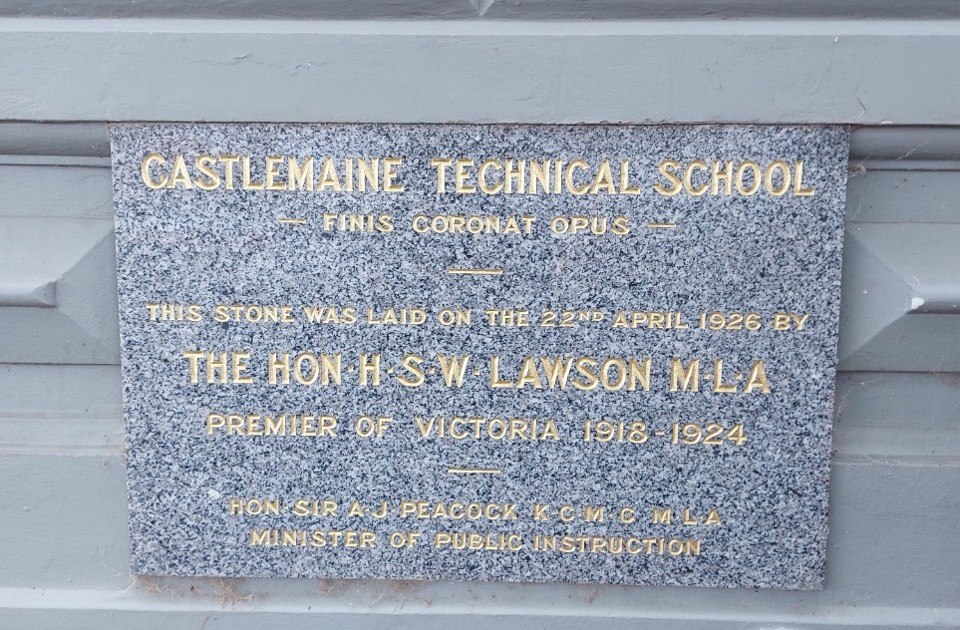
Plaque on Civic Centre, previously the School of Mines
Polished rock surfaces are prized items to geologists as they allow detailed examination of the rock constituents and fine-scale structure.
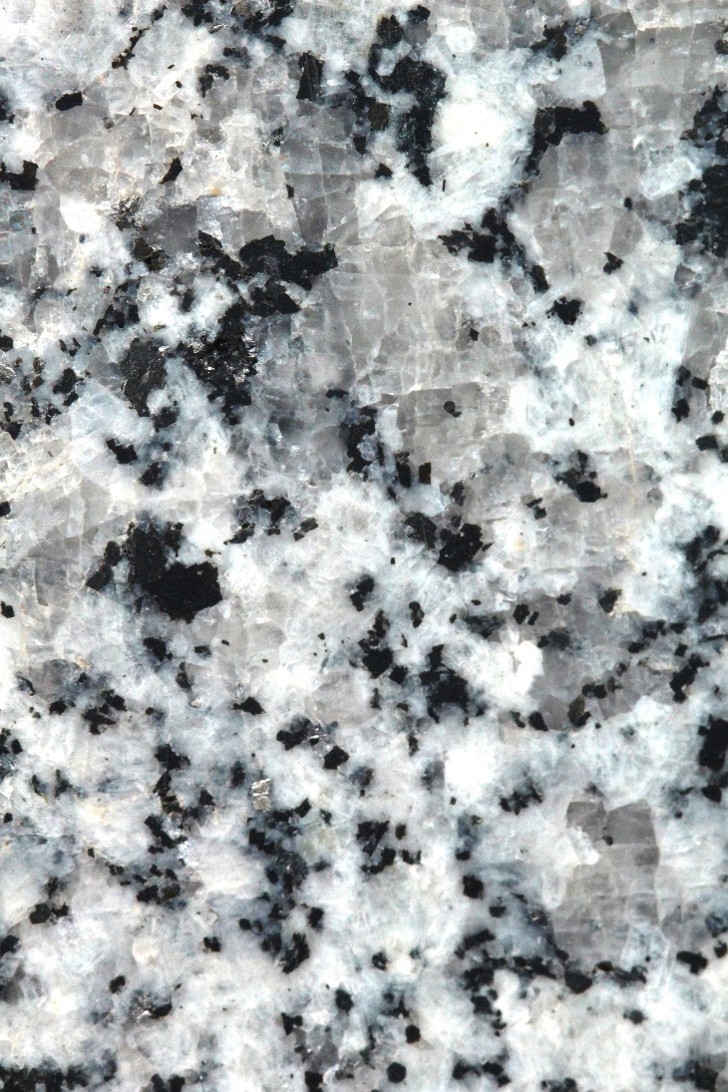
Granite plaque close-up
Looking closely we see three different constituents, coloured white, black and watery grey, which geologists call minerals. The white mineral is feldspar, the black is biotite (black mica) and the grey is quartz, a form of silica. How do these minerals come to be in the rock, welded together? The answer lies in the nature of granite.
(At this point it should be noted that the geologically accurate name for this handsome rock is granodiorite, rather than granite, due to its lack of pink feldspar. Granite is commonly used as a less cumbersome name.)
Granite is an igneous rock, which means it began as molten or liquid material. A huge mass of earth’s crustal material melted deep below the surface and gradually rose, making its way into the Basement rocks and forming an enormous reservoir of molten rock, known as a batholith.
The molten material, called magma, cooled slowly and solidified into rock several kilometres underground. The slow cooling led to the formation of the large mineral crystals visible to the naked eye.
Geologists believe that at least four kilometres thickness of rock has been eroded to expose the granite country we see today. Radiometric dating techniques, using naturally occurring radioactive elements in the mica and feldspar, show that the granite formed about 368 million years ago.
The question might be asked: where has all that material gone? Just as the material for the Basement rocks, sand and mud, came from the erosion of a mountain range, so this granite and its Basement rock cap have been eroded by the long action of water, ice and wind, breaking the sandstone and mudstone back into sand grains, mud particles. Eventually the granite too was worn down, quartz crystals broken into tiny sand grains and feldspar and mica crystals chemically changed to clay minerals, mud particles. All this material has been carried away by rivers and eventually deposited onto an ocean floor.
A quick calculation shows that the average rate of erosion is about a millimetre every hundred years. Less than half a metre of surface has been eroded in some 40,000 years of occupation by Dja Dja Wurrong people.
Extending our stroll around the Castlemaine streets shows us that granite has been, and continues to be employed widely in gutters, footpath features, bases of buildings, etc. Even the heritage-listed old Telegraph Office in Barker Street with its warm-toned Basement sandstone walls has a set of smart, if slightly jarring granite steps, presumably replacing the original, worn sandstone.
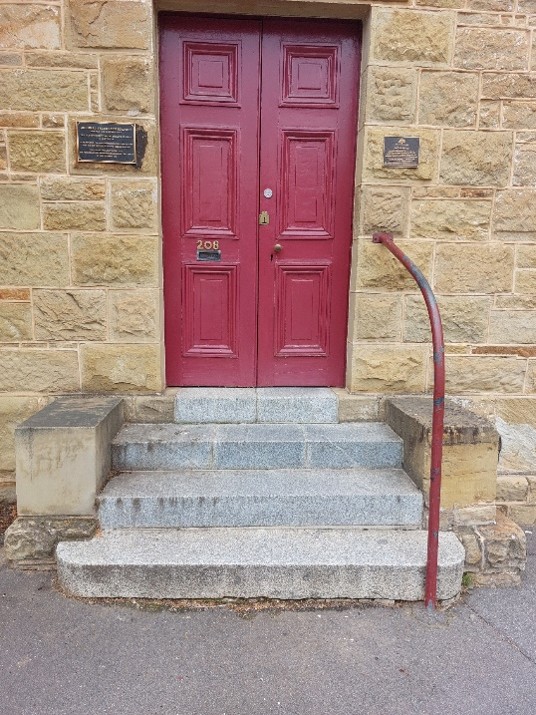
Old Telegraph Office, Barker Street, replete with granite steps
So where does all this granite come from? Not Castlemaine, which as we know lies on Basement rocks. The source is not far away. To Be Continued…



 Click on image for info/order page
 Click on image for info/order page
 Click on image for info/order page






I have a lot of pieces of granite in my garden..have even given some away…it’s garden edging…. often a rough side and the others smooth. Some very long ones and some shorter..