More than wildflowers

Two FOBIF members recently visited the south end of the Castlemaine Diggings National Heritage Park to see what was in flower. Common Heath Epacris impressa in its pink and white forms was everywhere.

Common Heath. Photo by Bronwyn Silver

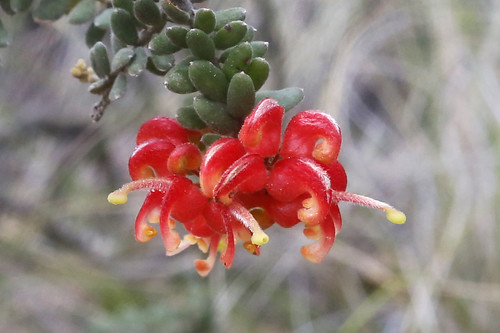
Downy Grevillea Grevillea alpina, Bushy Needlewood Hakia decurrens and Rough Wattle Acacia aspera were also in flower.

We spent some time observing a Black WallabyWallabia bicolour that was browsing on a Bush-pea shrub next to Porcupine Ridge Road and also found a profusion of bright orange Bracket Fungi Pycnoporus coccineus growing on a fallen log next to the Wewak Track.

Black Wallaby. Photo by Bronwyn Silver.

Bracket Fungi. Photo by Bronwyn Silver.


Posted in Nature Observations, News | Comments Off on More than wildflowers

Nuggetty Walk

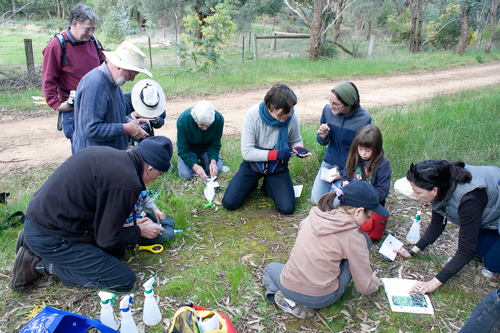
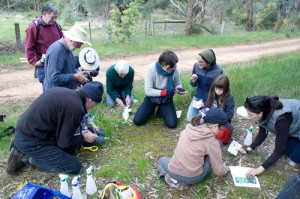
Thirteen people braved the cold, foggy and wet conditions on the July FOBIF walk to the Rock of Ages. This magical site is situated on top of Mount Moorul which is a couple kilometres north of Maldon. It is part of the Nuggetty Ranges.

Some of the walkers on 17 July. Photo by Bronwyn Silver

At first fog prevented us from seeing the normally magnificent views from the summit. However the weather cleared and while walking along Nuggetty Track you could see north for miles. The Hedge Wattle Acacia paradoxa pictured on the right in the photo below was growing throughout the area.

View from Nuggetty Track, Photo by Bronwyn Silver, 21 July 2011.

Miles Geldard led the walk and provided an entertaining and informative commentary about the geology of the area and its fauna and flora. Two of the few plants in flower were Purple Coral-pea Hardenbergia violacea growing on granite bolders on the Rock of Ages and Small-leaf Clematis Clematis microphylla.

Purple Coral-pea. Photo by Genis Wylde.

Small-leaf Clematis. Photo by Genis Wylde.

Rock Ferns Cheilanthes sp. had clearly benefitted from months of regular rain.

Rock Fern. Photo by Bronwyn Silver.

Posted in Nature Observations, News | 1 Comment

CMA responds on creek clearance

At the FOBIF AGM a question was put to the Catchment Management Authority’s Damian Wells about vegetation clearance along Barkers and Campbells Creeks. We’ve had the following response from the CMA this week:

‘The CMA inspected sites in the region in response to community/stakeholder enquires following flood events.

‘Any sites that contained accumulated flood debris i.e. loose vegetative material such as sticks, logs, branches, leaf material were targeted for removal. At almost all blockage sites the accumulated flood debris was positioned against in stream ‘live vegetation’, therefore it actually was contributing to the blockage. Predominately, this in stream ‘live vegetation’ consisted of exotic vegetation, mainly willow but may have included hawthorn, ash and poplar species.

Campbell's Creek, July 2011: the stumps visible here are willows; the CMA says its works have had a 'negligible' effect on native vegetation.

‘At some sites live native vegetation (canopy) species such as red gum and wattle were amongst the accumulated flood debris sites. Therefore the act of accessing and removing the debris and live exotic species at the identified blockage sites with large mechanical machinery was unavoidable.

Continue reading

Posted in News | Comments Off on CMA responds on creek clearance

Broom attack on Mount Alexander

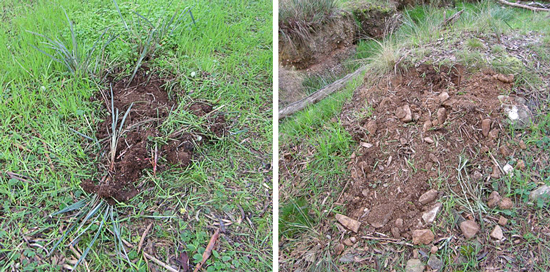
FOBIF members in April alerted Parks Victoria to the existence of a substantial and dense clump of English Broom on the east side of Mount Alexander. We had not previously noticed this pestiferous weed on the Mount, although it is infesting large areas of Victoria, including the goldfields. Parks staff subsequently sprayed the outbreak, with some effect, as the photos show. Having revisited the site in July, we believe that it will need another attack.

Broom outbreak on Mount Alexander, April and July. The clump is dense but confined, and can still be controlled with appropriate vigilance.

English broom was imported to Australia as a garden hedge early in the 19th century, and is now a declared noxious weed because of its ability to smother native vegetation and reduce agricultural productivity. It’s another example of the problematic effect of gardens on the Australian environment: garden escapes account for 65% of Australian environmental weeds, which cost around $4 billion a year in lost production and control costs. Given the location of the Mount Alexander infestation, we strongly suspect it is a result of dumping of garden waste.

This case illustrates the importance of early attack on weed infestations. In our view, one more year would have seen this limited outbreak impossible to control. Parks Victoria have assured us they will re-treat the area ‘as soon as possible’.

Posted in News, Weeds | Comments Off on Broom attack on Mount Alexander

Floods: keeping ‘out of harm’s way’

The North Central region had between four and seven times its long term rainfall average in January this year, and Castlemaine had five times its long term average. The rainfall between September and January was unprecedented, and came into an already wet catchment.

These figures formed the background to the talk given by Damian Wells, the CEO of the Catchment Management Authority to the FOBIF AGM on Monday night.

Flood damage was the theme of the talk, and there were two recurring issues:

The first was: it’s better to have assets ‘out of harm’s way’ than to have them in flood plains where they have to be protected.

The second was the flack copped by the CMA over its alleged neglect of waterways ‘causing’ the floods. Members will remember that this note was struck in Castlemaine, when it was claimed in the local press in January that plantings along creeks, or failure to clear creeks of vegetation, had raised flood levels in the town. [See our post of May 13]

Muckleford Creek over Lewis Rd, September 2010. The floods have been a boon ecologically, but although Victoria had eight major floods last century, Councils do not have adequate maps of flood levels. So building continues on flood plains. Photo: Bronwyn Silver

On the first issue, Damian noted that town levies are the responsibility of councils, but that rural levies protecting property are a long standing maintenance problem and the source of continual disputes as to who is responsible for them. The lower Loddon has 200 kilometres of levies, and these failed in 117 places in January. It has been estimated that restoration of levies could cost $650 million. He praised the government’s offer to buy out farmers in vulnerable areas, as a more practical long term solution to inevitable floods than prohibitively expensive protection measures.

On the second theme, Damian noted that the CMA had been ‘howled down’ in Creswick for its supposed responsibility for floods there, but subsequent investigations had completely vindicated its position. Bridges and road culverts are major causes of water blockages and subsequent level rises, but the major problem is building on flood plains. The CMA is continually challenged by developers in VCAT when it opposes building in such areas.

He agreed that peak flood level models should be incorporated into planning schemes on a state wide basis, to avoid the situation of people building on flood prone land. Incredibly, he noted that current modelling of flood risk zones is inadequate. [In spite of the fact that Victoria had serious floods every 10-20 years in the last century— in 1909,1916,1917 1974 1956 1974, 1990, and 1993— it seems we still don’t have good maps telling us where not to build!]

Continue reading

Posted in News | Comments Off on Floods: keeping ‘out of harm’s way’