Moss: Examining the detail

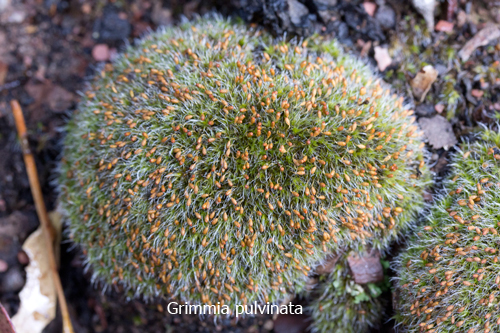
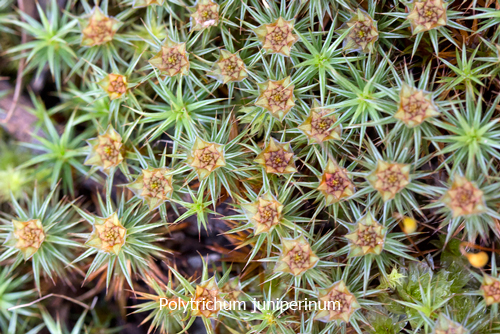
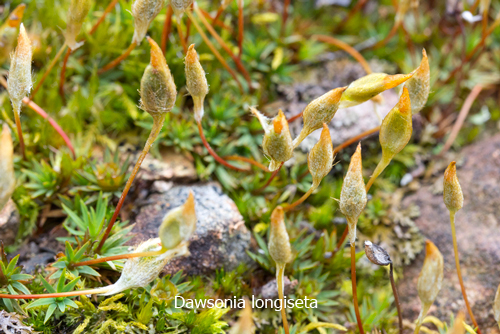
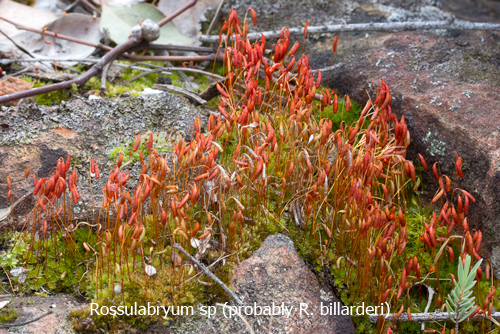
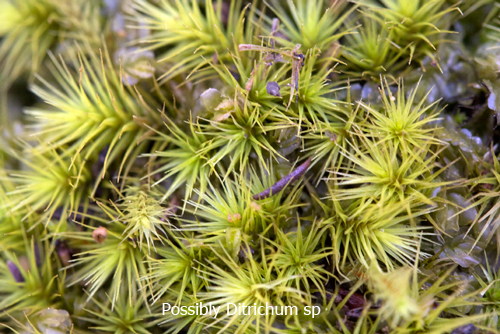
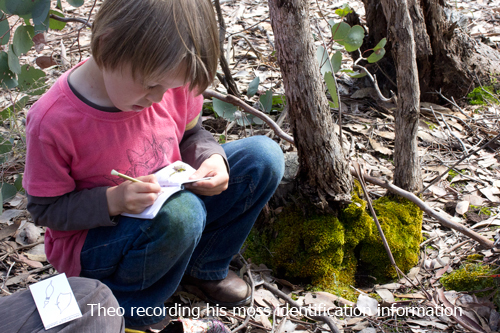
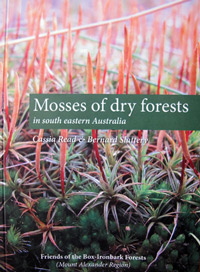
Fifteen people took part in a fascinating moss field day at Clinkers Hill Bushland Reserve on 27 August. This was part of the Moss and Liverwort project that is working on producing a brochure about local mosses and liverworts. The group spent two hours identifying, photographing and recording ten varieties of moss.

Beth Mellick from the Norman Wettenhall Foundation supplied magnifying glasses and recording materials for everyone.

The afternoon was led by postgraduate student Cassia Read. She wrote this summary of her background:

I’ve been studying and working in the field of ecology for the last 15 years, starting out with a botany degree at Melbourne Uni, followed by a mixed bag of jobs, including Fungimap coordinator, researching the evolution of plant architecture, and reporting on the impact of climate change on biodiversity in national parks. I’m currently doing a PhD at Melbourne Uni on biological soil crusts of the Mallee and Wimmera. Crusts are intriguing communities of moss, lichen and fungi that live at the soil surface in arid environments. These crusts have an important role in ecosystem function. I’m particularly interested in how they influence seed germination and survival and how they recover following livestock exclusion, as stock with hard hooves remove moss and lichens and expose the top soil to erosion. I’ve recently moved to Castlemaine. While my family and I are all enjoying the bush my two young daughters have quickly turned into ‘moss monsters,’ ripping up moss when we’re out walking so they can please mum with a handful of the precious green stuff.

Two of the mosses the group studied are pictured below in magnified form.

Breutelia affinist with male "flowers" (red/brown centre on the crown of the moss). Photo by Bronwyn Silver

Barbula crinita. This moss has a long golden hairpoint and the apex of the leaf meets the hair at an obtuse angle. Photo by Bronwyn Silver

The project is supported by Friends of the Box-Ironbark Forests, the Norman Wettenhall Foundation and Connecting Country. If you would like to find out more information contact Beth Mellick on 5472 1316.

Posted in Moss and Liverwort Field Guide group, Nature Observations, News | 1 Comment

FOBIF walkers enjoy a sunny August day

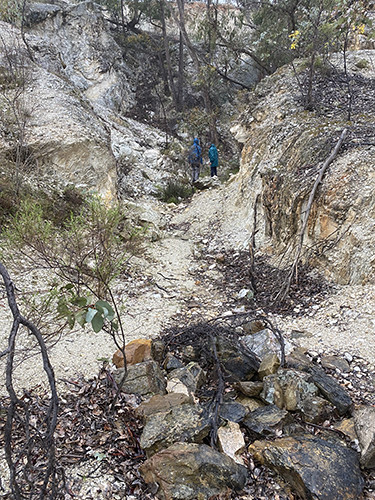
Sunny weather made for a great FOBIF walk on 21 August. There were thirty walkers on this excursion to the Muckleford bushlands. Paul Hampton from Muckleford Landcare was the leader with Doug Ralph providing a commentary on the mining history of the area. As usual Frances Cincotta shared her expert knowledge of the local plants. It was wonderful to see early wildflowers, particularly the many massive clumps of Greenhoods.

FOBIF walkers in Muckleford Bushlands. Photo by Marie Jones

During the morning, walkers detoured from the track to view see exclusion zones that were established ten years ago. Viewing the Sticky Boronia Boronia anemonifolia that had benefitted from this protection was a highlight of the day.

Sticky Boronia and Frances Cincotta explaining the history and purpose of the exclusion zone. Photos by Noel Young

Posted in News | Comments Off on FOBIF walkers enjoy a sunny August day

Small birds, part 3

The more noisy and active of the birds are the Honeyeaters, often flying rapidly between trees, calling loudly and chasing one another. The Red Wattlebird Anthochaera carunculatais is the largest and most aggressive, chasing all comers away.

Red Wattlebird. Castlemaine. Photo by Damian Kelly, 30 April 2011


One of the most common honeyeaters in the Castlemaine area is the New Holland Honeyeater Phylidonyris novaehollandiae. WIth a striking black and white plumage with a hint of yellow, it is hard to mistake it for anything else.

New Holland Honeyeater. Castlemaine. Photo by Damian Kelly, 30 April 2011

Another very active honeyeater is the White-plumed Honeyeater. A pale green and grey bird that is often in groups flitting quickly through the foliage.

White-plumed Honeyeater. Bells Swamp. Photo by Damian Kelly, 28 July 2011

The Fuscous Honeyeater Lichenostomus fuscus has a similar colouration to the White-plumed, but has yellow rather than white highlights. Another fast moving bird seen in lower vegetation.

Fuscous Honeyeater. Gowar School area. Photo by Damian Kelly. 19 July 2011

Posted in Nature Observations, News | Comments Off on Small birds, part 3

Kalimna tourist road: in spite of the best intentions…

We have received a reply from the Mount Alexander Shire to our concerns about the incremental widening of the Kalimna Tourist road. We have been assured by the Infrastructure manager and Superintendent of works that road crews are aware of the problem, and conscious of the natural values on roadsides like this one.

We have no reason to doubt these assurances, but the brute fact remains that the road is getting wider. The sad sign half concealed in vegetation at the top of Lyttleton Street, warning us: ‘Danger–Narrow Road’ is a sign of a past era. The road is now over eight metres wide in places, and the widening is most pronounced on slopes, where workers have had to put in gutters to get excess water away.

Kalimna Tourist road: the problem of incremental widening needs to be looked at for unsealed roads generally.

It’s not our business to be telling Council how to do its job, but there is clearly a problem here. A similar problem arose two years ago in the National Heritage Park. When FOBIF complained to Parks Victoria about road widening, Parks responded by drawing up more specific guidelines for road maintenance. This may be an option for Council, and we have written suggesting it as a possible solution.

Posted in News | Comments Off on Kalimna tourist road: in spite of the best intentions…

Moss and liverwort field guide

A meeting took place recently to plan a new field guide about mosses and liverworts. You can find out more about this project by clicking here. Recording sheets for moss observations can be downloaded here and here.

Posted in Moss and Liverwort Field Guide group, News | Comments Off on Moss and liverwort field guide