The Cascades: sculpture park or work of nature?

The Cascades at Metcalfe – is this a sculpture park or a work of nature? The answer is obvious but you would be forgiven for thinking the former. Here at this mesmerising stretch of the Coliban River, organic curves and scalloped surfaces are found in one of the hardest of rocks; such is the power of incessant running water. But why does granite form these smooth shapes? Unlike sandstone or shale which have many lines of weakness, granite is relatively homogenous and is worn down to more rounded shapes (Photos 1).

But many granites are not completely homogeneous and contain lines of weakness called joints (Photos 2 & 3). The Harcourt Granodiorite has several sets of joints, some vertical and some horizontal. Quarrymen at Harcourt exploited these planes of weakness and called them the ‘easyway’. The Cascades joints are mainly vertical cracks spaced just a few metres apart and are easily visible on Google Earth. The joints run almost east-west, parallel to this part of the river, providing an easy path for the rushing water which over time eroded deep gutters (Photo 2 & 4).

Photo1: Granite typically forms nice rounded outcrops.

Photo 2: Smooth and scalloped surfaces are separated by vertical cracks called joints. Some of the joints have been eroded into deep gutters by the flowing water.

Photo 3: The straight lines in the background granite are joints and even the flat horizontal surface in the foreground is probably a joint.

Photo 4: A deep eroded gutter along one of the east-west joints.

This is the seventh post in our geology series written by Clive Willman. 

Posted in Geology | Comments Off on The Cascades: sculpture park or work of nature?

Dialogues of the deaf 2: an example

Tarilta resident Rob Simons sent The Conversation article to local fire managers asking they consider it before undertaking the upcoming Helge Track burn. The reply he got is remarkable, in that it completely ignores the argument of the article:

‘Thanks for sending the below link to the article.

‘While there are differing views on planned burning, fire is a natural part of Victoria’s environment.

‘Victorian government legislation requires the Department of Environment, Land, Water and Planning (DELWP) to reduce the risk of damaging bushfires and to protect human life.

‘As described in the Forest Act 1958, The Chief Fire Officer, on behalf of the Secretary to DELWP, is required to carry out proper and sufficient work in State forests, national parks and on protected public land for the immediate prevention and suppression of fire and the planned prevention of fire.

‘Bushfire risk is linked to the distribution and accumulation of fuels if left untreated. DELWP, the Country Fire Authority (CFA) and stakeholders have developed strategic bushfire management plans using science, simulation tools, and local knowledge to manage this risk. These plans inform bushfire risk reduction targets and locations in the landscape where planned burns are conducted. (Bushfire Management Strategies for each region can be found on the DELWP website)

‘Through the Loddon Mallee Region Strategic Bushfire Management Plan, the Helge Track planned burn unit has been identified as an important location for burning to be applied to reduce the impact of bushfire on the community.

‘To meet its statutory requirements, DELWP intends to complete this planned burn when weather and fuel conditions are suitable.

‘While DELWP planned burns do not totally eliminate the risk and potential impacts of bushfires, they are a key part of an integrated bushfire risk management strategy to protect life, property and the environment including community education and awareness, ensuring access for firefighters and equipment and fast response to bushfires.

‘I hope the information is of assistance.’

No, the information is not of assistance. Everything in it is already well known to anyone who’s taken an interest in fire management. Worse, the letter makes no effort to deal with the matters in the Conversation article.

For the purposes of this discussion, FOBIF is not interested in taking sides in the argument. Up to now we have concentrated on trying to ensure that DELWP does what it says it will: observe the controls in its protocols, keep fires cool, look after old growth trees.

But what we’d like to see is a genuine engagement of the fire managers with the other side of that argument. That argument has been carefully put together by reputable scientists on the basis of detailed research.

Doesn’t it deserve a consideration?

Posted in News | 1 Comment

Fun reading: is this a flashback, or a flash forward?

Given the spate of gold exploration licences being sought, and granted, in this region, we’d like to remind readers of a fun document which appeared as the pandemic was gathering pace, and may not have gotten the attention it deserved.

It’s the Victorian Auditor General’s report on mine and quarry rehabilitation, tabled in August 2020. You can find it here. Like all such reports, it’s not easy reading, but it’s worth a crack, and the one page summary at the start won’t stretch your brain.

All prospective miners are required to pay the state upfront an amount of money adequate for restoring the land after the mine or quarry has been exhausted.

A common sight in our region. The Castlemaine Diggings Heritage Action Plan (2005) put it nicely: this landscape ‘demonstrates the severe environmental impact that can result from inadequate environmental constraint.’ Are we facing a repeat performance?

Are they doing this? The report’s conclusions are succinct:

‘The Department of Jobs Precincts and Regions (DJPR) is not effectively regulating operators’ compliance with their rehabilitation responsibilities. This exposes the state to significant financial risk because some sites have been poorly rehabilitated or not treated at all. If not addressed, these sites also present risks to Victorians and the environment.[FOBIF emphasis]

‘Systemic regulatory failures encompass:

  • using outdated cost estimates
  • not periodically reviewing bonds for their sufficiency—including a four-year bond review ‘moratorium’ for which there is no documentary evidence that it was duly authorised
  • failure to assure that site rehabilitation had actually occurred before returning bonds
  • approving inadequately specified rehabilitation plans
  • lack of enforcement activities.

‘Further, while some changes to address conflicts of interest were made following Parliament’s Independent Inquiry into the EPA in 2016, Earth Resources Regulation (ERR)—the primary mining regulator—still resides within DJPR, which seeks to foster and develop the mining industry.’ (FOBIF emphases).

The disturbing part of this is the revelation that the regulator and the promoter of mining are in the same department. This kind of compromise, where the regulator is too close to the industry it’s regulating, is all too common. Does the casino industry come to mind?

The upshot of this is that extensive areas of Victoria are being degraded by mining with little prospect of rehabilitation—unless the tax payer stumps up millions for the work ($361 million and counting, so far).

The DJPR, in its acknowledgement of the Auditor General’s report, accepted that change is necessary, recognising that

‘transformational improvement in site rehabilitation is required to protect public safety, land, infrastructure and the environment, in order to avoid any repeat of past problems associated with abandoned and legacy sites.’

We’re not sure how the transformational improvement is going. Watch this space.

Posted in News | Comments Off on Fun reading: is this a flashback, or a flash forward?

The middle of nowhere, on the outskirts of town

A strong group gathered yesterday in fine weather for FOBIF’s first walk of 2022. Mike Reeves had devised an ingenious route on the outskirts of Elphinstone: confined to a relatively small area, the walk wound through bushland gullies which could have been miles from anywhere, and provided enough ups and downs to generate a moderate amount of sweat. The walk ventured into areas set for a DELWP burn this season, and participants were interested in imagining what would be the outcome of the operation. Watch this space.

The middle of nowhere?FOBIF walkers wind through bushland near Elphinstone.

Our thanks to Mike for a brisk start to our walking year; and to Frances Cincotta for illuminating insights into the vegetation along the way.

Our April walk will be led by Jeremy Holland on Mount Alexander. Check this website for details.

Posted in News, Walks | 1 Comment

Strategic fuel breaks 1: the prospects for 2022

As we’ve reported (see our posts, with maps, here, here and here), DELWP is planning to create Strategic Fuel Breaks (SFB) in our region over the next two years. Castlemaine households have been recently letterboxed about this program. Note that the works as originally proposed have been held up by approvals problems. Initial works will be re-instating previous fire-breaks and concentrating on woody weeds: these are the works shown on the letter to households.

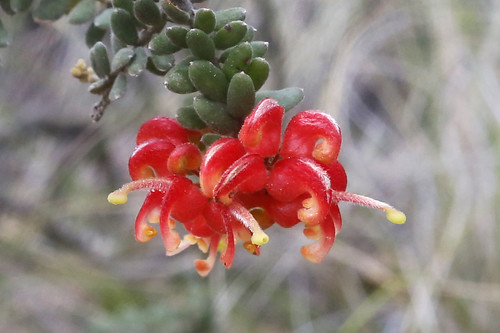
Grevillea dryophylla, Walmer forest. Enviro groups have been engaged in detailed conversations with DELWP in an effort to see that rare and vulnerable species are not damaged by the fuel breaks project.


Several local enviro groups have been in consultation with DELWP over the implementation of this program, with the focus being on protection of biodiversity values. Castlemaine Field naturalists, FOBIF, Castlemaine Landcare, Muckleford Landcare, Golden point Landcare,Friends of Kalimna Park and several individual community members have engaged in a detailed set of meetings on the project, including onsite meetings to look at the challenges involved.

The letter below to the SFB implementation team was drafted by Euan Moore, Castlemaine Field Naturalists Vice President, on behalf of the local groups involved.

***********

First, I would like to thank you and your team for your patience and time working with our community group here in Castlemaine. We do appreciate your efforts.

So that we can avoid misunderstandings in future, this letter summarises what our community group believes is the way the Strategic Fuel Break (SFB) program will be implemented. Please let us know if we have misunderstood what your team said.

1 The SFBs to be implemented in the 2021/22 year are:

  1. Daltons Rd,
  2. Woodbrook Rd,
  3. Youngmans Track,
  4. Chewton-Fryerstown Rd & Wattle Gully,
  5. Around the Loddon Prison,
  6. Forest Creek / Leanganook Track,
  7. Kalimna Park adjacent to houses, etc.

2 The other SFBs (Fryers Ridge, Irishtown Track, Porcupine Ridge, Muckleford Forest, etc.) may be constructed in 2022/23 or later.

Continue reading

Posted in News | 1 Comment