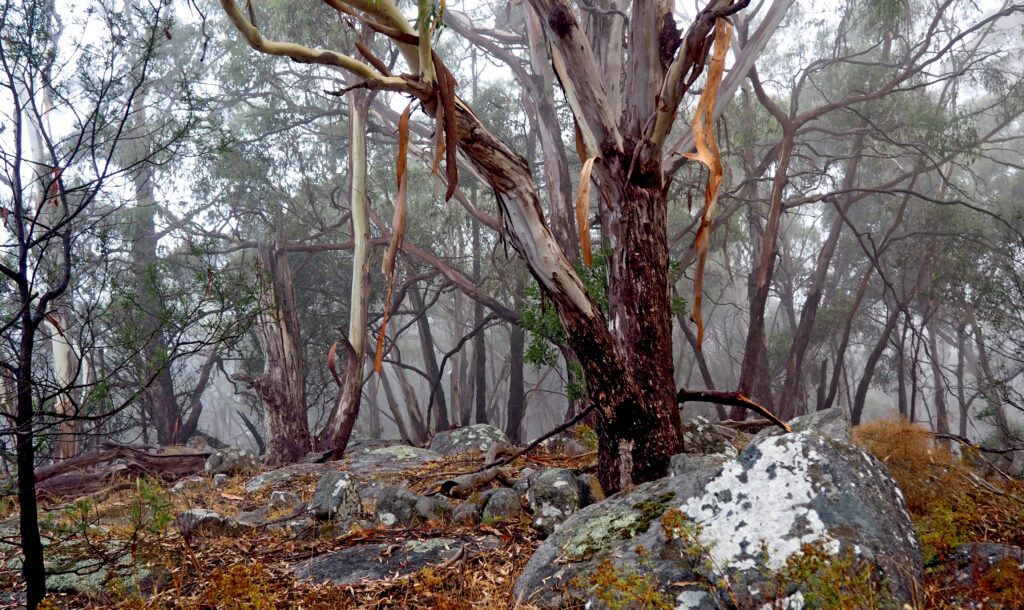
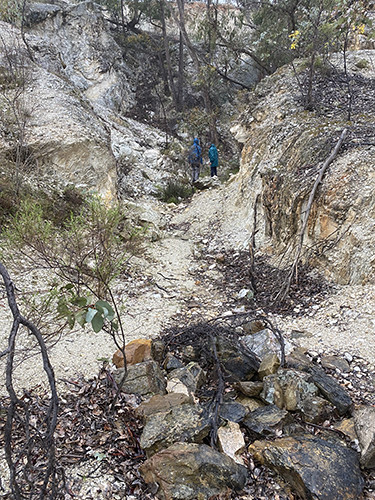
A dump of snow on Saturday night changed the face of Mount Alexander, and attracted numerous sightseers on Sunday. The snow had essentially retreated by Sunday afternoon.
On a less poetic note: FOBIF has asked Parks Victoria for the rationale of the extensive vegetation removal along Joseph Young drive on Mount Alexander. Of course, safety is an obvious explanation, but we’re still a bit befuddled as to the logic of the particular removals. The simple fact is that the only way to make this road (or any similar road) safe in violent winds is to remove every tree within thirty metres, which would completely destroy the environment of the area and remove most of the reason for going there. Is the road safer now than it was before the removals? We’re not sure. We’ll let you know when–or if–we find out the criteria for removals.
Noel Young has sent us this beautiful photo of the Castlemaine Spider Orchid for our TOGS photo project.
Photo submissions need to be in by August 19. You can find the guidelines here and you can see the project Flickr album here.

Castlemaine Spider Orchid (Caladenia clavescens) at the Monk, Photo by Noel Young, 28 September 2017
Damian Kelly has sent us a photo of two young Yellow-footed Antechinus (Antechinus flavipes) peeping out of an old fence post. People might remember Damian’s Antechinus photo (second one) that was very popular in TOGS show last year.
There are still 3 weeks (August 19) to go before the cut off date for photos for our Flickr page and the TOGS show. You can see all our photos for the show here.

Photo by Damian Kelly, Campbells Creek, 2018.

Damian’s Antechinus photo from last year’s TOGS show.
The 2019 FOBIF Annual General Meeting will be held this year on Monday September 9 at 7.30pm in the Ray Bradfield Room. More details about the program and guest speaker are forthcoming.
Do you want to play a role on the FOBIF committee? Or nominate someone else to the committee? All that’s needed is a piece of paper signed by the nominee, a nominator and a seconder—all FOBIF members. There’s no need of an official form, but for convenience, here’s a sample:
I nominate_________________________________
for the position of____________________________
Signed____________________________________
Seconded__________________________________
I accept the above nomination
Signed___________________________________
Positions on the committee are President, Vice President, Secretary, Treasurer, and two ordinary members. Nominations should be in before the meeting.
A solid group followed Karen Baker on a trek uphill and down dale across the Chewton bushlands community yesterday. A hilly walk was promised, and delivered: but the climbs proved more than worth the effort, and a fine day offered beautiful views across to the west and south. This area has wonderful old specimens of Red Stringybark and Yellow Box, and it was great to see the recovery of the land exemplified in extensive moss cover and interesting regrowth and restoration bush.

From the Chewton bushlands: the stumps in the foreground are relics of previous exploitation, now being restored.
Our thanks to Karen for an inspiring presentation of her home patch, and to Antoinette Birkenbeil for providing a suitable suite of perches for lunch.
Next month’s walk is another over the hills and far away venture above the Expedition Pass reservoir, led by Barb Guerin and Lionel Jenkin. Check the program for details.
We now have over 4o beautiful photos for our Box-Ironbark Forests photo project. Click on Janet’s photo below to see the photos displayed on Flickr.
You can send photos for this project till the 19 August. See here for the details.
The picture below shows two mature Ironbarks cut down and removed from alongside the Poverty Gully track in the Diggings Park. Illegal timbergetting from public land has become a bit of a plague lately, and FOBIF has heard both from nearby residents and from rangers of what seem to be semi professional operations effectively looting the park.

Poverty Gully track, July 17: two substantial trees have been cut down, cut up and removed. The pattern has been repeated across the area adjoining Castlemaine and Campbell’s Creek
According to DELWP, ‘Under the Forest Act 1958, people who collect firewood outside designated firewood collection areas or a firewood collection season or take more than the maximum allowable amounts can face fines of up to $8,059, or a maximum penalty of one year imprisonment or both, if the matter proceeded to Court.’
We believe Parks Victoria has embarked on a new effort to tackle the problem. No details are available, and in spite of the odd arrest, the results aren’t convincing. It’s hard to supervise large areas of forest at any one time: if the infractions are of a commercial scale, the appropriate approach would seem to be to investigate outlets, as was done in the
Bendigo area successfully in May.
FOBIF has sent an objection to the Mount Alexander Shire to the displayed plans for a new supermarket at Forest and Urquhart Streets Castlemaine. The essentials of our objection are as follows:
‘We emphasise that we have no opinion on the wisdom of a second large supermarket in the town, or its location, or its design: we have to trust to the competence of council on these matters.
‘Our objection is solely related to the proposed landscape plantings for the development. In particular, I refer to pages 06-02 07-02 and 08-02 in the relevant section of the planning documents.
‘On these pages it is proposed to plant the following environmental weeds around the development:
‘Cootamundra Wattle: this is not only an Environmental Weed, which spreads into the bush, replacing indigenous plants and damaging the natural ecosystem, but it also crosses with our indigenous Silver Wattle and thus is in the process of causing Silver Wattle’s extinction in Castlemaine, because the progeny of Silver Wattles are now crosses, and therefore weeds. It’s like letting a feral bull into a cattle breeding stud and not having a morning after pill available. Even if a “sterile cultivar” were proposed, this would look the same as the non-sterile ones and thus act as a promotion for Cootamundra Wattle, increasing its popularity with gardeners unaware of its problems. We also question if a “sterile cultivar” is guaranteed to remain absolutely sterile forever?
Continue reading