Rubbish plague reaches Castlemaine town boundary

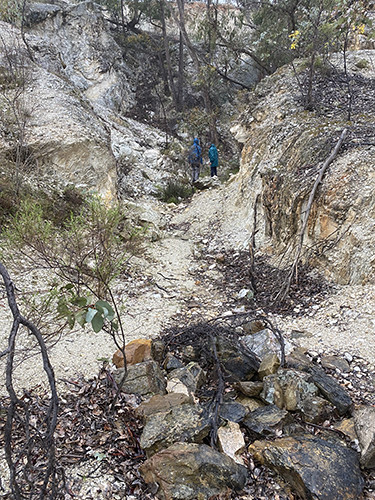
The plague of rubbish dumping which can be seen all over our bushland has reached the Castlemaine town boundary with the dumping of a pile of junk in Kalimna Park, only a hundred metres from Kalimna Point [and a few metres from the rather sad Bicentennial plaque].

Rubbish near Kalimna Point: time needed to remove such junk is another imposition on Parks Victoria's limited resources.

It’s hard to fathom the mentality of people who apparently don’t notice that they are desecrating valued public space, but one of the factors presumably is the perceived expense of taking rubbish to the tip.

FOBIF raised this question with Council Environment Officer Amy McDonald a couple of weeks ago, and her response was simple: Council can’t afford to give out free tip vouchers because of budgetary problems.

Here’s an interesting question: who is responsible for the removal of ‘hard’ rubbish from our lives?

Council can’t afford it. There appears to be a significant number of citizens who don’t want to take the responsibility of getting rid of it responsibly. So inevitably, Parks Victoria is left with the job of removing it from the bush–which inevitably cuts down the time Parks staff can put into more productive things. In the end, the taxpayer foots the bill, one way or the other.

It’s clear that public education has to have a large role if this unpleasant and unhealthy behaviour is to be reduced. It will be interesting to see if the Council’s Environment Strategy deals with such a mundane but important matter [see above].

Posted in News | Comments Off on Rubbish plague reaches Castlemaine town boundary

Autumn ends

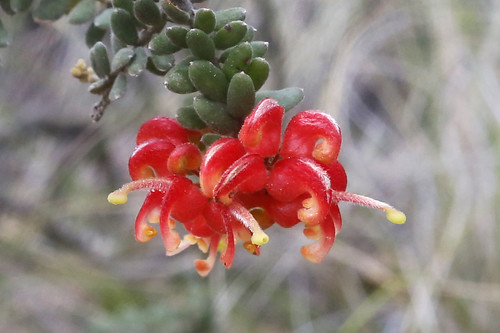
One sign of autumn is the prolific seeding of the local coffee bush [Cassinia arcuata]. Cassinia is one of the good soldiers of ruined land, which is why you see it recolonising mining sites. This is what the Cassinia flower looked like in February:


And here’s what it looks like at the end of May:


If you brush even lightly past one of these honest Aussie battlers, you’ll find your clothes are acting as couriers of dozens of seeds.

Posted in Nature Observations | Comments Off on Autumn ends

Advance of the micro kingdoms

Alison Pouliot delivered a lively and informative Connecting Country presentation last Thursday to an audience of about 75 people on ‘Fungi: the mysterious kingdom’. No one leaving the Campbell’s Creek Community Centre that night could be in any doubt about the beauty or the importance of these strange entities.

Another feature of our environment which is in even greater evidence at the moment is the micro world of the bryophytes: mosses and allied plants which are often seen in association with fungi and lichens. They attract attention with their vivid splashes of green around bushland, especially in relatively moist corners–but to really get the amazing interest of these plants it’s necessary to get down on your knees and have a close look, because most of them are only a few millimetres high.

The cup like forms are a lichen, Cladonia pleurota. The miniature 'pine' trees are a moss, polytrichum juniperum. The red box leaf gives an idea of the scale. Smutta's Track, April 2011

These are ancient life forms, which existed on Earth long before flowering plants came along: maybe it’s for this reason that they have an otherworldly look about them.

Moss capsules, Metcalfe Nature Conservation Reserve, May 30 2011

Mosses, fungi, lichens and liverworts don’t like dry weather, and weren’t so prominent during the drought. They’ve been quite spectacular in the last twelve months. Liverworts are possibly even more spectacular than the others. For a look at the fire dependent Marchantia berteroana, check our photo gallery.

Posted in Nature Observations | Comments Off on Advance of the micro kingdoms

Forests: nature at your service

Local environment groups will mark World Environment Day this year with an ‘expo’ in the Castlemaine Market building on Sunday June 5 between 10 am  and noon. This is the same day as the Castlemaine Farmers market.

The theme of the displays will be ‘Forests: nature at your service’–the idea that biodiversity is, so to speak, not just a pretty face: it is what underpins our lives. The point is made by Edward O Wilson like this:

‘Recent experimental studies on whole ecosystems support what ecologists have long suspected: The more species that live in an ecosystem, the higher is the productivity and the greater its ability to withstand drought and other kinds of environmental stress.’

FOBIF will be running a display on the day. Members interested in putting in a short time on a table should contact us at the usual addresses.

The Mayor, Cr Janet Cropley, will launch the Shire’s Environment Strategy in the course of the morning.

Posted in News | Comments Off on Forests: nature at your service

Remnant vegetation: some revelations

On April 6 the Victorian Environment Assessment Council released its final report on its ‘Remnant Native Vegetation Investigation.’ As with all VEAC reports, the document is full of useful information and provocative ideas. In spite of its calm and measured tone, it contains at least one implied criticism of land managers.

The focus of the report was on parcels of native vegetation around the state: small reserves, unused road reservations, and patches on private land.

South Walmer Conservation Reserve: small patches of land like this are vital biodiversity reserves

There are tens of thousands of such parcels throughout the state, half of them on private land ‘in patches closely embedded with and abutting those on public land’. It is surprising to read in the report of their importance to biodiversity:

‘Fragmented landscapes still support the majority of Victoria’s biodiversity. Around 40 percent of Victoria’s native land vertebrate species (mammals, bird, amphibians, reptiles and fish not confined to marine or coastal waters) are virtually restricted to fragmented landscapes in Victoria, and a further 45 percent rely on fragmented landscapes across a major part of their distribution in Victoria. That is, only about 15 percent of our land vertebrates are mostly restricted to largely-intact landscapes. Fragmented landscapes are likely to be similarly important for other species: land invertebrates, fungi and plants…’

Not only that, but such patches are important for agriculture:

Continue reading

Posted in News | Comments Off on Remnant vegetation: some revelations