Bridal creeper: getting into practice

As an update to the article below on bridal creeper, the Nuggetty Land Protection Group is inviting interested community members to attend a community workshop at the Bridal Creeper Trial site. This site is immediately behind the Maldon cemetery in the Maldon Historic Reserve. The workshop will be held on Sunday 10 July from 11.00am to 12.30pm and finish with a free sausage sizzle and cupper.

The workshop will exhibit the results of earlier chemical treatment and demonstrate application methods, including making spore water from rust infected plants, chemical gloves, scrunching methods and physical removal.

Ring Ian Grenda on 0412015807 or email iangrenda@live.com for more information and to place orders for free bags of rust which can be picked up on the day.

Posted in News | Comments Off on Bridal creeper: getting into practice

Muckleford Gorge: a privileged excursion

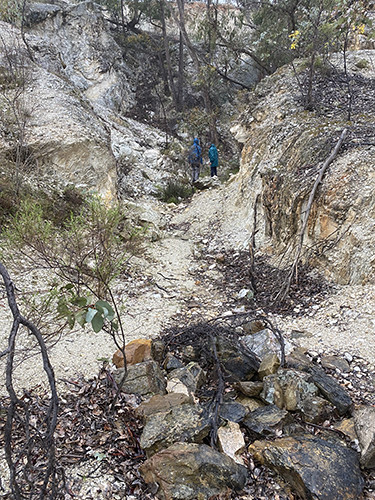
The May FOBIF walk organised by Deirdre Slattery was through the magnificent Muckleford Gorge on Ian Garsed’s property.  Ian has excluded the gorge from grazing under the Bush Tender system–a good example of what VEAC  has recommended for conservation on private land [see above]

Walking through the gorge, May 19

Everyone on the walk acknowledged how special it was for Ian to allow us access to the gorge to see its natural beauty – the geology coupled with the flora and fauna was fascinating.  It was a very popular event with 55 people attending and an age range from six to the seventies.   Ian gave us an informative overview of the property before we started the walk and also answered questions at the end.  The day was interspersed with people asking questions of those they thought would have some knowledge so there were many conversations based on these questions with other information being added as we walked.

More photos of the Gorge and a detailed description of the walk can be found on the Muckleford Landcare website.

The next walk is on June 19 in the Castlemaine Diggings NHP: check the program for details.

Posted in News | Comments Off on Muckleford Gorge: a privileged excursion

Uncommon beauty conceals a deadly trap

Carnivorous plants can trap prey in a various ways: pitfall traps, flypaper traps, snap traps and lobster-pot traps. The well-known local carnivorous Scented Sundew Drosera whittakeri uses the flypaper trap method. Insects are captured in the sticky dew exuding from hairs growing on its leaves.

Another trapping method is the ‘bladder trap’ and the intriguing Utricularia dichotoma is one of the carnivorous plants that uses this method. This ‘bladderwort’ is commonly known as Fairy Aprons due to the appearance of its flowers.

Fairy Aprons have a tiny ‘bladder’ which is small and submerged under water or in damp soil with a hair-triggered door that responds within 1/30th of a second to suck in any passing insect. The vacuum-driven bladder has been described as the most sophisticated carnivorous trapping mechanism to be found among plants. The violet flowers which are enlarged in this photo are tiny and grow on a thin stem.

Fairy Aprons. Photo by Bronwyn Silver, 1 January 2011

Early this year Doug Ralph discovered scores of Fairy Aprons in a swampy area in Harcourt not far from Mount Alexander. Three FOBIF members accompanied him to see and record the sighting. Although none had seen them before, Ern Perkins from the Castlemaine Field Naturalists reported that bladderworts have been previously been recorded on Mount Alexander, and also on some of the wet granite areas in the Harcourt-Sutton Grange area.

Posted in Nature Observations, News | Comments Off on Uncommon beauty conceals a deadly trap

Waterways, floods, vegetation

The January floods caused a bit of angst in our community, with some trying to pin blame on Government bodies or current management practices.

At the AGM in July FOBIF members will be able to hear the viewpoint of CEO of the North Central Catchment Management Authority, Damian Wells.

Damian will talk about the challenges of catchment management in the context of the recent floods.

The floods were followed by a spate of calls in Castlemaine for massive vegetation clearance near waterways, as a way of lowering flood levels.

Forest Creek in spate, Castlemaine February 5 2011

Does vegetation near streams raise water levels in flood time? The belief that it does partly arises from the fact that for decades landholders were encouraged to clear streams to ‘improve flow’.  Now when they see vegetation returned to the margins of waterways they assume that this will worsen flooding. In fact the effect is minimal. Readers are referred to an Australian Land and Water publication, Managing the effects of riparian vegetation on flooding at

http://lwa.gov.au/files/products/river-landscapes/px061170/px061170-chapter-5.pdf

Its cautious but clear conclusions include, in part:

‘–Adding or removing large wood (snags) in streams has little effect on the height and duration of large floods.

Continue reading

Posted in News | Comments Off on Waterways, floods, vegetation

Smutta’s Track: an update

We have received a reply from DSE District Manager Steve Nicholson to our concerns about the conduct of the autumn Smutta’s Track burning operation [see below Smutta’s Track management burn]. It reads in part:

‘Following the ignition, and through subsequent patrols, crews are expected to extinguish any trees on the edges of burns and particularly any habitat trees they may have ignited. Given that this tree was raked around and largely protected from ignition via ground fuels, a reasonable explanation, which is supported by ground inspection, suggests that a fire brand, falling limb or otherwise may have ignited the tree….If this did occur, it is reasonable to expect that patrols would have, in most cases, identified the issue and ensured the tree was extinguished.

‘It is regrettable that this particular tree, having significant natural values as a habitat tree, suffered damage…It is essential that we now take this opportunity to reinforce the importance of good preparation, targeted and appropriate ignition and effective patrols to limit the possibility of this reoccurring.’

Less damaging, and just as effective

Crude control line, with early erosion signs


On the subject of the crudely made control line, Steve Nicholson noted that ‘it is district practice to keep to a minimum the amount of control line constructed…in some cases we may need a control line that can accommodate access for larger fire vehicles to ensure we can undertake burns safely.’ He assured us that the track in question would be rehabilitated ‘as soon as practicable’. Continue reading

Posted in Fire Management | Comments Off on Smutta’s Track: an update