Bird discovery tour

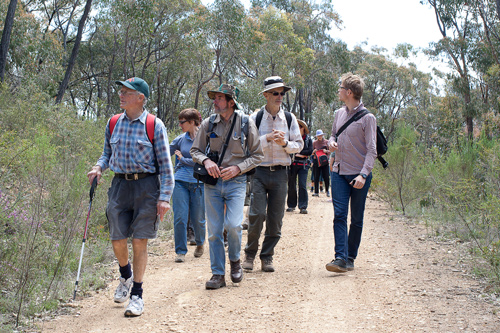
Thirty-seven people came along to Geoff Park’s recent FOBIF walk in the Muckleford Forest. The focus was on birds and despite the large group it was possible to see and hear a fair range. These included Striated Thornbills, Weebills, Grey Strike Thrushes, Galahs, Grey Fantails, Rufus Whistlers and Brown Flycatchers. Many in the group were familiar with Geoff’s blog, Natural Newstead, and appreciated the opportunity to pick up some tips on how to find and identify birds as well as seeing some of his favourite spots.

Geoff Park with some of the walkers

The next walk is 16 September. We will be going to the south end of the Castlemaine Diggings National Heritage Park. The walk will be led by Bernard Slattery. Click here for more details.

Posted in News | Comments Off on Bird discovery tour

Zone 3: what’s going to happen there?

As we reported on our website last month, DSE has released the draft Fire Operations Plan for consultation. Although FOBIF has many concerns about the plan, and urges members to consult it and make a submission based on their local knowledge, we are urging you here to focus on proposed burns in Zone 3. These are burns generally relatively remote from settlement, and have in the past on paper been devised principally for ecological reasons.

The draft DSE Fire Operations Plan proposes several significant Zone 3 burns in our region in the next three years. The stated purpose of these exercises is: ‘to provide an irregular mosaic of areas of fuel reduction which will complement works in adjacent fire management zones and can assist in ecological resilience and forest regeneration.’ All burns are proposed for Spring between now and 2015:

Brown's Gully, Castlemaine Diggings NHP: FOBIF is getting mixed messages about how much of this bush is to be burned, and what attention if any will be paid to ecological values. It's up to the public to urge that DSE follow its own policies on Zone 3 burns.

Muckleford: Dunn’s Reef—257.6 ha [CAS 11] and A Frame Tk—319.9 ha  [CAS 12]

Maldon: Donkey Farm Tk—188.4 ha [CAS 10].  Nuggettys –274.7 ha [CAS 5]

Chewton: Railway Dam—193.4 ha [CAS 13]

Taradale: Plantation Tk –151.7 ha [CAS 17] Carnell Rd—225 ha [CAS 14]

Glenluce: Amanda’s Tk 409.3 ha [CAS 15]

To find maps of these proposed burns, go to the DSE website:

FOBIF and other interested groups were told by DSE in July that the objective in zone 3 is to aim at ‘at least 20%’ of burn coverage: that is, to burn 20+% of each named parcel, perhaps up to 35%. However, we have been told recently by fire operatives that they aim to burn 50% of each zone 3 parcel [This confirms our observations of past Zone 3 burns, some of which go much higher than 50%]. Further, although the DSE Code of Practice and the stated aim of the burn as we have quoted it above requires a clear ecological perspective on the burn, we have been reliably informed that the intention of these exercises is purely fuel reduction.

It is important that pressure be exerted on DSE to implement its own stated policy regarding the use of fire for ecological purposes.

You can make a difference by writing a short submission to DSE by August 31:

Continue reading

Posted in Fire Management | Comments Off on Zone 3: what’s going to happen there?

The view from St Arnaud

The St Arnaud Field Naturalists Club has made a detailed submission to DSE regarding the draft fire operations plan for the St Arnaud area. Below we reprint part of the covering letter attached to the submission. Although of course conditions vary from district to district, readers will notice that many of the concerns expressed here overlap with our own [Please note that ‘ecological management zones’ have now been renamed ‘landscape management zones’. DSE signage is sometimes out of date]:

‘…We note that all areas listed [for burning] are labelled “Ecological Management Zone”; we believe this to be misleading as there is no reason to manage the ecology of the areas by burning, ie., there are no fire-dependant species. Burning will produce a simplification of the understorey remaining after 15 years of intense drought and heavy grazing by kangaroos. Already, long-term (more than a decade)studies by both our group and Monash University researchers show that habitat degradation and simplification(loss of species) have resulted in a decline in the number of bird species using our bush areas as well as a serious decline in the number of birds within all species. This decline continues despite two years of above average rainfall. Further loss of the integrity of our Park and allied reserves will mean a further decline in species.

Hedge wattle, August 2012: spring burning is a contentious issue because of its effects on flowering plants and breeding birds and animals.


‘For the National Park and Reserves, loss of the remaining understorey and ground litter layer will result in increased soil temperatures leading to loss of soil microbiota- the basis of the entire food chain; loss of soil moisture resulting in

Continue reading

Posted in Fire Management, News | Comments Off on The view from St Arnaud

Little Monster?

The beautiful creature pictured below is an early instar caterpillar, from the genus Doratifera, probably Doratifera oxleyi. These moths are commonly called cup moths. It was found in suspended by a thread in an area of severely damaged bushland in the Diggings Park this week.

Cup moth caterpillar: It’s less than a centimetre long, and you can’t deny it’s pretty— but don’t touch it! We’re not sure if it’s the creature that’s eating our bushland. Photo: Bronwyn Silver, 14 August 2012

Cup moths Cup moths ‘belong to a small group of moths that have unusual slug-like caterpillars that are often beautifully marked and coloured. They derive their name from the cup shaped cocoons made by the caterpillars when they pupate. There are several different species of cup moth that feed on eucalypts and other native plants. The caterpillars differ in colour, pattern and size but they all have the characteristic slug-like appearance with clusters of spines on their bodies. The spines can inflict a sharp and painful sting, rather like a nettle and the caterpillars are often known as ‘stingers’.  The stings may cause local inflammation if they touch bare skin.’ [ref: Department of Primary Industry, SA]

We mistakenly reported last week that the enormous damage inflicted on eucalypts in the south end of the Shire was caused by lerps. Now we believe that the damage is caused by a leaf miner of some sort, and have suspicions about the cup moth–but we’re not sure. Theories are invited.

Porcupine Ridge Road: eucalypts in the South of the Shire are being devastated by a leaf eating creature. Photo: Bronwyn Silver, 14 August 2012

Posted in Nature Observations, News | 6 Comments

Looking after a Yellow Box

As part of National Tree Day on the morning of 29 July, 15 volunteers planted 240 indigenous plants under the ancient Yellow Box tree at Chewton. Low plants, ground covers and shrubs were planted under the tree and larger shrubs including Rough, Hedge and Golden Wattles and Bushy Needlewoods were planted further away. A grant from Mount Alexander Shire was used to buy these plants from Frances Cincotta of Newstead Natives.

Although the main effort was put into planting, people also removed small bridal creeper plants that had survived last year’s eradication work by FOBIF. A few days after the planting several FOBIF members attacked the infestation of gorse on the bank between the Yellow Box tree and the Great Dividing Trail. We are hoping that future walkers will be able to enjoy this beautiful spot without being confronted with masses of gorse and bridal creeper. As well the understorey plants will promote the health of this magnificent tree.

Alex enthusiastically attacking the gorse.


Posted in News | Comments Off on Looking after a Yellow Box