Invasive species: new legislation in prospect

FOBIF has made a short submission to the Department of Primary Industries as part of the consultation process for the preparation of a new Invasive Species Management Bill.

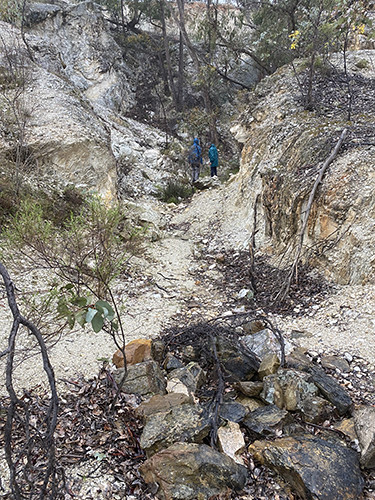
Dumped garden rubbish in the Diggings Park near Chewton: oxalis, capeweed and thistles are spreading from the dump. When Parks Victoria officers clean up such dumps, they have to pay tip fees to dispose of the rubbish.

The submission is in response to a discussion paper released by DPI. The paper proposed that the new bill require people to take every reasonable care to prevent the spread of invasive species. We urged that this provision be strengthened, given that many weeds are spread through carelessness–either on construction machinery or dumping of garden refuse. Recent examples of the former in our area include spread of Stinkwort and Needle grass on Shire machinery; and the dumping of garden rubbish is a constant headache for public land managers, who have to clean it up and then pay the Shire for tipping fees!

FOBIF’s brief submission is printed below:

‘We support any measures which will more effectively control invasive species in Victoria. We would like to make the following brief comments on the Discussion Paper:

Continue reading

Posted in News, Weeds | Comments Off on Invasive species: new legislation in prospect

Get to know your weeds

The North Central Catchment Management Authority has released a Weeds Identification Guide for the region. In many ways it’s an improvement on previous guides, because the photos are better and many species are illustrated by more than one picture.

Sample page from the NCCMA weed identification guide. Multiple photos make for easier recognition.

Unfortunately the guide leaves out five common environmental weeds, including Pampas grass, Cootamundra Wattle and Gazanias–apparently because of cost limitations. Gazanias, in particular, are in full flower at the moment, and seem to be promoted by many people in gardens and nature strips. They have a sinister capacity to spread into bushland.

All the same, the guide is highly recommended. FOBIF has a few copies available for members–contact us at info@fobif.org.au

Posted in News, Weeds | Comments Off on Get to know your weeds

Fire: DSE responds to FOBIF submission

We have received a response from DSE to our submission on the draft Fire Operations Plan.  We will be making a comment on this response and the state of consultations on fire management after the upcoming meeting between DSE and local groups in Bendigo on Tuesday next, October 9. The DSE response is printed in full below:

‘Thank you for your submission regarding our planned burning in the Murray Goldfields District. Your input has been considered during our planning process.

‘The DSE planned burning program aims to minimise the impact of major bushfire on human life, property and the environment. The 2009 Victorian Bushfires Royal Commission recommended changes to the Code of Practice for Fire Management on Public Land (2006). This Code supports delivery of an expanded planned burning program to reduce fuel levels and the likelihood of bush fires becoming uncontrollable.

‘Our Fire Operations Planning Process starts in February and is finalised in October. During this period DSE consults with a broad range of stakeholders regarding our planned burning on public land.

‘DSE has considered your submission and makes the following response:

  • This year a new “Code of Practice for bushfire management on public land 2012” was released which outlines Zone 3 or Landscape Management Zone (LMZ) burns with an aim to provide bushfire protection outcomes by reducing the overall fuel and bushfire hazard in the landscape as well as provide for ecological outcomes. The burns zoned as LMZ’s that you have identified have an aim for at least 20% burn coverage and up to perhaps 40% coverage of target areas within the burn unit.
  • Please note that CAS 012 – A Frame track has been withdrawn from the Fire Operations to allow for longer growth stages.
  • CAS 005 – Nuggetty Hill has been reduced in size.
  • CAS009 Rusconis Road has been halved in size to exclude some rich flora and fauna values in line with your comments.

Continue reading

Posted in Fire Management, News | Comments Off on Fire: DSE responds to FOBIF submission

Local water birds

The diversity of water bodies in and around Castlemaine provides the opportunity to view a variety of birds. One of the largest is the Great Egret. This bird can be seen along the edges of swamps and larger dams such as Cairn Curran. Watching one in flight is a sight to behold!

Great Egret. Photo by Damian Kelly, 2012

Although somewhat cryptic and hard to see, the Black-fronted Dotterel is actually quite common in this area. Next time you are near the water’s edge have a scan along the edge and you might be surprised to find a few of these beautiful birds.

Black-fronted Dotterel. Photo by Damian Kelly, 2012

The Chestnut Teal has quite a difference between the sexes, with the male standing out. Although not a common species in this area, these birds can be seen in pairs, sometimes mixed in with other species. But on a sunny day this bird is quite a sight.

Chestnut Teal. Photo by Damian Kelly, 2012

Posted in News | Comments Off on Local water birds

Garden birds around Castlemaine

Damian Kelly was the guest speaker at the FOBIF AGM in August. His presentation was about observing local birds in our gardens and he included many excellent photos, including the three below, of birds from his Lyttleton Street garden. Damian has written the text that accompanies these photos.

Rufous Whistler and White-naped Honeyeater. Photo by Damian Kelly

Many gardens in Castlemaine have a variety of wildlife, with birds often being the most visible. One very useful thing you do in your garden to encourage birds is add a shallow bowl of water and keep it fresh. In the warmer weather you will be rewarded with views of a variety of birds. The above two species are quite common in our area and can be seen sharing a bowl in our garden. The Rufous Whistler has a melodious call and will polish off a lot of insects around the garden. The White-naped Honeyeater is more of a nectar feeder and will be attracted to a variety of flowering plants as well as snacking on insects when available.

Bronzewing Pigeon. Photo by Damian Kelly

Above is a Bronzewing Pigeon also enjoying a pool in the garden. Although generally a seed eater, Bronzewings can be seen around Castlemaine. They tend to be a bit more secretive, spending more time in sheltered locations. But again, the provision of water will always attract them to your garden.

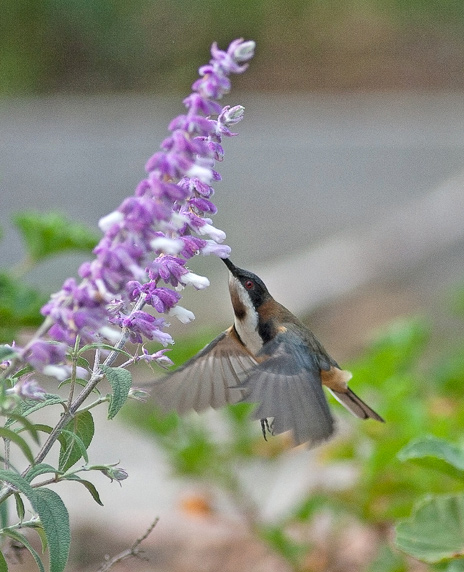
Eastern Spinebill. Photo by Damian Kelly

The Eastern Spinebill is a remarkable flier, able to hover to take nectar from flowers. They are not fussy about the type of flower, happily feeding on natives or introduced plants – in this case a salvia.

Posted in Nature Observations, News | Comments Off on Garden birds around Castlemaine