Poverty Gully: achievements, and puzzles

FOBIF members have had a preliminary look at the CAS 107 Zone 2 Arthur’s Track management burn in Poverty Gully this week. The exercise, conducted last Friday April 4, was the continuation of the burning operation begun late last year. The purpose, in the words of DSE’s Code of Practice, was to ‘protect nearby assets, particularly from ember spotting during a bushfire.’ It also aimed ‘to achieve ecological outcomes by seeking to manage for ecologically desirable outcomes, provided bushfire protection objectives can still be met.’

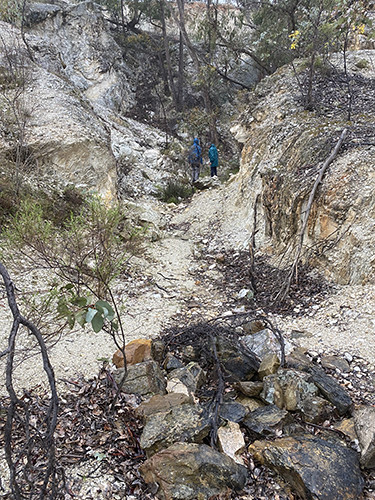
At first sight a moderate mosaic burn seems to have been achieved, as the first photo shows. Further, the Eltham Copper Butterfly and endangered spider orchid areas were avoided.

Arthur's Tk burn: a moderate mosaic, with protection for areas where endangered species are known.

On the other hand, we were faced with a puzzle which we’ve often faced before: although relatively few trees were brought down in the fire, some of the ones which did come down were among the biggest in the area:

Peppermint gum felled by DSE fire. This tree, like one of equal size near it which was also brought down, was next to an administration track. It's baffling that it could not have been identified and protected.

We can’t see any fire protection gain in the destruction of such trees, and the ecological loss, in an area with few big trees, is obvious. We will be pursuing with DSE the possibility of getting a more reliable method of identifying and protecting such trees.

Posted in Fire Management, News | 1 Comment

Another side of Kalimna

Julian Hollis

On a perfect Autumn day, geologist Julian Hollis recently led fourteen walkers on the second FOBIF walk of the year, through Kalimna Park. We were lucky to be accompanied by Julian, who is often seen walking in the area and has studied it for some years.

Kalimna is well known for its variety of native vegetation, and particularly its spring wildflowers. It is less well known for its 400 to 450 million years of geological history, but Julian’s explanations brought that history to life for the walkers.

On the way to Kalimna we stopped at the cutting on the north-east corner of the intersection of Campbell and Hargreaves Street. There, Julian explained that the cutting was created in the 1850s so that horses would not be faced with such steep inclines. Two interesting geological features of the cutting were the quartz reef and anticline shown in the photos below. 

Quartz reef and Anticline on the corner of Campbell and Hargreaves Streets

Heading towards the Tourist Road we stopped to take in the view to the south, where Mount Franklin and other peaks could easily be seen.

View over Castlemaine and beyond from Kalimna

In the couple of hours that followed we walked on tracks to the north-east of the Park and then back to the Mount Alexander Golf Course. Julian discussed the large anticline on the Tourist Road, as well as some intriguing tube-like holes in a rock face, and he pointed out evidence of early miners’ cottages. We now know that some of those miners were unlucky, because we saw a shaft in excess of 35 metres, in which no gold at all was found. 

Anticline on the Tourist Road (left). Looking into the deep mine shaft (right).

Many will have driven over the Tourist Road but fewer would know that its original gravel surface came from quarries in Muckleford. 

We also saw evidence of a little known geological ‘shear’, and Julian showed how rocks can be dated according to the impressions left by graptolites known to have lived at particular times.

Thanks to Julian for leading another informative and authoritative walk in our local area.

Dominique Lavie has sent us some extra photos which highlight the stunning colour and texture of the many rock formations we viewed. Her photos can be found here.

Posted in News | Comments Off on Another side of Kalimna

Poverty Gully reduction burn completed?

 DSE completed the second half of its Zone 2 reduction burn in Poverty Gully on Friday April 4. Our reports on the first half of this operation can be found here and here. We will be having a look at the results in the next week and reporting what we find.

Murray Goldfields Fire Manager Simon Brown has revealed that the Kalimna Park burns will be delayed till next year. These will involve the area around Kalimna Point and almost the whole of the rest of the Park, on both sides of the tourist road.

Posted in Fire Management, News | Comments Off on Poverty Gully reduction burn completed?

Poor Coliban

Travellers across the Coliban River on the Taradale-Metcalfe road recently will have noticed that the river is looking terrible. Although there’s a very small flow,  the water is an unhealthy milky colour and there’s a peculiar scum on it.

The problem is that there’s been little rain since October and practically none this year. The Catchment Management Authority is aware of the problem, and is planning a small environmental release from the Malmsbury reservoir in the near future.

The Coliban at Taradale. An environmental release is planned to give the river a break: but maybe the Coliban would be in better shape if water wasted in the Poverty Gully channel in January had been put into the river instead..

There’s an interesting dimension to this problem. The water in the Malmsbury/Upper Coliban dams is managed by the Coliban Water Authority, mostly for community and licence holder use.. The CMA is entitled to a very small amount of this water for environmental flows into the river system.

The problem is that some of the water released to licence holders seems to be blatantly wasted. As an example: in January water was released into the notoriously leaky Poverty Gully water race. Although it’s hard to get a figure on it, Coliban water has conceded that a relatively small proportion of the water released at Malmsbury actually makes it through to Castlemaine. Sources at the authority tell us that they’d like to take the race out of commission–but for some reason or other they haven’t taken the necessary steps to do this.

The water released into Poverty Gully is relatively small, in the grand scheme of things: but when the Coliban river is sick, it would seem to be a better idea to give it a hand, rather than toss precious water into the air.

The CMA welcomes community feedback on river quality: write to info@nccma.vic.gov.au

Posted in News | Comments Off on Poor Coliban

How to shoot birds

On Thursday 25th April Chris Tzaros will give a presentation on tips and techniques for photographing birds, at Newstead Community Centre at 7.30pm. “We are really looking forward to having Chris address our group again” said Frances Cincotta, President of Newstead Landcare Group.

Chris has maintained a strong interest in natural history since his childhood. Brought up in central Victoria, he has a particular passion for and knowledge of woodland and wetland ecosystems, particularly birds.

In 2005 Chris authored a comprehensive book on birds, mammals, reptiles and amphibians of our local area titled, “Wildlife of the Box-Ironbark Country”.  The nature soundscape CD that comes with the book was recorded by Andrew Skeoch, a member of Newstead Landcare.

“I’m currently employed with BirdLife Australia” said Chris. “I co-coordinate a major woodland bird conservation project throughout Victoria, New South Wales and Tasmania”.

Grey-crowned Babblers photographed by Chris Tzaros

Everyone is welcome to Newstead Community Centre next Thursday evening to learn how Chris gets the amazing shots that he produces. The presentation will go for about an hour and will be followed by supper. A gold coin donation from attendees helps the group cover costs.

On the following Saturday Chris Tzaros and Geoff Park will run a workshop on bird photography, but that booked out very soon after it was advertised on Geoff’s “Natural Newstead” blog.  Another talented member of Newstead Landcare, Geoff has been photographing nature and writing about it on-line since December 2008 and you can read and subscribe to this informative nature diary by clicking here.

Posted in News | Comments Off on How to shoot birds