How wide should a bush track be?

FOBIF has once again questioned Parks Victoria about its track maintenance policy, after complaints from members about track works in the Fryers Flora Reserve and the Diggings Park. Complaints centred around the tonnes of blue metal put on some of the tracks, and the relentless widening of some roads.

Parks has advised us that recent works are mainly part of flood recovery works. The blue metal on the roads will be gradually packed into the surface. It’s visually not great, but may perform some useful function. More important is the fact that tracks seem to get wider every time work is done on them. This time, the work was done by contractors from Melbourne, who appear to have been given no briefing about how to handle road verges.

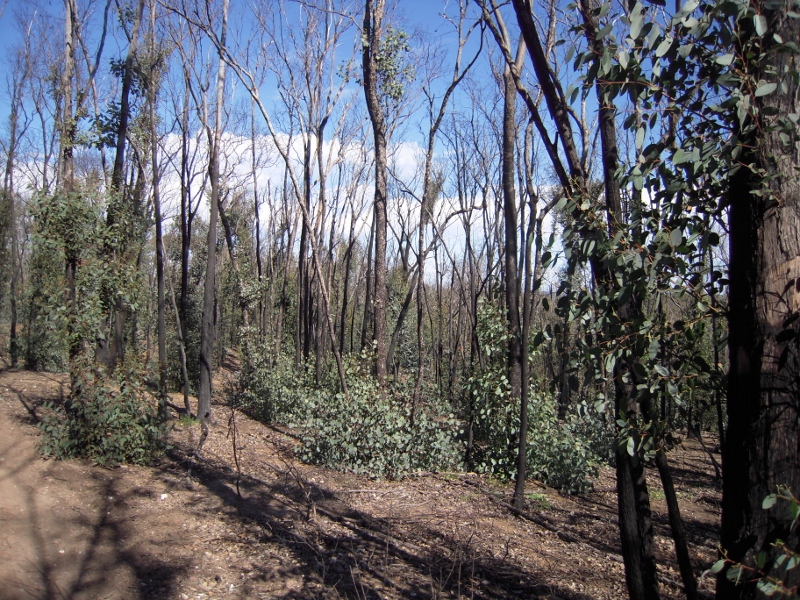
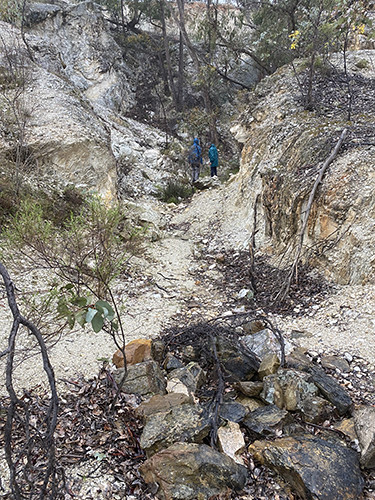
Near Tk: the apparently unanswerable question seems to be, how wide does a track need to be?

FOBIF has no problem with roads and tracks being maintained for important purposes, like fire management. Our problem is that over the years we have tried without success to get an answer to a very  simple question: what is the maximum width of a bush track? Given that we’ve measured some of them as wider than the Pyrenees Highway, it seems to be, Pretty Wide.

Posted in News | Comments Off on How wide should a bush track be?

Fungi guide

Wombat Forestcare has produced a handy guide to the Fungi of the Wombat Forest and Macedon Ranges. The guide comes in the form of a hardy folder, and has over a hundred large postage sized photos with succinct information on the species illustrated.  Although some of these species are more prominent in the wetter forests than they are in Mount Alexander region, the guide references many which can be found in the woodlands of the box ironbark country.

The folder has been produced for the Forestcare group by Alison Pouliot, and contains much useful info in addition to the species photos. Among other things, it warns that ‘knowledge about the edibility of  Australian fungi is scant and deadly poisonous species exist in Australia.’ Uninformed sampling of fungi is definitely not a good idea. It’s worth noting that even in Europe, where community familiarity with fungi is better developed than here in Australia, it’s been estimated that 50-100 people die from fungal poisoning each year. This is known, rather macabrely, as the ‘try and die’ method of getting to know fungi.

A much better idea is to get to know them for their beauty and ecological importance. The folder is available from Wombat Forestcare for a reasonable $6.00.  FOBIF has a limited number of folders, which we can sell to members on monthly walks at the recommended retail price.

Posted in News | Comments Off on Fungi guide

Moss matters

The photo below shows ecologist Paul Foreman doing a briefing on Mount Alexander on plans to boost the population of Southern Shepherd’s Purse with a special seeding program.

The plant [Ballantinia antipoda] is found only on the Mount, and its population has been under pressure in recent decades for various reasons. It thrives on moss mats covering granite sheets on the upper slopes.

Briefing on Mount Alexander: the Ballantinia is dependent on the moss mats over granite sheets on the Mount, which is the only place on earth the plant still lives.


FOBIF’s moss propaganda campaign resumed last weekend with a tour of Clinker’s Hill run by Cassia Read for beginners interested in getting a hook on this plant domain. Participants were introduced to a few general ideas on the nature and importance of moss, and given a look at ten species growing in the area’s gullies and tracksides.

Several photos were taken during this workshop, but we decided to protect the innocent by not publishing them here. Instead, to give an idea of what a true moss expert should look like, we produce the photo below, from the British Bryological Society.

Disturbing behaviour of moss enthusiast. Readers are assured, however, that gumboots are rarely required in our climate. Photo: British Bryological Society 2004


The gumboots are a giveaway that the picture wasn’t taken in our region recently: but the necessity to peer in to dark damp holes may be something we’ll have to face if the present dry conditions continue.

Posted in News | Comments Off on Moss matters

If it glows like a fire…

Julie Hurley giving an outline of the Victoria Gully project.

Twenty five walkers did the stroll from Clinkers Hill Reserve deep into the Poverty Gully area on last Sunday’s monthly FOBIF walk.

Walkers got a briefing from Julie Hurley on weed clearing and restoration work in the reserve by the Victoria Gully Group. Victoria gully runs through the Reserve down to Forest Creek at Tute’s cottage.

Although degraded like many other waterways in this district, the gully has great potential as a public asset, and the work done by the residents’ group has already enhanced the little known but very pretty reserve.

Pyronema fungus in fire ash: it weirdly resembles the glowing fire out of which it came.

Highlights of the walk included sighting of an echidna snoozing in a tree bole, and a series of weirdly spectacular fungi outgrowths from DSE’s autumn management burn. The fungus, Pyronema omphalodes, flourishes in fire ash, and bears an irresistible and intriguing resemblance to a glowing fire.

By taking an off track route up and down nameless gullies and ridge tops, Sunday’s walk showed how you can get a pretty remote feeling in our local bush–less than a kilometre from the town edge. And we got the chance to look over three contiguous DSE management burns: 2009, 2012 and 2013.

Some of Sunday's walkers at lunch.


Posted in News | Comments Off on If it glows like a fire…

Government fire program careers wildly on

The State Government has announced a ‘major milestone’ in its management burning program: ‘more than 200,000 hectares of planned burning already carried out on public land this financial year.’ And there’s more to come: we’re heading for the biggest artificial burning program in Victoria’s history.  

What is most striking about the government’s press release [printed in full below] is the  absence of any detailed notion of what, exactly, has been achieved in this welter of burning: the statistic is everything.

'To reduce the risk of bushfires on our parks and native animals': Ashby Track area, six months after a management burn, 2012.


Readers will remember that FOBIF wrote to the responsible ministers last year asking whether serious consideration had been given to the Royal Commission Implementation Monitor’s recommendation that the five per cent burning target be revised. The Monitor suggested that the rush to burn lots of country might be compromising public safety by encouraging burns in remote areas.

Although the responsible minister, Peter Ryan, had said that the government would ‘consider’ the monitor’s view, all we got from his spokesman (and from the Environment Minister Ryan Smith] was a lot of patronising generalities about fire. At the time we took this to mean: ‘No, we’re not paying any attention to what the Monitor says.’ The latest press release confirms this view.

There are interesting research projects under way on the effects of frequent burning on bushland in various habitats. There’s no evidence that these projects are influencing government policy, though it’s clear that many DSE officers are concerned about the likelihood that these practices will radically alter bush environments for the worse. It’s a bit like deliberately burning down your own house, while carefully researching the effect of fire on residential amenity.

Continue reading

Posted in News | Comments Off on Government fire program careers wildly on