Change of route for FOBIF’s April walk

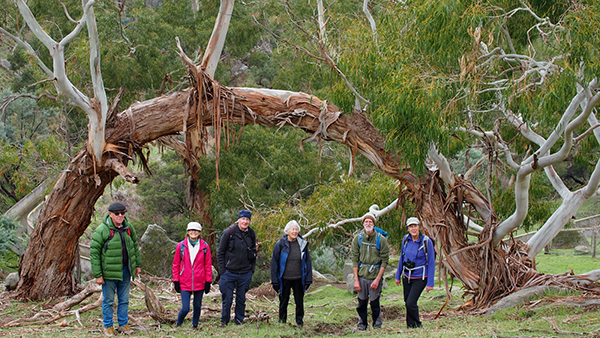
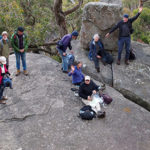
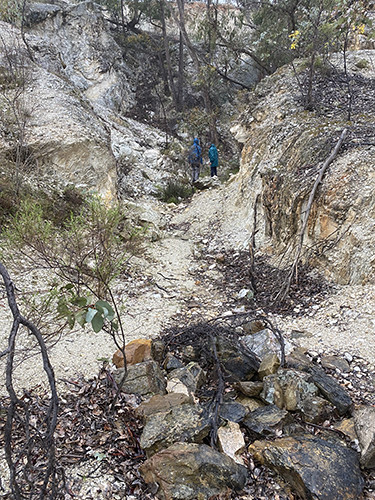
The route for FOBIF’s April walk, next Sunday the 21st, has been changed. It will now start at the Hunters track dam, on the corner of Irishtown Track, and cover about 5 km, partly on tracks, some through bush along the Salters creek bed; there’ll be a couple of rough steep climbs. We suggest if people usually use walking poles they’d find them helpful. As it’s Easter Sunday and a short walk we plan to be back in town by 1 pm. For more information contact Julie Hurley or Rex Odgers 0427 002 913.

Posted in News | 2 Comments

Driving 2: Do gladiators have sensitive thighs?

A regular offender in the matter of promoting tough guy destructive driving is The Age Drive section. Its edition of last Saturday [April 13] featured an extensive review of the Suzuki Gladiator, complete with pics of mud being spattered, and a car conquering an impossible slope.

A strange feature of SUV ads is that in an increasingly urbanised society, they try to flatter the viewer as an intrepid adventurer raring to go out and tear up the world. A chink in the armour of this adventurer was inadvertently  revealed in the Age’s account of the Gladiator.

Generally favourable, the review noted that ‘the front seats… are a bit flat and the cushion lacks under thigh support…’

Our readers will not have failed to note the heroic names attached to most off road vehicles: Wrangler, Gladiator, Ranger, X Trail, etc…We did not previously know, however, that the heroes who thrash these vehicles over our long suffering soil were so sensitive in their  under thighs. Toughen up, Fellas!

Posted in News | Comments Off on Driving 2: Do gladiators have sensitive thighs?

Remember the thinnings trial?

The ecological thinnings trial was conducted about 15 years ago in four locations in the box ironbark region. Locally the thinnings plot is in the Diggings Park along Morgans Track, between the Chewton-Fryerstown Road and the White Gum Track.

The principle behind the trial is as follows: devastation of the forests following the gold rush led to the destruction of most large trees, and regeneration of dense stands of saplings. The original woodland structure of reasonably widely spaced large trees was thus replaced by what we mostly have now: forests dominated by relatively spindly trees. These forests are naturally thinning themselves, with the gradual death of weaker trees, but the process is taking a long time. The thinnings trial is designed to hasten the process, by taking out relatively weak trees, thus allowing the better trees to grow more robustly, and thus creating a healthier woodland structure.

Section of the thinning trial near Morgan’s Track…

The project had a biodiversity aim: that is, it was intended to produce a better environmental outcome, not just straighter trees.

FOBIF did not oppose the trials, though we thought it was just as well to let nature do the thinning over time, and we were sceptical of the capacity of managers to maintain a credible monitoring program over a long enough period of time to show how effective the program was going to be.

Well, so far, so good, as far as the monitoring is concerned. A recent paper by researchers from Parks Victoria, DELWP and the Arthur Rylah Institute has given an account of the story so far in the thinnings plots. The conclusion of the paper is that tree growth in the plots is significantly higher than in adjacent control areas:

‘Three thinning treatments, differing in their density and pattern of retained trees, were compared with controls to determine the most effective approach for restoring these systems and increasing the rate of recovery for biodiversity benefits. The thinning treatments applied different retention levels of stems, one which reflected conventional silvicultural practice and two designed to reflect a patchy forest structure. The response of tree diameter growth to thinning treatments, for multiple tree species, was examined approximately a decade after thinning. All three thinning treatments increased tree growth-rates similarly (0.32–0.57 cm/yr), compared with the controls (0.2–0.27 cm/yr). These data suggest that the choice of thinning treatment may not be critical for accelerating tree growth, and land managers can focus more strongly on the treatment that provides the best overall outcomes for biodiversity.’

…nearby section of unthinned bushland. The principle behind the project is that thinning produces a more natural and biodiversity rich woodland structure.

There’s a long time to go, of course: in a drying climate, and with poor soils, growth rates are slow.

The paper is jointly written by Geoff Brown, Andrew Murphy, Ben Fanson and Arn Tolsma. Unfortunately it’s not available online.


Posted in News | Comments Off on Remember the thinnings trial?

An invasive South American weed: Espartillo

Margaret Panter has produced another weed identification  pamphlet, this time about an invasive South American weed, Espartillo. If the text below is hard to read you could try this link for a clearer copy.

Posted in News, Weeds | Comments Off on An invasive South American weed: Espartillo

Black Saturday, ten years on: what’s changed?

The March edition of the VNPA’s Parkwatch magazine is now online, and can be found online here.

The magazine has numerous articles of interest, but we particularly recommend the section where the magazine looks over the Bushfire Royal Commission’s recommendations for action, and assesses how well these recommendations have been followed:

  • Improve community education, the effectiveness of warnings and strategies for safe evacuation.
  • Establish a comprehensive approach to shelter options.
  • Upgrade emergency management, including fire path prediction and the revision of lines of authority.
  • Upgrade the capacity to respond to fire ignitions, including aerial response.
  • Power lines should go underground.
  • There should be a commitment to research and effective action on arsonists.
  • Planning and building controls need strengthening.
  • Improved fuel reduction burning effectiveness.
  • Implementing the recommendations.

For each of these recommendations, the report is mixed: and the magazine concludes as a general comment: ‘The Implementation Monitor for the commission’s recommendations, Neil Comrie, pointed out that the 67 recommendations shouldn’t be considered in isolation. Rather, all identified strategies to protect life (as a priority), infrastructure and the environment should be considered together. Despite its limitations, fuel reduction planning continues, to a large degree, in isolation from other very useful strategic options.

‘And climate change is still the elephant rampaging through the room.’

Posted in Fire Management, News | Comments Off on Black Saturday, ten years on: what’s changed?