Central West forests: sorting out what the public thinks

The Victorian Environment Assessment Council has released a summary of responses to its draft recommendations on the Central West forests. The summary can be found here.

The consultation is an interesting example of a public body sounding out opinion as part of its decision making process. In addition to a widely representative reference group, and direct communication with landholders with an interest in the areas in question, VEAC conducted drop in sessions in the region, and invited submissions:

‘In total, 2698 written submissions on the draft proposals paper were received. Approximately 24 percent were from Melbourne, 20 per cent from in or near the investigation area, 19 per cent from other parts of rural and regional Victoria, and 3 per cent from interstate;34 per cent were submitted with no location information. 137 submissions were from organisations and the remainder were from individuals.’

There were 1500 identical [ie, pro forma] submissions. Of these, 919 opposed the creation of a Wombat National Park, and 618 were pro forma submissions prepared by the Victorian National Parks Association. These supported the draft recommendations plus the creation of a national park in the Mount Cole area. The individual submissions reveal a wide variety of often contradictory views, which the council will have to account for in its final recommendations. Some of the submissions showed a degree of cynicism about the Council’s independence, but as far as we can tell, the process has been pretty transparent. Given our own cynicism about aspects of the Victorian Government’s ‘engage Victoria’ process, we were interested in VEAC’s comment on the way it considered the public’s views:

Because submitters do not constitute a representative sample of the population, recommendations are not based on the number of times a comment or viewpoint was submitted; rather, it was what was in the submissions that counted.’

The final report will be delivered to the Minister in June.

Posted in News | Comments Off on Central West forests: sorting out what the public thinks

Want to be in the Easter bird check?

BirdLife International has identified areas of conservation importance around the world as Key Biodiversity Areas (KBAs). This includes KBAs right here in our region. Our KBAs were designated especially for their importance for two special birds, Diamond Firetail and Swift Parrot, and cover both public and private land.

The three KBAs in the Mount Alexander Shire are Clydesdale-Strangways, Sandon-Strathlea and Muckleford-Newstead.

Sandon State forest: Sandon is one of the key biodiversity areas in our region, along with Clydesdale-Strangways and Muckleford Newstead.

Birdlife’s Easter health check takes an annual snapshot of the threat and conservation actions of the areas that matter most to birds. BirdLife compares results between KBAs across Australia and around the globe. The results are extremely valuable, especially for identifying species decline and targeting conservation work.

BirdLife is looking for local people to complete a 2019 Easter health check for each KBA. To help, Connecting Country is running a workshop on Friday 12 April 2019 in Newstead.   Greg Turner from BirdLife Victoria will talk through the process for our part of the Bendigo Box Ironbark area. Geoff Nevill from the Muckleford Forest Friends Group will also talk about his group’s work in the region.

This annual check is all about assessing habitat and its threats. Anyone with an interest in landscape restoration is most welcome to come along and get involved, whether you’re a beginner or an experienced birdwatcher. Come  to this workshop to learn how you can participate in the Easter Health Check: 

  • Learn about the KBA’s in the Mount Alexander Shire.
  • Find out about KBA Easter Health Check – what it is and how to do it.
  • Meet other people working with KBAs.

Where: Newstead Community Centre Mechanics Hall, 9 Lyons St, Newstead VIC, on Friday 12 April 2019: 9.00 to 11.30 am. It’s free, with morning tea and refreshments provided.

To book, click hereIf you have any questions, please contact Ivan Carter at Connecting Country on (03) 5472 1594 or ivan@connectingcountry.org.au.

Posted in News | 2 Comments

Here’s a pretty picture: tell us how nice it is

FOBIF has made a reluctant submission to the current government consultation on forest management. Our reluctance is based on two concerns:

  1. These consultations increasingly look like popularity polls, along the lines of the Herald Sun’s daily polls on subjects like, ‘Are the young people of today irresponsible?’ In any case, being voluntary, they’re not necessarily a reflection of the community’s views.
  2. The questions in this consultation are either patronising or they try to force respondents into expressing preferences they may not want to express: for example, they ask respondents to ‘prioritise’ ‘conserving plants and animals’ and ‘providing jobs’. This is the old ‘jobs versus the environment’ hoax, and we don’t accept it.

Nevertheless, we had a go. Here is the substance of our submission. The questions are the ones provided by the consultation, and are in italics:

1 How can we protect and improve our forests for all Victorians?

By properly resourcing forest managers, and having them well advised by good research.

2 What benefits do you want future generations to gain or enjoy from Victoria’s forests?

Victorians should be able to benefit from the role of our forests in catchment protection and water supply; they should also be able to enjoy the beauty and biodiversity of our forests. Governments should vigorously pursue plantation timber, to obviate the need to log our native forests.

Continue reading

Posted in News | 3 Comments

Fire: another submission

FOBIF has made a late submission to the Bushfire Management consultation [see our previous post], after our representatives attended ‘drop in’ consultations in Castlemaine and Bendigo this month. The substance of our submission is set out below:

  1. The poor quality of the maps supplied for this process, both online and in the hard copies available at the ‘drop in’ sessions, was such that we are unable to comment in detail on the three options offered in this consultation.
  2. We are quite unclear as to the manner in which DELWP will make up its mind about the three options offered. Discussions with your representatives did not clear up this matter:
  3. It’s obvious—we hope—that DELWP could not be running a crude popularity poll, particularly since online consultations like this are not necessarily representative of the public as a whole.
  4. In any case, we do not see that this consultation will add much to the dozens of such consultations which have taken place over the years. We ourselves have attended innumerable meetings and submitted dozens of submissions on the subject of the many fire operations plans developed since the 1990s. We do hope that this consultation will not take place in isolation from those previous efforts.
  5. In the light of the above, we submit that DELWP should take heed of the findings of the Royal Commission Implementation Monitor, and conduct a carefully conceived risk reduction strategy, not dominated by preconceived notions involving scorched earth strategies.
  6. In the light of this, it seems to us that some combination of options B and C might be an appropriate approach to take.

However, as we have repeatedly emphasised over the last 20 years, everything depends on the detail of the implementation:

Continue reading

Posted in News | Comments Off on Fire: another submission

Burns Hill – a recovering landscape

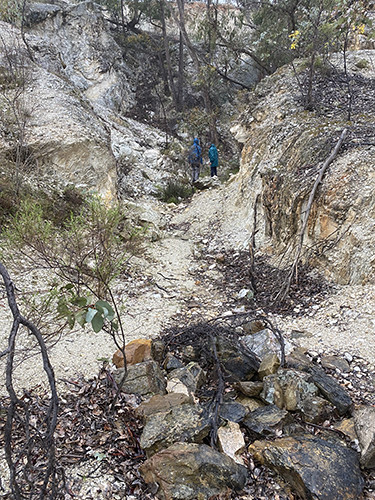
There was a good turnout for the first FOBIF walk this year despite the hot weather. The 5km trek began at the Chewton Shop and followed Forest Creek to the Monster Meeting site. It was then up Burns Hill with terrific views over the township to the south and along the reef to Trapps Gully before coming back down along the Forest Creek. 

Marie Jones who led the walk has been involved for decades in the revival of the Forest Creek area. She gave an excellent running commentary on the impact of mining and white settlement in the area and the extensive rehabilitation undertaken by the local Landcare group and others. Marie also gave us a rundown of the historical significance of the Monster Meeting site and handed out the newly produced Chewton Domain Society pamphlet, ‘The 1851 Monster Meeting of Diggers at Forest Creek’.

Thanks Marie for leading a wonderful walk which introduced walkers to little unknown trails so important in our history and so close to town.

As explained in an earlier post the April and May FOBIF walks have been swapped. The next walk (21 April) will now be led by Julie Hurley or Rex Odgers starting out from Warburton Bridge. As usual meet at Continuing Ed at 9.30 or at 9.50 at Warburton Bridge, Glenuce. 

Posted in News, Walks | 2 Comments