Is is a bird? No, it’s a plane

Views can be a wonderful experience, but a double edged one: a house may offer a magnificent view of a nearby hill, but a person sitting on that hill may not be pleased by having to look at the house in question.

Aeroplanes offer magnificent views: but people on the ground who have to put up with their intrusiveness and noise possibly won’t be impressed that the passengers in the sky are getting ‘the experience of a lifetime’, as one helicopter company describes its scenic flights over the Port Campbell National Park.

The Strathbogie Shire is facing a different version of this problem, in relation to the largest tract of Box Ironbark bushland in Victoria. Skydive Nagambie, which claims to be ‘Australia’s premier skydiving company’, is proposing to set up an airfield 3 km from the Heathcote-Graytown National Park, in the vicinity of Mount Black.

It’s hard to believe that planes would be dropping parachutists over the park, to fall into trees: but the prospect of up to 20 flights a day on up to 215 days in the year even close to the park is not impressing some local naturalists. Objections to the application have been made by the Trust for Nature and local environmentalists. For more info, the Strathbogie Shire website is at www.strathbogie.vic.gov.au, and local objectors can be contacted via rachelots@hotmail.com

Posted in News | Comments Off on Is is a bird? No, it’s a plane

Hakeas: can a good thing be a bad thing?

Visitors to local bushlands will have noticed the widespread flowering of our beautiful local Hakea [H. decurrens, or ‘bushy needlewood’—see picture below], which was particularly proliferating in the south end of the Diggings Park visited by our walking group on June 19.

Hakea decurrens, Castlemaine Diggings National Heritage Park, May 2011. Photo: Bernard Slattery

Hakeas are native only to Australia, though some have found a place as weeds in South Africa and New Zealand. Some Hakeas are weeds in Australia too—and that includes the wonderful Hakea laurina [Pincushion hakea], a native of WA. A patch of this can be found on the east side of the Kalimna Tourist road, almost opposite Kalimna Point [see picture below]. The origin of this patch is obscure. It flourishes in years of good rainfall, and fades in dry seasons. It seems not to have spread very far in the time it has been in the park, though one can never tell when an ‘exotic’ plant may become a pest.

Hakea laurina, Kalimna Park, June 2011: in parts of Victoria it's a pest. Could it become one here? Photo: Bernard Slattery

There are many definitions of ‘weed’, but one useful one is: any plant, no matter how beautiful, which tends to aggressively outcompete indigenous vegetation, creating a relatively boring monoculture. The Australian National Botanic Gardens website, after observing that Hakea laurina has become a pest in parts of Australia, warns: ‘Care should be observed in planting any hakea species and it is recommended that hakeas should not be planted in areas that are close to natural bush.’


Posted in News | Comments Off on Hakeas: can a good thing be a bad thing?

Floods and vegetation: a voice from the 1930s

In the light of the odd angry shot fired earlier this year at conservation works along our creeks, it is interesting to read a letter in the June issue of the Castlemaine Historical Society Newsletter. The letter, dated 25/9/1934, was retrieved from the Forests Commission files, and was written by noted Castlemaine artist A. M. E. Bale. Several of Bale’s works hang now in the Castlemaine gallery.  She had a house in Gingell [now Gaulton] Street, backing onto Barker’s Creek. We reprint the letter courtesy of the Historical Society. It illustrates the fact that creek management controversy didn’t start yesterday:

‘Dear Sir,

‘I have to complain of the over much zeal of the employees of the Commission at Castlemaine. They are carefully removing every scrap of bramble and gorse along Barker’s Creek, regardless of the fact that where there is nothing but “noxious weeds” to bind the banks of the creek together, then it would be best to leave a little of them to carry out that necessary function. So much gorse has been taken from the creek banks just behind my property in Gingell Street and the earth so loosened in consequence that in the last year or two the creek has washed away yards of the bank and the few trees that are scattered along it have in some instances fallen into the creek. Where there was a fence and a footpath (on the creek side of it) beyond the fence of my paddock, the path has gone and the outer fence had to be moved back. Last flood the water was half across my paddock for the first time since I have had it. Next time, as no binding roots whatever are being left, the water will probably take a yard or two more and then be nibbling at my land. It would be much better that your employees should use some judgment and leave some gorse on the creek banks to bind them-in places where native growths have been already destroyed.

Plaque on AME Bale's house in Gaulton Street: her concern was that erosion followed over enthusiastic vegetation clearance.

‘The Town Clerk seems pleased that what the Council have done in the matter of taking out the willows and gums higher up lets the water “get away quickly”. My opinion is the faster it gets away, the more violent it is and the more of the banks it takes with it. I would plant the banks behind my place with tee tree etc., but the cattle would leave none of it. In such a case the only binding force to rely on is one distasteful to cattle-such as gorse and I do not see what harm gorse does in such a position.

Continue reading

Posted in News | Comments Off on Floods and vegetation: a voice from the 1930s

An abundance of Greenhoods

We are likely to have an exceptional few months of orchids this year. Hundreds of Nodding Greenhood rosettes can already be seen.

Nodding Greenhood rosettes in the South Walmer Nature Conservation Reserve. Photo by Bronwyn Silver, 24 June 2011.

An early flowering type is the Tall Greenhood Pterostylis longifolia, pictured here. Photos of other local Greenhoods can be viewed in our photo gallery.

Tall Greenhood, 10 June 2011.

Posted in News | Comments Off on An abundance of Greenhoods

A walk in the mist

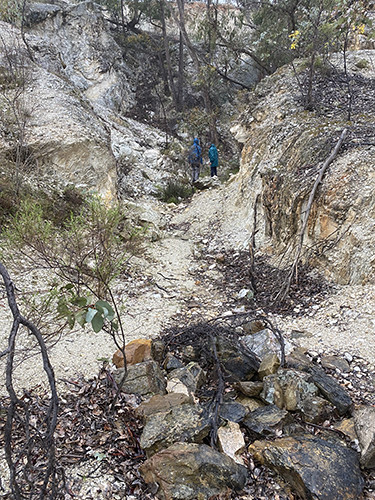
On June 19 twenty three hardy souls braved unpromising conditions to tackle FOBIF’s June walk in a remote corner of the Castlemaine Diggings National Heritage Park. In fact, however, the weather held nicely, and the group experienced some great moments walking the serene and misty ridges of the south end of the Park, sampling a stretch of the Goldfields Track through Stone’s Gully, and doing a bit of a scramble over Sebastopol Gully and through interesting relic mining sites.

The FOBIF group takes a break on a ridge north of Sebastopol Creek. They look a bit chilled, but in fact the weather was benign, and even a bit serene. Photo by Frank Forster, 19 June 2011.


The dim winter’s day provided some good sightings of fungi and a few patches of the rare Fryerstown grevillea [not in flower], plus a surprising show of wildflowers, masses of hakeas in bloom being the highlight. And the rain held off till the precise moment the group finished the walk in the afternoon.

Posted in News | 1 Comment