Poolside

Last summer saw an amazing explosion in numbers of dragonflies and damselflies around our creeks and dams. This year there are already significant numbers of these interesting and important creatures. The Forest Creek pools near the walking track are playing host to numerous species, including: blue ringtail damselfly, Aurora bluetails, Wandering perchers and Blue skimmers. Photos of these and others can be found in our gallery

On Forest Creek, November 2011: we've tentatively identified this as an Australian flatwing damselfly, but would appreciate suggestions.

Posted in Nature Observations | Comments Off on Poolside

Make yourself comfortable!

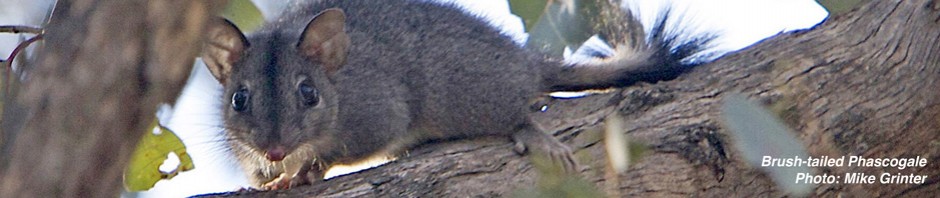
The brush tailed Phascogale, or Tuan, is FOBIF’s chosen symbol for a number of reasons: it’s an iconic box ironbark species, it’s endangered, and, let’s face it, it’s cute.

One of the interesting things about the Phascogale is that it has reacted to a decline in natural habitat in our area by adapting to human environments. A Castlemaine resident once found one in the pocket of a coat hanging in the porch outside his back door, and there have been quite a few found in people’s roofs. And we’re told that they’re quite fond of curling up in stubby holders!

Tuan: it seems they often prefer the comfort of someone else's home. Photo: Doug Ralph

The photo above was taken in a house at Clydesdale. The baby was found in a box in a cupboard. The householders have put up nesting boxes but the Tuans think living in the house is better.

To have a look at five videos of tuans around the house in Clydesdale, click here

Posted in Nature Observations | Comments Off on Make yourself comfortable!

What’s its name?

Doug Ralph recently found this caterpillar attached to a Tall Sundew. Does anyone what it’s called?

Another one of Doug’s recent images is this lacework-like gumleaf.

Posted in News | 1 Comment

A management plan for Forest Creek?

A draft management plan for forest Creek, prepared by Max Shlacter for Connecting Country, in consultation with various community groups [including FOBIF], residents and agencies, is now in circulation. It can be found here

The informative and interesting plan divides the creek into four sections: from Expedition Pass to the Monster meeting site; from the Monster meeting site to Colles Road bridge; from Colles Road bridge to the Pyrenees highway; and from there to the confluence with Barkers Creek. It acknowledges that it is impossible–and probably undesirable–to restore the creek to a pre 1850s state,  but sets out ways this area can be improved. In doing this, it clearly canvasses the many challenges facing creek managers, in particular reconciling flood control, ecological health and fire issues.

Responses to the plan are invited: write to info@connectingcountry.org.au by December 4.


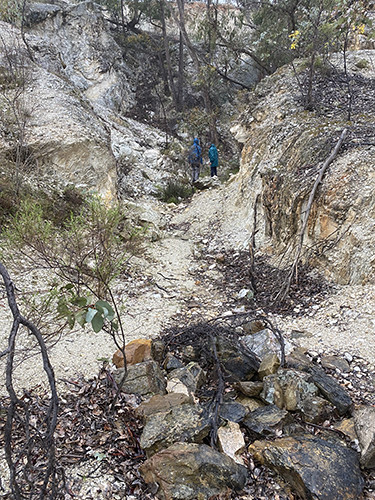
Forest Ck track, gouged by floodwaters, January 2011. The challenge is to develop a restoration policy which will protect the creek and surrounds while allaying fears about flood and fire. Photo: Bernard Slattery

Posted in News | Comments Off on A management plan for Forest Creek?

It’s hard to like them, but they’re quite at home with us…

The picture below is of a dead Redback spider, Latrodectus hasselti, found in a Castlemaine garden. The species is infamous for its alleged propensity to lurk on toilet seats, but is actually quite shy, though it has made itself comfortable in human environments. As the Australian Museum puts it, the redback ‘favours proximity to human habitation, with webs being built in dry, sheltered sites, such as among rocks, in logs, shrubs, junk-piles, sheds, or toilets.’ They’re not particularly aggressive, but obviously you’d want to be careful if you’re working in areas where they might be found.

Dead redback: they've adapted to human environments

The Museum’s detailed account of the spider can be found here . Its account of the spider’s mating habits is not pleasant reading, and sensitive readers—especially males— may want to stop now:

‘Male Redback Spiders do not produce a web, but may be found on the fringe of a female’s web, especially during the summer mating season. The male has to make overtures to the female to discover whether she is ready to mate, which can prove fatal if she mistakes him for prey. It has been found that in order to occupy the female’s attention during mating, the male spider offers her his abdomen by standing on his head and ‘somersaulting’ his abdomen towards her mouthparts. The female begins to squirt digestive juices onto the male’s abdomen while the first palp is inserted. If he is not too weak, he will manage to withdraw, and then insert the second palp. She will continue to ‘digest’ his abdomen. Most males do not survive this process, which seems to be unique to Latrodectus hasselti.’

Posted in Nature Observations | Comments Off on It’s hard to like them, but they’re quite at home with us…