Promises, promises?

Readers will remember our criticisms of DSE’s conduct of the Smutta’s track management burn early this year [see our posts of April 26 and May 2]. Specifically we were concerned by the destruction of a very large tree near Hunter’s track, and by the sloppiness of a control line which we believed could easily become yet another unnecessary and erosion prone track in the area, likely to be used by trail bikes and other vehicles.

We were assured by DSE District Manager Steve Nicholson that ‘DSE is committed to rehabilitating the control line as soon as possible after a burn is completed to minimise erosion and access by vehicles.’

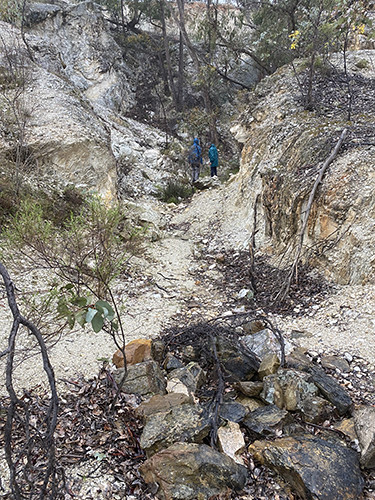
FOBIF members visited the area on November 1, and discovered that nothing had been done to rehabilitate the track in question, and that it had indeed been taken up for vehicle use. This track is completely pointless–it goes from nowhere to nowhere else, and is duplicated by other tracks in the area. We will take up the matter again with DSE.


'Temporary' control line near Hunter's Track, several months after the management burn. These lines become permanent, erosion prone tracks unless rehabilitated. Photo: Bernard Slattery

Posted in Fire Management | Comments Off on Promises, promises?

Fire management: so what’s new?

DSE is in the process of reviewing its Code of Practice for fire management on public land. The review is being done in the light of the Bushfire Royal Commission’s recommendation 59. This recommendation required that the Code  ‘provide a clear statement of objectives’ in fire management, an explicit risk analysis model ‘for more objective and transparent resolution of competing objectives, where human life is the highest priority’, and the specific characteristics of fire management zones, including ‘burn size, percentage area burnt within the prescribed burn, and residual fuel loading.’

A draft Code has been produced, and is open for consultation. It can be found here

Members are strongly recommended to look it over and to make a response, which can easily be done by email to Fire_Code.review@dse.vic.gov.au Responses are due by December 9. Be prepared to grit your teeth, however: there’s rather too much bureaucratic language in it for our taste. An example: Strategy 91 is ‘implement interoperability improvements and partnership arrangements.’

FOBIF representatives went to a briefing on the draft Code in Bendigo on November 4. We will be  making a detailed submission on it in due course. In the mean time it is worth recording three points: the fact that the Code tends to be a nice document no one observes; the inability of the Code’s procedures to prevent sloppy or out of control burns; and the fact that the government’s five per cent burn target contradicts one of the Code’s important rules. To elaborate:

Continue reading

Posted in Fire Management, News | Comments Off on Fire management: so what’s new?

Next Moss and Liverwort Group activity

The Moss and Liverwort Group will be holding their third activity on 26 November at 10.30am at 8 Preshaw Street, Castlemaine. Cass Read is going to lead people through this session which will look closely at the 20 most common local moss species through microscopes.  New participants are welcome. If you have a moss you would like identified, bring it along. Also more binocular microscopes would be useful on the day. Ring Beth Mellick on 5472 1316 for further details.

Breutelia affinins


Posted in Moss and Liverwort Field Guide group, News | Comments Off on Next Moss and Liverwort Group activity

Monitoring the Box Ironbark Thinning Trials

A re-monitoring of the Box Ironbark Thinning Trials begun in 2005 is currently underway in four locations across the Box Ironbark estate, including Castlemaine. The company undertaking the monitoring, Australian Ecosystems, is in need of some volunteers to assist with the monitoring work as the re-growth due to the recent rains has been extraordinary.

The field work requires agile, fit and enthusiastic volunteers with a good sense of bush safety. No botanical skills are required although a field sheet will need to be filled in. The days may be long and the ability to read a compass will be an advantage. The required period of time is from Monday 31 October though to 9 November 2011 and monitoring will be done in two stints of 3-5 days. The location is the Castlemaine Diggings National Historical Park.

Contact Damian Cook at 0402 127 933 to find out more information and/or to volunteer as a monitor.

Posted in News | Comments Off on Monitoring the Box Ironbark Thinning Trials

Eucalypt Identification Workshops

The Eucalypt Identification Worshops organised by Connecting Country are now booked out for Castlemaine and Maldon but spaces are still available for Sutton Grange and Newstead. More details about the course and booking information can be found on the Connecting Country site.

Posted in News | Comments Off on Eucalypt Identification Workshops