Tarran Valley 2: the cost of development to nearby bushland

Would the development require that woodland in the reserve be severely altered in order to protect residents from fire?

The CFA submission to the panel states that ‘the broader surrounding bushland having interface with the subject land has the potential to generate severe bushfire behaviour, including crown fires, extreme ember attack and significant radiant heat.’ The CFA handpasses the management of this problem to the land manager, the Department of the Environment.

Mount Alexander Shire planners, who support the proposal, do likewise, saying blandly that ‘determining whether the proposal will change the way surrounding bushland needs to be managed in the long term is the responsibility of other authorities.’

The submission by the ‘other authority’, the Department of Environment, is quite clear on the matter: the location of houses close to the Reserve would immediately create pressure for it to be rezoned to Zone 1 [Asset Protection] for the purposes of fire protection.  Here’s the DEPI submission:

‘A change in adjacent use is likely to cause a change of the surrounding fire management zone to FMZ1 Asset Protection Zone. In order to provide additional protection for the subdivision fuel reduction of an area of approximately 270 hectares would need to occur … To achieve the fuel hazard requirements of an APZ, the fuels in the area would be maintained at a ‘moderate’ level over approximately 90% of the 270 ha. This will result in a burning regime of fuel reduction burns being conducted on a five-year rotation.

‘An increased rate of burning will result in a significantly changed landscape. Regular burning to meet FMZ1 objectives results in the eventual loss of coarse woody debris on the ground, which removes key habitat for invertebrates and small mammal and reptile species. Over time, this will diminish the abundance and complexity of faunal species within the historic area.

‘An increased burning regime is expected to result in the loss of trees containing hollows used by native fauna. This loss of habitat is likely to impact on the abundance of fauna over time. More regular burning will also alter flora species composition, as a five-year rotation is below the average tolerable fire interval for many box-ironbark species and so we could expect to see a move to a simpler structure in the forest most likely containing larger grassland areas and fewer mid-storey species.’

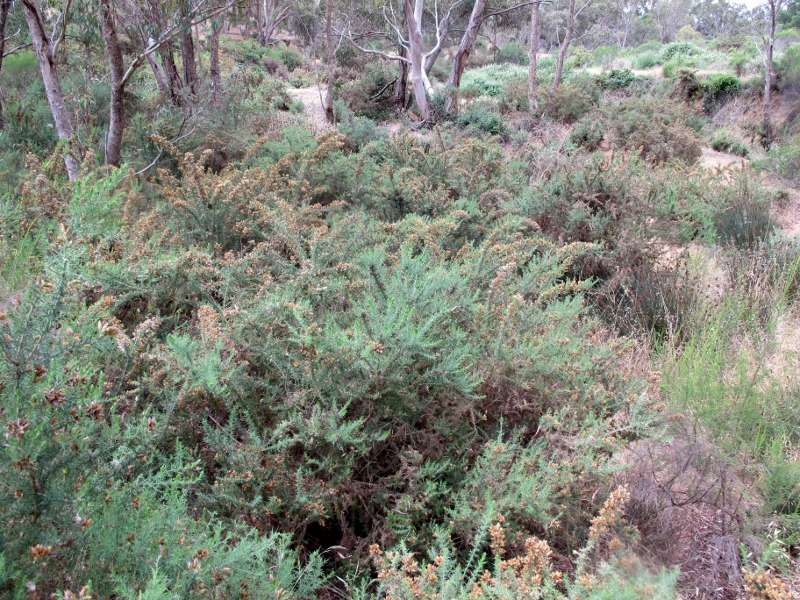
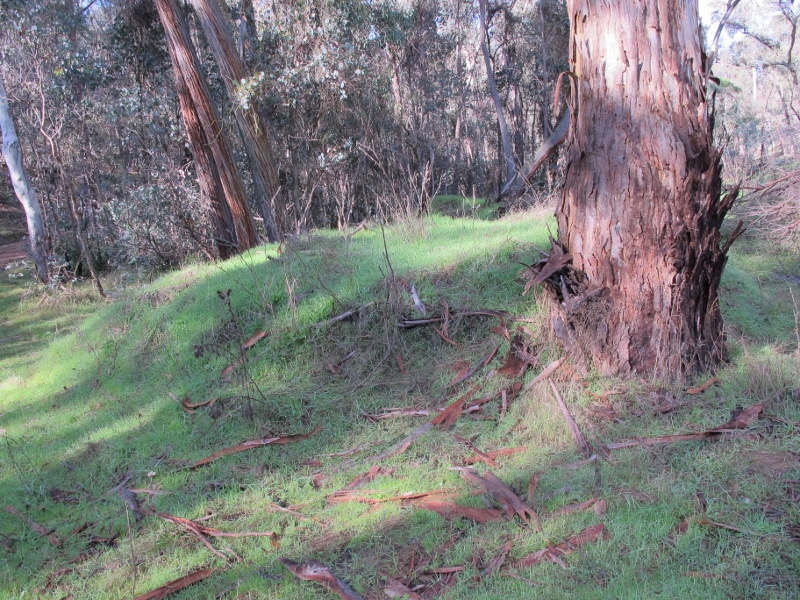
In the Maldon Historic Reserve: DEPI says that proposed development nearby would inevitably require severe fuel reduction in the reserve, with inevitable damage to forest structure. The Department adds that 'it is not appropriate to manage risk created on private land using Crown land for defendable space.'

In the Maldon Historic Reserve: DEPI says that proposed development nearby would require severe fuel reduction in the reserve, with inevitable damage to forest structure. The Department adds that ‘it is not appropriate to manage risk created on private land using Crown land for defendable space.’


Posted in Fire Management, News | Comments Off on Tarran Valley 2: the cost of development to nearby bushland

Tarran Valley 3: the cost of fire

The DEPI submission is an eloquent statement of something which has been informally acknowledged for years: that fuel management in Asset Protection Zones necessarily involves destruction of important ecological values. DEPI also provides us with another interesting insight into fire management problems by offering an estimate of the money cost of these operations:

‘Costs associated with the specific small-scale land management measures are more expensive relative to broader landscape management measures. The requirement to manage at the smaller scale also limits future broader landscape-level risk management activities, as DEPI would be obliged to prioritise the management of the specific sites. The current approximate cost for the type of burning required to implement APZ is about $116 per hectare, imposing a cost to government (at current rates) of $31,320 every five years.’

The DEPI submission comments tersely that it is not the business of the public land manager to have to fix problems created by new developments: ‘Minister Smith and DEPI consider that it is not appropriate to manage risk created on private land using Crown land for defendable space.’

It remains to be seen how strongly the Department, and Parks Victoria, maintain these positions at the panel hearing. In the past they have made some very nice statements in their submissions, but have failed to defend them vigorously when it really counted.

The panel hearing will be held in Castlemaine on May 7.

Posted in Fire Management, News | Comments Off on Tarran Valley 3: the cost of fire

Box-Ironbark Forest survey

FOBIF is currently conducting a survey of members and other interested people about our local natural environment. Information from this survey will be used to produce a flyer. Click on the image below to see a PDF version of the survey. Members will also receive a copy in the mail.

Screen Shot 2014-04-28 at 2.32.22 pm

Posted in News | Comments Off on Box-Ironbark Forest survey

25 April – FOBIF photographers at TOGS

FOBIF is having another photo show at TOGS Cafe and Gallery, 56 Lyttleton Street, Castlemaine. The title of the show, Small Wonders, reflects the surprising discoveries people often make when they take a close look at nature. All photos are taken in our local area.

This year 12 photographers will take part. The photos in the box below gives an indication of the diversity of the subject matter and the quality of the images.

8-photosThe show will begin on 25 April and run until 5 June. Togs is open daily between 9 am and 5 pm. Photos are for sale.

Posted in News | Comments Off on 25 April – FOBIF photographers at TOGS

Kalimna Park burn delayed

The Friends of Kalimna Park have been informed that the DEPI burn planned for this autumn has been deferred to next year, to allow for more detailed planning of this exercise close to Castlemaine. The fuel reduction exercise will involve some mechanical removal of vegetation around Eltham Copper Butterfly colonies in the zone.

This management burn was originally planned as two exercises: one [in the Kalimna Point area] of 23 ha, the other, [adjoining the golf course] of145 ha. These two have now been combined into a single zone of 170 ha.

Conservationists have argued to DEPI that this sensitive exercise on the edge of town should best be handled in stages, in very small lots: the advantage of this being that the desired fuel reduction could be obtained in a mosaic manner, minimising ecological damage and reduction of amenity in a heavily used area. We suspect, however, that DEPI is under political pressure to increase the size of its burn blocks: big burns, it seems, are cheaper. Our suspicions have been strengthened by remarks made by DEPI deputy head Paul Smith in March [see our report].

The Kalimna burn [coded CAS 003] is zoned 2, Bushfire Management. In this zone managers aim for an 80% burn cover.

Posted in Fire Management, News | Comments Off on Kalimna Park burn delayed