Trees ain’t trees

Where did the idea get about that our trees all ‘look the same’?

The problem has been around for a long time: in 1770 Captain Cook wrote about the NSW coast: ‘the woods do not produce any variety of trees.’ In 1836 Darwin claimed that ‘the extreme uniformity of the vegetation’ was ‘the most remarkable feature of the vegetation’ he observed in Australia. And in 1939 the poet AD Hope talked of the ‘drab green and desolate grey’ of our vegetation. And he compounded the insult by suggesting that the Australian people were just as monotonous…

Maybe these very worthy experts weren’t looking hard enough?

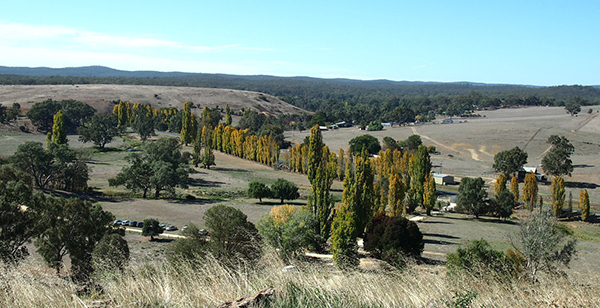
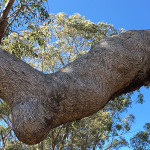
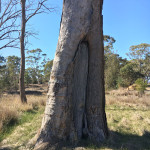
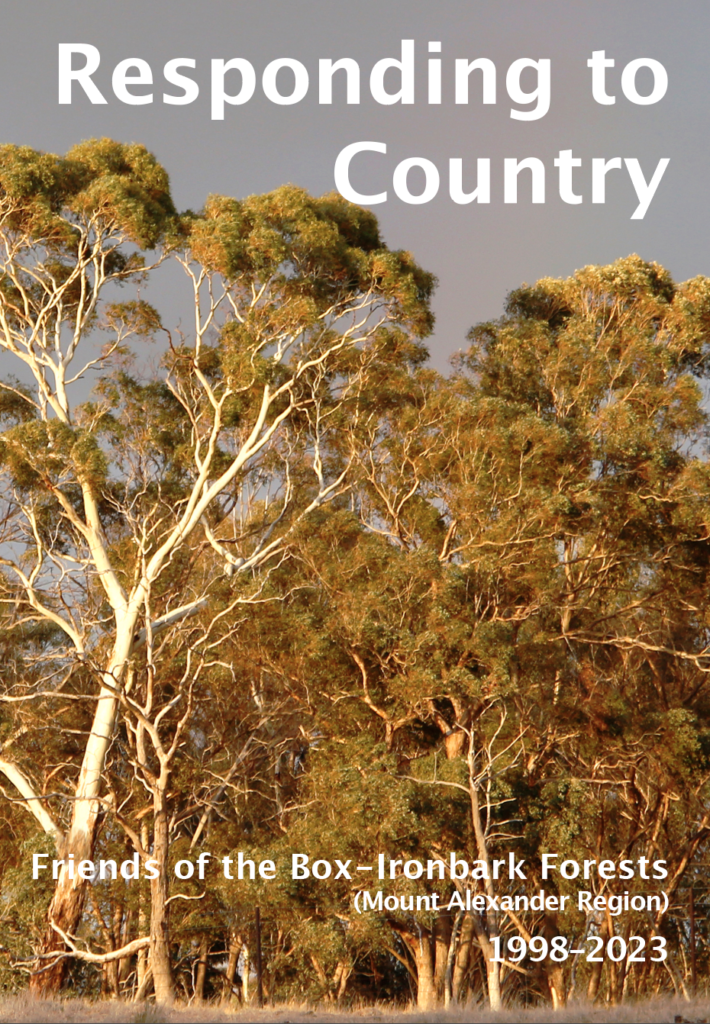
Our new exhibition of photos in Castlemaine is set to have a go at overturning the still widespread notion that our trees are monotonously uniform. Trees of the Mount Alexander Region mounted by the Friends of the Box-Ironbark Forests will run at Togs Place café from 26 February till 31 March 2016. The exhibition aims to highlight the amazing variety to be seen in our local indigenous trees: even those of the same genus—for example, eucalypts—can exhibit a wild variety of shape and colour, as well as hosting an extraordinary diversity of wildlife.

web Y 12 x 16 inch Nankeen Kestrel

One of the exhibition photos by Patrick Kavanagh (Nankeen Kestrel, Moolort Plains). Tree hollows are vital for the survival of much of our wildlife, so even dead trees can be important features of the land. This photo shows one of three fledglings raised in this hollow on the Moolort Plains. The other two have just ventured from the nest. This one seems to be stretching in preparation for the big step out.

The exhibition photos have been selected from over 125 photos that were submitted to FOBIF during December and January after a ‘call for photos’ was posted on our website. In June the exhibition will have a second showing at the new arts venue, the Newstead Railway Arts Hub. At this exhibition at least one photo from each contributor will be included in a continuous slideshow.

Photos will be for sale with proceeds going to FOBIF to cover costs.

Posted in News | 1 Comment

Some positive news for FOBIF

Memberships and donations are rolling in

FOBIF wishes to thank all its members for the generous donations they have made both last financial year and this current year. In fact the donations received have totalled fifty percent of the membership payments.

Your generosity will enable FOBIF to continue with its projects to help keep the biodiversity of the Box-Ironbark Forests healthy and safe into the future.

If you haven’t yet paid your membership, forms are available here.

Certificate of Appreciation

Lisa Chesters, Federal Member for Bendigo, presented a certificate of appreciation to FOBIF in recognition of our contribution to strengthening community and supporting the volunteer sector as part of International Volunteer Day December 2015.  These are fine words and well deserved – and it was appreciated by the FOBIF Committee on behalf of our members.  Well done everyone!

cert of app


Posted in News | Comments Off on Some positive news for FOBIF

2016 FOBIF walks start soon

This year’s FOBIF walks’ program has been finalised and can be viewed here. The first walk  (20 March) will be a combined FOBIF/Connecting Country event. The focus will be on birds and three experts will lead several short walks on Andrew Skeoch and Sarah Koschak’s property near Newstead. The meeting spot is still Continuing Education in Templeton Street (9.30am). However if you would like to meet in Newstead instead, ring Bronwyn Silver 5475 1089 or Tanya Loos 5472 1594 for details about an alternative meeting spot. More information on the walk can be found here.

Posted in News | Comments Off on 2016 FOBIF walks start soon

A dump here, a dump there, but rainfall is well down

A summer storm caused flash flooding in parts of Castlemaine on Thursday, putting the railway station underpass under water, and creating a brief swamp on the Western Oval, but, like its predecessors, leaving plenty of areas dry.

Muckleford Creek at the Pyrenees Highway last Thursday. The creek was off its peak when Alex Wiggenraad took this photo. Parts of the shire got a heavy dump, others barely a drop: but the overall figures for the last 12 months [and the last 16 years] are dismal.

Muckleford Creek briefly risen from the dead at the Pyrenees Highway last Thursday. The creek was off its peak when Alex Schipperen took this photo [the dark line on the pylons shows the high water mark]. Parts of the shire got a heavy dump, others barely a drop: but the overall figures for the last 12 months [and the last 16 years] are dismal.

Figures for 2015, in the mean time, are pretty dismal: 386 mls at the Castlemaine Prison station, against a long term average of about 600 mls. And we’re not alone. According to the Bureau of Meteorology, ‘for most of Victoria, rainfall during 2015 was below to very much below average. The Statewide average rainfall was 505.2 mm, 23% below the long-

...and the next day...

…and the next day…

term annual mean of 660.2 mm’. The good news is that the 2015 El Nino may have passed its peak–but the problem isn’t just of one or two years. As the map below shows, we’re in serious rainfall deficit over the last 16 years.

20160108.16year.drought (1)


The rainfall shortage, combined with rising temperatures,  has implications for land managers, of course: the challenge to enable bushland to cope with changed conditions involves ‘ramping up many traditional conservation efforts, such as eradicating pest threats, stopping habitat clearing, and the protecting of reserves’, according to the Vicnature Report released today.  The sensible measures in this report do, however, assume a properly resourced land management agency, among other things.


Posted in Nature Observations, News | Comments Off on A dump here, a dump there, but rainfall is well down

Here’s a reason to celebrate

There seems to be some kind of controversy bubbling about the Australian flag and Australia day in Castlemaine. FOBIF doesn’t get involved with debates of this kind, but we’re always looking for an excuse to celebrate, anyway.

And if we need to commemorate events which took place in 1788, how about this: in that year the Eucalyptus genus was first named for science, and the first description of a Eucalypt species published.

Messmates on Mount Alexander: it's a tree which can vary in size from a small mallee to a forest giant, depending on conditions.

Messmates on Mount Alexander: it’s a tree which can vary in size from a small mallee to a forest giant, depending on conditions. Australians are a pretty variable lot.

Seeds of an unknown species had been collected from Bruny Island in Tasmania on Cook’s 1777 expedition, and taken to England. It took until 1786 for them to be got out and studied, by an amateur French botanist, Charles Louis L’Heritier de Brutelle, who invented the name, Eucalyptus, and called the tree in question, Eucalyptus obliqua—now commonly known as Messmate. The publication in which this was revealed to the world for the first time: Hortus Anglicus, publication date, Paris 1788.

Unfortunately, it seems that scholars have found that the book didn’t actually appear till 1789—but we don’t care. Isn’t it good Aussie practice to accept that near enough is good enough? And if you want to celebrate something Australian, surely  it’s hard to get anything more Australian than a Eucalypt?

Posted in News | Comments Off on Here’s a reason to celebrate