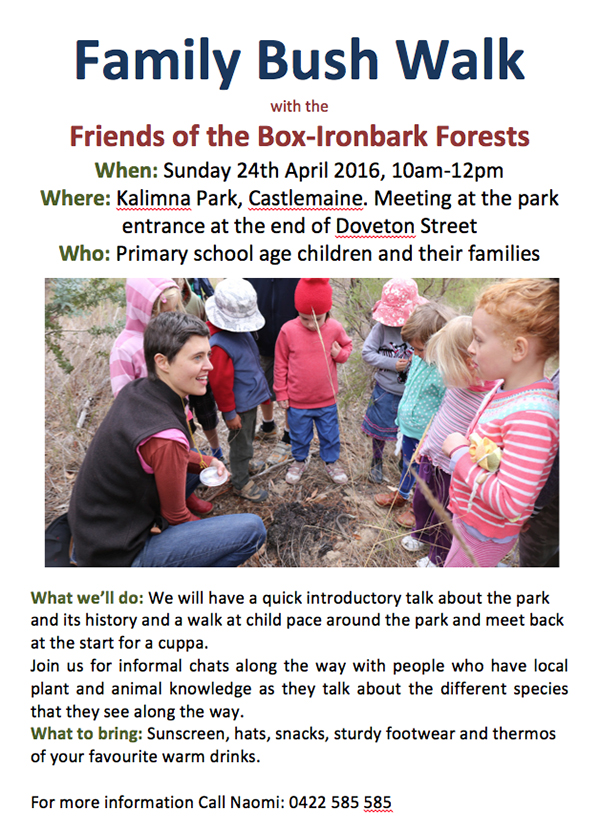
You can download the above as a flyer.
You can download the above as a flyer.
FOBIF has made a submission to Vicroads on the Safe Roads project, which aims to reduce ‘run-off roads’ accidents, mainly by installing barriers and removing vegetation likely to be on the end of a crashing vehicle.
Our submission aims to preserve the safety benefits of the project while minimising damage to vegetation. The substance of our submission follows:
‘For historical reasons, highway corridors in this region are valuable reserves of large trees, of a size not common in state forests and other reserves. Further, even trees rated as ‘medium’ by statewide standards, are relatively large in this area, and worth considering as highly valuable.
‘We appreciate your engineers’ efforts to minimise vegetation removal for this project, but we believe that the emphasis of the project is too heavily on coping with run off road accidents, and not enough on avoiding them.
‘We agree that saving lives should be the main focus of this, as of any highway project. But in our opinion driver behaviour, and ways of modifying it, should be the main object of attention here: this is a winding stretch of road, and every effort should be made to persuade drivers to drive accordingly.
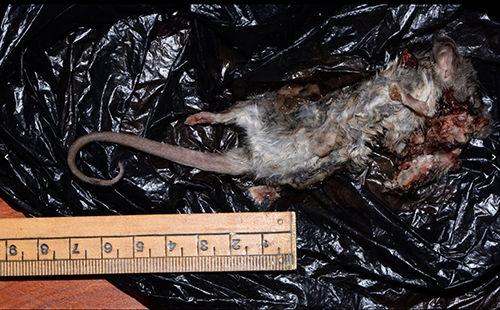
Local ecologist Damien Cook came across an unusual road kill near the Chewton- Fryerstown road in late March: an Eastern Pygmy Possum. According to a recent article on the Museum Victoria website, it’s ‘listed as near threatened in Victoria; at risk from predation by foxes and cats, competition with feral honeybees and increasing fire frequency’. It’s particularly rare in the box ironbark region. The last record for here was 1993 in Elphinstone. It’s not great that the find is of a dead possum: but we can take some positive news from the fact that the creature seems to be still hanging on in our area.
The pygmy possum can get most of its food from nectar and pollen, and relies on a diverse understorey to meet its needs. Here, of course, is a problem: understorey and leaf litter, considered vital components of the ecosystem by environmentalists, are often seen simply as fuel by fire managers.
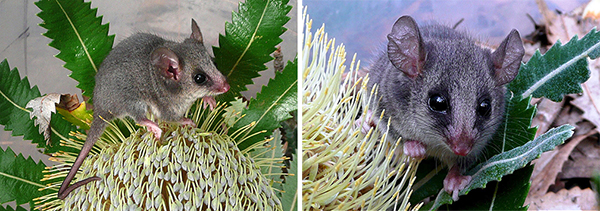
Eastern Pygmy Possum, photos by Renee Ellerton
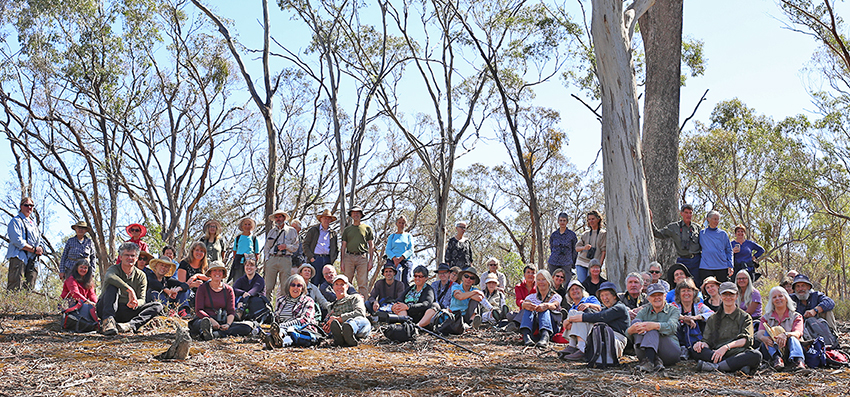
The group resting at the end of the walk to the dam near the corner of the property.
The combined FOBIF/Connecting Country walk on 20 March was an enormous success. The weather was wonderful, Andrew Skeoch and Sarah Koschak’s Strangways property was the perfect location for a guided walk, and it turned out to be a great way to conclude the Feathered Five Festival. There were over 60 walkers who split into three groups led by Asha Bannon, Tanya Loos and Andrew Skeoch. Forty-one different species of birds were observed and five mammals: an Eastern Grey Kangaroo, a Swamp Wallaby, an Echidna, a Yellow-footed Antechinus and a Koala.
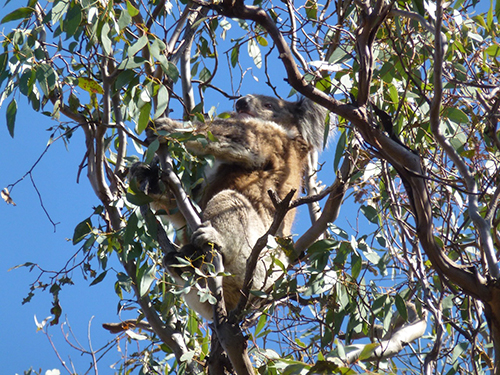
Photo taken by Geraldine Harris
For a full report on the walk have a look at the ConnectingCountry Facebook page which includes a series of terrific photos taken by Dean McLaren.
Thanks to Andrew and Sarah for sharing their property with us and helping to organise the day. Also thanks to the walks leaders and others who put time into organising the day.
Our next FOBIF walk will be on 17 April in the the Yapeen/Guildford plateau area. It will be guided by Max Kay with guests Julian Hollis and Maurie Dynon. More detail can be found on the FOBIF walks page. There is no need to book for this one.
Representatives of several conservation groups, including FOBIF, have done a couple of reconnaissance trips along the Pyrenees Highway to look over trees marked for the chop as part of Vicroads proposed Safe Road Project.
FOBIF will be making a submission on the proposals by the due date of Friday April 8. Submissions should be sent to Vicroads at 53-61 Lansell St Bendigo or by email to nrmailbox@vicroads.vic.gov.au
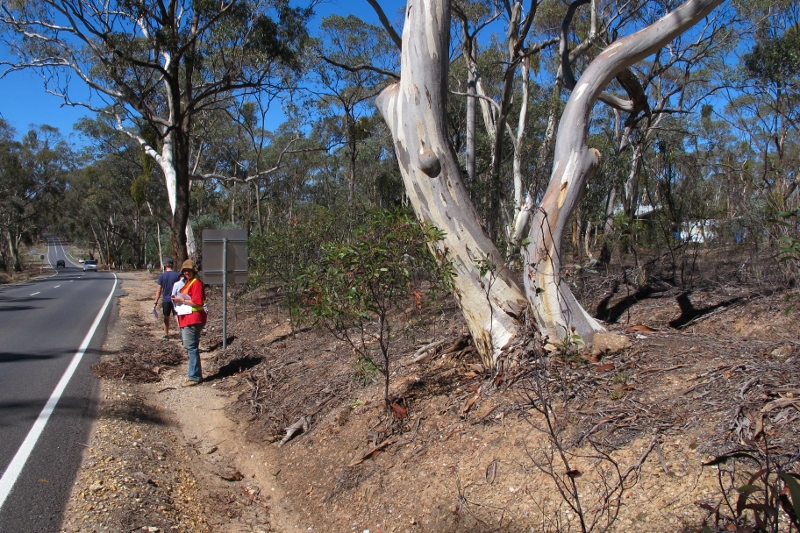
FOBIF is puzzled that some trees high on embankments, like this Yellow Gum, are marked for removal. We are also interested in the fact that highway edge vibration strips are not included in the project.
Initial impressions from the group include the realisation that a tree classified ‘medium’ [that is, with a trunk diameter between 52 and 70 cm at breast height] might be medium by the standards of, say, a Gippsland forest, but in this region that could be significantly larger than average.
We are also puzzled that highway edge vibration strips are not listed as among the works; and that only limited improvements to the road shoulder are planned: the road for significant stretches has little or no shoulder and falls quickly away to eroded gutters.
It seems that the strips were considered in the early stages of this project, but left out for budgetary reasons. There is substantial evidence that they reduce runoff road accidents. One US report offers the following: ‘According to National Highway Cooperative Research Program (NCHRP) studies, milled shoulder and edge rumble strips reduce single-vehicle run-off-road injury crashes by as much as 24 percent on rural freeways and by as much as 46 percent on two-lane rural roads.’ If this research matches Australian experience, it would seem strange to leave the strips out of this project, whose main object is to reduce such crashes.
We’ll be looking to clarify these and some other questions before making our submission. We also want to clarify the matter of distances between roadside barriers and adjacent trees; and we’re curious that a number of trees high on embankments have been marked for removal.
As a footnote: in the time it spent examining the roadside, the group witnessed a couple of scary examples of driver irresponsibility: passing at excessive speeds on sections with limited visibility. It’s clear that the margin for error on a road like this, with a narrow verge and steep drop offs is small: and that traffic calming should be a priority. We don’t envy Vicroads in the challenges it faces on this one. Our society continually plays the contradictory game, where we are told that speed kills–and yet high speed, powerful vehicles are put in the hands of anyone with the money, and events like the Formula 1 Grand Prix [not to mention numerous TV programs] glamorise speed and power.




White Everlasting Daisy (Chrysocephalum baxteri)

Slime Mould
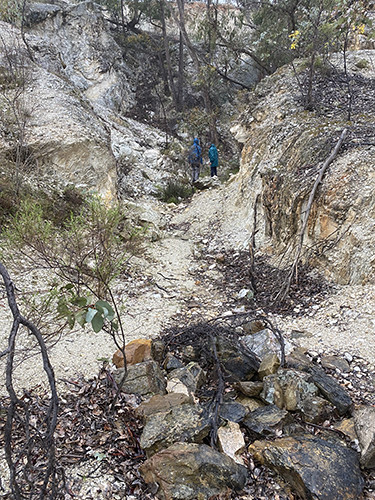
Dunns Reef

Tall Greenhoods

Gnat Orchid

Blue Caladenia
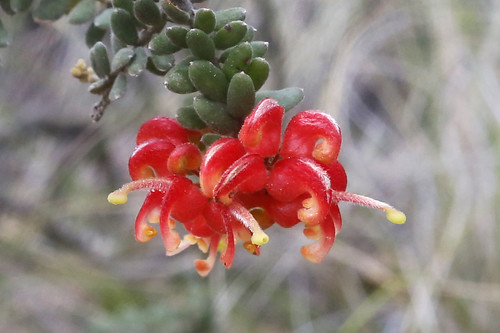
Downy Grevillea (Grevillea alpina)

Coliban river upstream of the Gibbons bridge

Coliban river upstream of the Gibbons bridge.

Coliban river upstream of the Gibbons bridge.

Sailors Gully ruin

Loddon River near Vaughan

Cortinarius archeri

Mycena subgalericulata

Cortinarius rotundisporus

Cortinarius cystidiocatenatus,

Ramaria sp.

Pink Heath

Mount Alexander

Mount Alexander
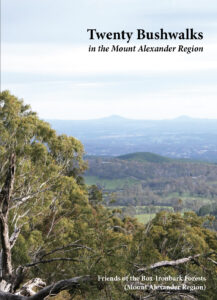
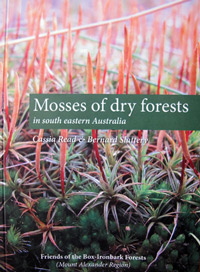 Click on image for info/order page
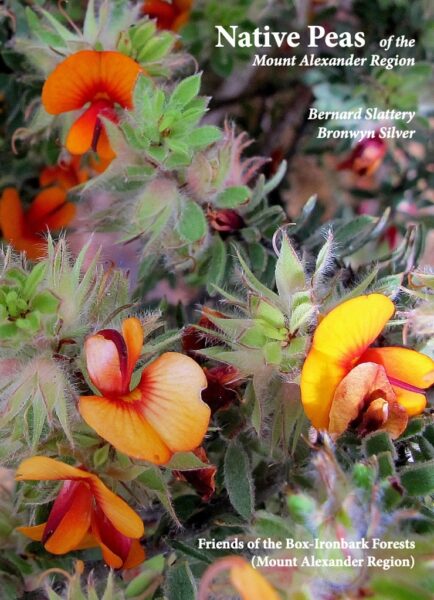
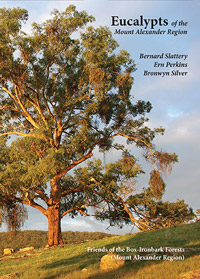 Click on image for info/order page
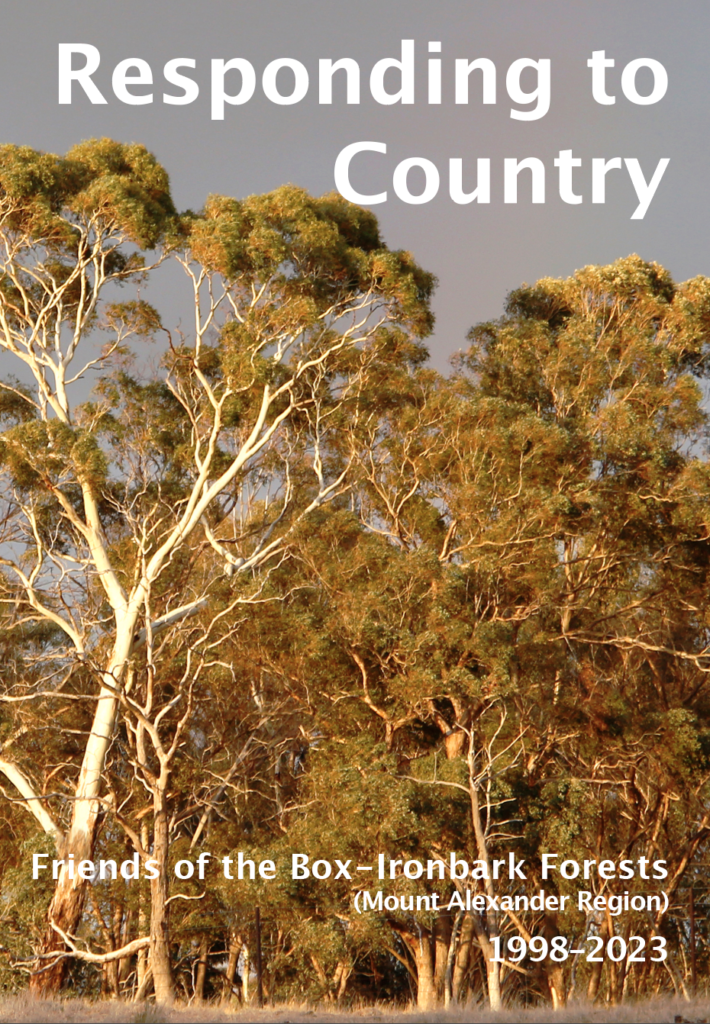
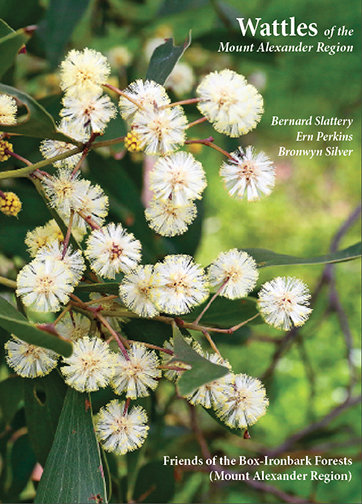 Click on image for info/order page