Winter–and a backward look

So it’s been the driest June on record around much of Victoria. Castlemaine weather station recorded 7 mls of rain for the month, compared to long term average of 56 mls. The previous lowest June rainfall was 13 mls in 1969. And it’s been pretty bleak into the bargain—rather too many grey but unproductive days.

There are interesting bright spots, however. For a few weeks now, large areas along Porcupine Ridge have been blooming with extensive stands of Woolly Wattle [Acacia lanigera]: quite a spectacular sight from the Ridge road:

The wattle season is on: dense Acacia lanigera regrowth along the Loop Track, July 3. It’s very beautiful, but casts doubt over the effectiveness of severe ‘fuel reduction’ burns.

Wattle stands in this area are dense and up to nearly two metres high—impossible to negotiate with any ease. Interestingly, this area was the recipient of a very severe DSE fuel reduction exercise in 2011–supposedly a ‘mosaic burn’– in which large areas of the fire zone were reduced to ash, and numerous big trees killed. Recovery has been patchy, with some areas showing good species regeneration. On the whole, however, it’s hard to escape the conclusion that this ‘reduction’ exercise has actually increased the fuel load. Dense shrub and tree regrowth has replaced tussock woodland, and the area is definitely harder to negotiate on foot than the adjacent unburnt areas.

Loop Track, November 2010: DSE’s fuel reduction exercise looked like a bushfire, and its long term effectiveness is doubtful.


Posted in Fire Management, Nature Observations | Comments Off on Winter–and a backward look

FOBIF AGM update

As outlined in a previous post, this year’s FOBIF AGM will be held at 7.30, July 10 in the Ray Bradfield Rooms. Details including how to nominate for the FOBIF Committee can be found here. Supper will be served and everyone is welcome.

Our speaker will be Brian Bainbridge, Ecological Restoration Planner, Merri Creek Management Committee. His topic will be Single species – many outcomes.

Single species conservation projects can have wide-ranging benefits when pursued in a holistic manner. Projects to secure local populations of Matted Flax Lily and Plains Yam Daisy have led Merri Creek Management Committee to build a deeper understanding of the Merri Creek’s changing ecology and the potential for landscape-scale conservation.  The projects have stimulated fresh approaches to engaging with community. 

Plains Yam Daisy

Posted in News | Comments Off on FOBIF AGM update

Winter reading

OK, it’s cold, and maybe not wet enough. Some quality reading to brighten a winter evening: the June newsletter of our neighbours, Wombat Forestcare, available online here.

Narrow leaf bitter pea, Castlemaine Botanic Gardens, Spring 2013. There are three Daviesia species in the Mount Alexander region.

This edition has the usual terrific info on fungi, the case against logging the Wombat and [among other things],  the third article in John Walter’s series on ‘egg and bacon’ plants. This one is on three species of Daviesia found in the Wombat: Hop Bitter Pea, Narrow Leaf Bitter Pea and Gorse Bitter Pea. All three can be found in the Mount Alexander region too. If you [like many of us] are frustrated by the difficulty of telling the difference between pea plants, you should find this article pretty useful.

Posted in News | Comments Off on Winter reading

Impressive regeneration along Campbells Creek

Ian Higgins led 18 people on a terrific walk along Campbells Creek last Sunday on the fourth FOBIF excursion for the year. The group joined the walking and cycling track at the back of Tonks in Lewis Drive, followed the track for several kilometres and then crossed the creek heading back through varied landscapes to the starting point.

Ian has been a driving force in the regeneration of this area as part of Friends of Campbells Creek Landcare over a number of decades. He gave an account of its history, identifying what had been planted, the progress of the plantings, and weeds that had been tackled. The efforts of many people have achieved a remarkable transformation of public land that used to be inaccessible, weed infested, and used for private grazing and rubbish dumping. McKenzies Hill Landcare Group has also been part of this project.

There were many highlights in the morning including the female flower of the Drooping She-oak and numerous large Hakeas in bloom.

Left, Female flower of Drooping She-oak, photo by Frances Cincotta. Right, Bushy Needlewood, photo by Noel Young.

The following photos were taken by Noel Young.

The next walk on 16 July will be through Faraday, taking in some interesting vegetation corridors with lovely remnant trees, and the shire’s only stand of Narrow-leaved Peppermints Eucalyptus radiata. Easy walking, about 7 km. For more information contact Bernard Slattery on 5470 5161.

Posted in News, Walks | Comments Off on Impressive regeneration along Campbells Creek

What can we learn from the ruins?

FOBIF has made a submission to the process of updating the Castlemaine Diggings NHP Heritage Action Plan [now known as the Heritage Landscape Management Framework].

Our view can be roughly summed up in the words of the old Heritage Plan: ‘The current forest setting is not an interpretive problem, but rather an interpretive bonus for the Park. It highlights the transience of mining, demonstrates the severe environmental impact that can result from inadequate environmental constraint, and illustrates some of the resilience of Australia’s native vegetation.’ [Our emphasis]

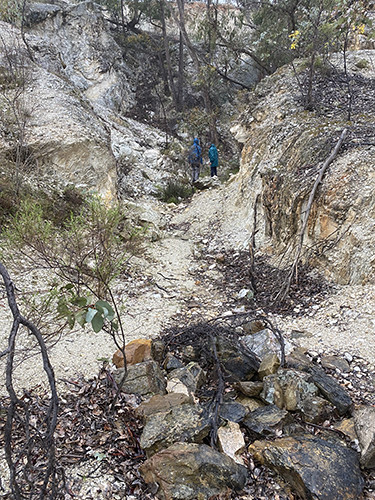
In Norwood Hill. This is not a natural scene, it’s part of our cultural history: the destruction of our waterways is part of the epic of gold, and needs to be explained to visitors.

Essentially, our submission urges consideration of the natural landscape as an important element in our heritage: consideration of mining ruins in isolation from the way mining affected the environment is to lose sight of one of the most important consequences of the gold rush: environmental change. That’s part of our heritage too.

The essentials of FOBIF’s submission are set out below:

Continue reading

Posted in News | 2 Comments