Become a citizen scientist

Bioblitz is a great opportunity for people to get out in the bush, parks or their gardens and become citizen scientists. It increases understanding and interest in biodiversity and contributes enormously to the scientific databases of thousands of species and their distribution. There is also the exciting possibility of finding a species new to science. You can find out how to be involved here

This year Castlemaine Field Naturalists Club is the host for the Castlemaine region project, comprising Mount Alexander Shire and the eastern half of Hepburn Shire. Local events are shown below. 

Posted in News | Comments Off on Become a citizen scientist

Roses, Bugs and Blue Wrens

A packed house attended FOBIF’s AGM last Monday to hear Cassia Read’s talk ‘Gardening the Goldfields: you can have your roses and Blue Wrens too?’

Cassia giving her talk. Photo Asha Bannon

A major theme in the info-packed talk was to present the garden as part of the wider environment, as well as an island in it. Of course, gardens meet the aesthetic, practical and emotional needs of the resident-gardener—but they also can provide food, shelter, water and habitat for local native wildlife. Cassia encouraged listeners to see their gardens as links in the neighbourhood to other gardens and to local bushland, critical stopping points for mixed-flocks of bushland birds, that forage across the local urban landscape.

Insects, bugs, and creeping things get a bad press generally, but they were heroes in this vision, signs and sources of health in the garden. Above all, the talk was not prescriptive: Cassia urged gardeners to open mindedly observe what was happening in the garden, to be prepared to try things, to look around the neighbourhood to see how their gardens could complement others.

One of the photos in Cassia’s talk: Julie Hurley’s fledgling garden.

We’re hoping Cassia’s talk will be a preview of a Gardening the Goldfields book FOBIF is looking to publish in…the near future.

Posted in News | Comments Off on Roses, Bugs and Blue Wrens

Last FOBIF walk for 2023

On Sunday Frances Cincotta led a large group on a short walk in the Fryers Range State Forest. Despite being cold it turned out to be good walking weather and the rain held off. The spring wildflower display was terrific and walkers loved the fascinating plant commentary by Frances during the approximately two hour hours that it took to complete the 2.7 km loop. She sent us this summary.

A good selection of native peas were in flower:  Common Wedge-pea (blue-grey buds and yellow flowers), and four of the so-called “bacon and eggs” species that have red and yellow within each flower: Dwarf Bush-pea, Matted Bush-pea, Showy Parrot-pea and Grey Parrot-pea.

We sorted out the differences between Hibbertia and Goodenia which both have yellow 5-petaled flowers but in Hibbertia the 5 petals are equally spaced while in Goodenia they are arranged ‘2 up 3 down’ (hence a Goodenia flower has only one axis of symmetry while a Hibbertia flower has many).  We also came up with a mnemonic device for the sepals: H for Hibbertia and H for Hasn’t got sepals attached to backs of petals and G for Goodenia and G for Got sepals ‘Glued’ to backs of petals.

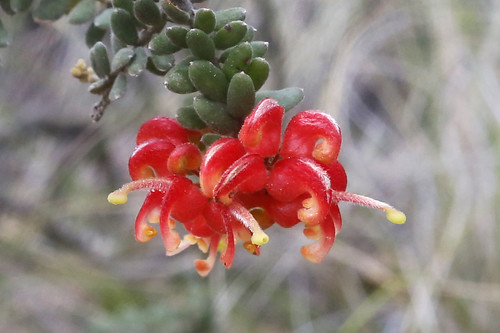
Flowering in the shrub layer were Daphne Heath, Heath Tea-tree and Fairy Wax-flower (all with white flowers), Downy Grevilleas (red flowers), and Rough Mint-bush (purple flowers), all in abundance.

Five types of everlasting daisy were in bloom: Hoary Sunray, and White, Grey, Sticky and Clustered Everlastings. Many of them adorned with “Cuckoo’s spit”. The bubbly foam is produced by the insect sheltering inside which is a  juvenile (or nymph) frog hopper also known as Spittlebugs. (See Liz Martin’s first photo below.)

We saw only a few Chocolate Lilies out in flower, one Bulbine Lily, one Yam Daisy/Myrnong, some Wax-lip Orchids and some Milkmaids out in flower. These wildflower were notably fewer in number and not as tall as seen in years with plenty of rain in the middle of the year. There was quite a variety of eucalypts on the loop walk, but the only species noted in flower was Red Box.

Our thanks to Frances for leading the walk and to Christine Henderson for letting us know about this wonderful corner of the Fryers Forest.

Once again Noel Young has compiled comprehensive field notes which include 17 bird species recognised by calls and 28 flowering plants. Photos below are by Liz Martin. 

Our next walk will be in March 2024. The 2024 walk program will be posted on this site in January. 

Posted in News, Walks | 1 Comment

FOBIF committee 2023-4

At the AGM the following members were elected unopposed to the FOBIF committee for the upcoming year:

President: Marie Jones; Vice President: Neville Cooper; Secretary: Bernard Slattery; Treasurer: Lynette Amaterstein; Committee members: Asha Bannon, Frances Cincotta, Christine Henderson, Jeremy Holland, Cassia Read, Bronwyn Silver, Jo Matthews

Posted in News | Comments Off on FOBIF committee 2023-4

Don’t look away

Local papers have recently carried items warning the public that snakes are about. Yes, they are, and the advice offered is good: be careful in areas snakes might frequent, control pets in such areas, be aware of correct procedures in case of a  bite, and so on.

Wheeler Street Castlemaine, September 20: more than five million reptiles are killed on our roads annually.

One piece of advice often missing is: watch out on the road. As we’ve pointed out numerous times, snakes are far more often victims than  aggressors. So, here’s our annual advice: keep an eye out for reptiles when you’re driving. [More than five million reptiles are killed by cars every year: see our Post]

Posted in News | Comments Off on Don’t look away