
FOBIF’s May walk: to the Res and back

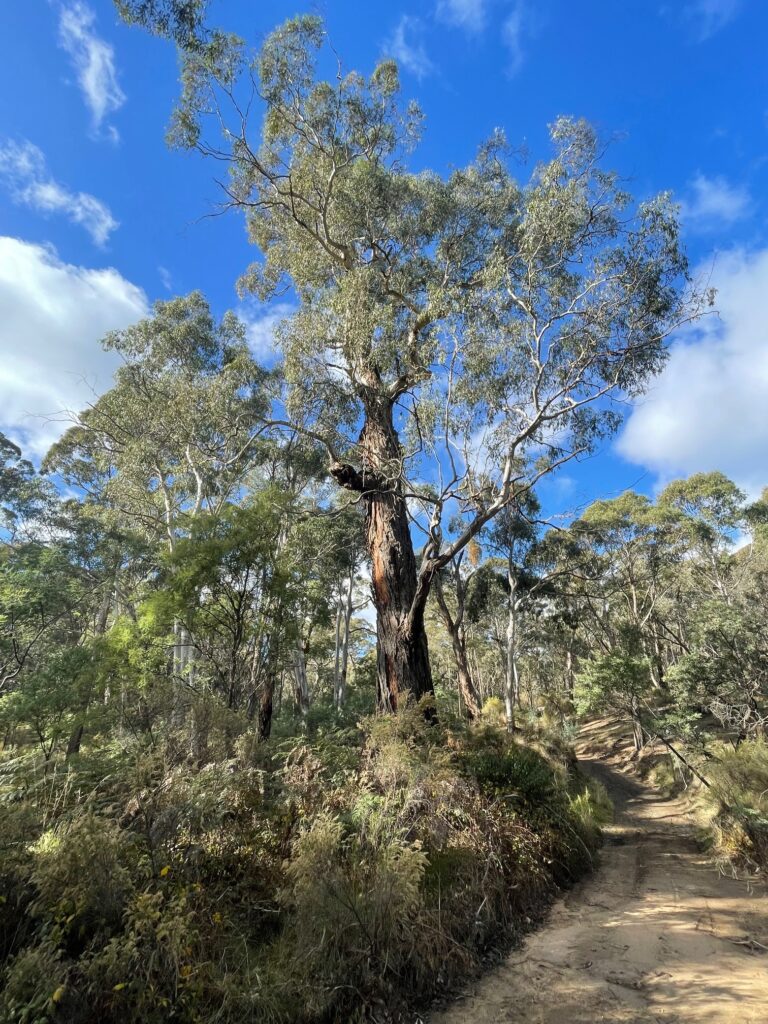
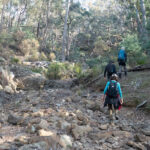
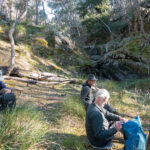
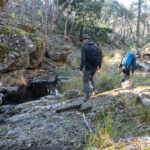
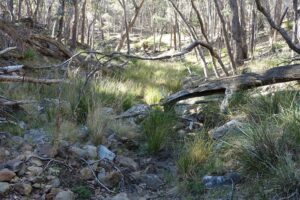
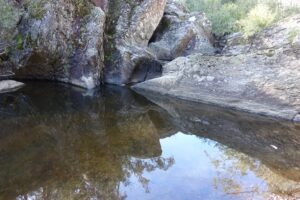
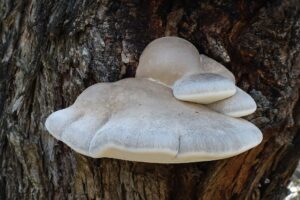
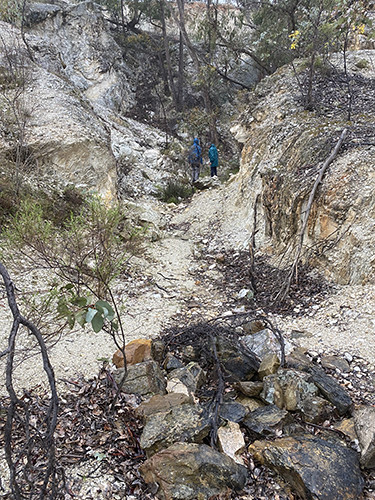
Our May walk next Sunday starts at the Monster Meeting site on Golden Point Road and follows the Forest Creek Track from Chewton to Expedition Pass Reservoir (Castlemaine Diggings National Heritage Park). We’ll meet at the Community House as usual to car pool, and pick up extra participants at the Chewton Post Office on the way to the starting point. See the program for details!

Posted in News | Comments Off on FOBIF’s May walk: to the Res and back

Stunning walk along the Loddon

Photo by Dominique Lavie

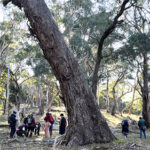
Walking north along the eastern bank of the Loddon River near Baringhup through stunning redgum trees on a beautiful sunny day, a sizable group heard stories of geology, Indigenous occupation, farming, hydrology, architecture, and natural history. Contributions to these stories were from the local farmers Kerrie and Rob Jennings, cultural historian and geologist, Barry Golding, and naturalist, Frances Cincotta. Sunday’s FOBIF walk was led by Gen Blades, Lisa Hall, Phil Robertson & Lesley Hodgson as part of a larger project of Walking the Loddon. 

Photos by Lisa Hall

Photos by Joy Clusker

Our next FOBIF walk along Forest Creek will be led by Marie Jones. Check our walks page for more information.

Posted in News, Walks | 1 Comment

The botanical life of a plant punk, and the story of a seaweed

The guest speaker at the monthly meeting of the Castlemaine Field Naturalists will be Professor Tim Entwisle.

Professor Entwisle is an author, botanist and former director of botanic gardens in Melbourne, Sydney and London. He also lived for a few years at Yapeen and completed his final years of secondary school at Castlemaine High School. His 2022 memoir “Evergreen: the Botanical Life of a Plant Punk” will be the subject of his talk this coming Friday. He will explain why he became a botanist (and phycologist) and some of the highlights of his three decades working in, and visiting, botanic gardens around the world.

Tim will also share with us the story of a seaweed (an alga) called Entwisleia bella, and how this came to be named after him. (He’ll bring some books for sale and signing).

It’s on  this Friday 12th April, 7.30pm, Uniting Church Fellowship Room, Lyttleton St. Castlemaine

All are welcome.

Posted in News | Comments Off on The botanical life of a plant punk, and the story of a seaweed

FOBIF walk, 21 April 2024

Loddon River, Baringhup: walk along stories

Walking along the Loddon River for 8 km, we go north from Baringhup. It is on public and private land with a mix of natural, cultural and historical layers. Traversing farmland and the edge of the Moorlort Plains, it is flat and gently undulating, there will be a few fences to climb and some unformed tracks. 

Meet at 9.30 am outside 30 Templeton Street, Castlemaine (Castlemaine Community House)  or 9.45 am at O’Sullivan-Tilley Memorial Park Baringhup Sturdy shoes, long pants and gaiters if possible, as it will be grassy and uneven with a few fences to climb.

Bring lunch and morning tea.

This is a one-way walk, and we have the Community Bus to shuttle people back to their cars.

For more info call Gen Blades 0431 371 065 or Lisa Hall 0488 102 191.

Posted in News | Comments Off on FOBIF walk, 21 April 2024

One for the Ages

A strong group took on FOBIF’s first walk for the year yesterday, to the Rock of Ages in the Nuggety Ranges. The recent dry weather has given the hills a real feel of late summer dustiness, but in this context the seven species of wattle observed stood out for greenery. The group also noted three species of mistletoe on a single tree. The views from Mount Moorul/The Rock of Ages are as always, spectacular. There’s something very special about this spot, enhanced by the presence of many bushes of the very rare Flat-leaf Bush-pea Pultenaea platyphylla. There are many reasons to return to this spot, one of them to see this species in flower (see first photo below).

Photos by Barb Guerin, Bernard Slattery and Bronwyn Silver.

Frances Cincotta sent us the following report:

“The walk was mostly under Long-leaved Box trees with some Grey Box, Yellow Box and Red Box. Walkers were challenged to count up how many Wattles we saw along the walk and we agreed at the end there had been 8 species,with Hedge Wattle being the most numerous, then some Gold-dust, Varnish, Lightwood, Spreading, Golden and  Black Wattles, and the introduced Cootamundra Wattle.

We were interested to see on one old Black Wattle tree three different species of mistletoe – Drooping, Grey and Harlequin. Mistletoes are very important local species from an ecological point of view as they are host plants for butterfly larvae, provide food for nectar feeders when they are in flower, and later berries for birds such as the Mistletoebird. Mistletoes are parasitic in that they tap into the vascular system of host trees, robbing them of water and nutrients, but usually they do not kill their host. Mistletoes are often called “hemi-parasites” as they do have chlorophyll in their leaves and make some of their own food.

There wasn’t much in flower on the walk – some of the Long-leaf Box trees bore cream flowers, and a few Magenta Stork’s bill added a splash of hot pink to the understorey, and amongst the granite boulders at the Rock of Ages were some Rock Isotomes still in flower (though they are at their peak in October). We expected the Rock Correas to be in flower but they all looked rather stressed and were not flowering yet. We were pleased to see the Flat-leaf Bush-pea plants doing well there – a threatened species.”

Our thanks to Bronwyn Silver for guiding us up the hill—and down again. And to Frances Cincotta for her entertaining pauses for plant identification.

Next month’s walk is to the Loddon River at Baringhup. Check the program for details.

Posted in News, Walks | Comments Off on One for the Ages