An abundance of Greenhoods

We are likely to have an exceptional few months of orchids this year. Hundreds of Nodding Greenhood rosettes can already be seen.

Nodding Greenhood rosettes in the South Walmer Nature Conservation Reserve. Photo by Bronwyn Silver, 24 June 2011.

An early flowering type is the Tall Greenhood Pterostylis longifolia, pictured here. Photos of other local Greenhoods can be viewed in our photo gallery.

Tall Greenhood, 10 June 2011.

Posted in News | Comments Off on An abundance of Greenhoods

A walk in the mist

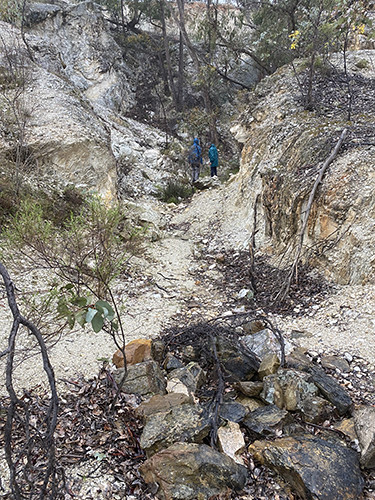
On June 19 twenty three hardy souls braved unpromising conditions to tackle FOBIF’s June walk in a remote corner of the Castlemaine Diggings National Heritage Park. In fact, however, the weather held nicely, and the group experienced some great moments walking the serene and misty ridges of the south end of the Park, sampling a stretch of the Goldfields Track through Stone’s Gully, and doing a bit of a scramble over Sebastopol Gully and through interesting relic mining sites.

The FOBIF group takes a break on a ridge north of Sebastopol Creek. They look a bit chilled, but in fact the weather was benign, and even a bit serene. Photo by Frank Forster, 19 June 2011.


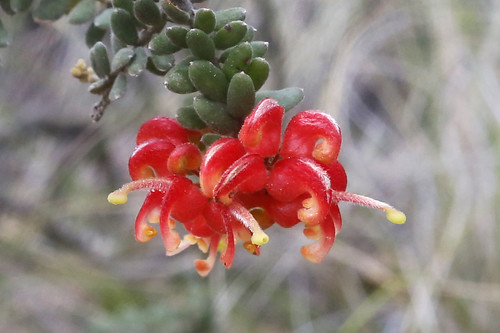
The dim winter’s day provided some good sightings of fungi and a few patches of the rare Fryerstown grevillea [not in flower], plus a surprising show of wildflowers, masses of hakeas in bloom being the highlight. And the rain held off till the precise moment the group finished the walk in the afternoon.

Posted in News | 1 Comment

DSE holds fire management workshop in Bendigo

Representatives  from the CFA, local government, The Wilderness Society, Bendigo Field Naturalists Club, Friends of Kalimna Park, North Central Victoria Combined Environment Groups [NCVCEG],  Apiarists Association and DSE attended a workshop on June 10 to learn about the process for implementing the findings of the Victorian Bushfires Royal Commission. Though FOBIF was not invited to this workshop, we were represented by members of some of the other groups. The following account of the workshop is taken from the notes of Richard Goonan [NCVEG]:

*******************

The Commission’s various recommendations are being implemented by different groups. This workshop focused in particular on recommendation 59 which includes:

– Provide a clear statement of objectives, expressed as measurable outcomes.

– Include an explicit risk-analysis model for objective and transparent resolution of competing objectives, where human life is the highest priority.

– Specify the characteristics of fire management zones-including burn size, percentage area burnt within the prescribed burn, as residual fuel loading.

– adopt the use of the term bushfire rather than wildfire.

As a result of implementing the recommendations, DSE’s  Code of Practice for Fire Management on Public Land (COP) will be reviewed and updated.

Continue reading

Posted in Fire Management | Comments Off on DSE holds fire management workshop in Bendigo

Word for the month: caespitose

Fungi field guides can disconcert the newcomer with their specialist vocabulary–in fact, learning about fungi seems to begin with the learning of a lot of new words to describe both the structure and the habit of a particular fungus. Some of these words are easy to absorb–for example, some guides, when describing fungi which appear in large numbers in the same place as ‘gregarious’ or growing ‘in troops’. Some are more technical–like caespitose, a word used to describe fungi which grow with their stem bases more or less joined. An example is the Mycena pictured below.

A caespitose cluster of Mycena clarkeana, Stone's Gully, Castlemaine Diggings NHP. Photo by Bernard Slattery, 19 June 2011.

The same cluster seen from above seems tightly clumped–or ‘densely caespitose’:

Caespitose clump of Mycena, seen from above

Posted in News | Comments Off on Word for the month: caespitose

DSE fire consultations begin

DSE has invited FOBIF, along with other concerned groups, to submit our ‘specific fire management issues, concerns and priorities as they relate to Fire Prevention Works’ in our area. This is part of the process of producing the draft Fire Operations Plan for the Murray Goldfields District. This plan will be made available for public consultation in August.

We have submitted the following list of issues to DSE. They are not necessarily in order of importance:

  1. We have ongoing concerns about the detailed management of burns: the escape of the Mount Alexander burn, apparently through inattention; the severity of parts of the Wewak Track burn, which seems to have generated more fuel [in the form of massive stringybark regeneration] than it removed; the crude approach to track making and mineral earth barriers [Smutta’s/Hunter’s Tk link] and the destruction of old habitat trees [Helge Tk, Wewak Tk and Hunters Tk].

Continue reading

Posted in Fire Management | Comments Off on DSE fire consultations begin