Ant behaving strangely

The ant pictured below is a member of the genus Rhytidoponera. The curious thing about it is that the creature is labouring to carry a shoot of moss [Pseudocrossidium crinitum].

Ant behaving strangely, Kalimna Park, February 2013


As far as we know, ants feed on other invertebrates and forage for such matter as honey. Moss somehow doesn’t fit the bill. The specimen above lugged its burden over difficult terrain for about a metre, then abandoned it. Any clues about this behaviour are welcome.

Posted in News | 1 Comment

Ever wonder where the soil went?

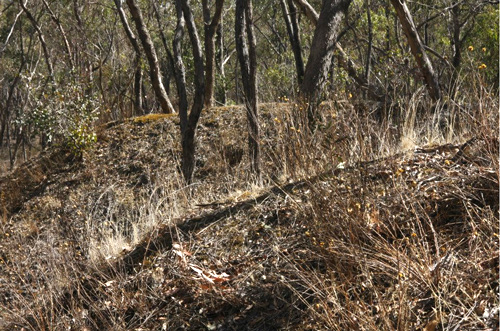
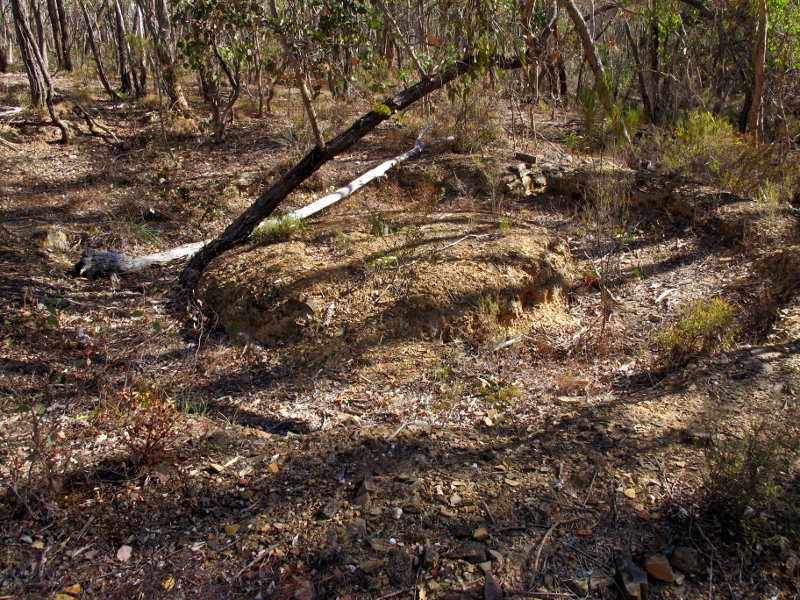
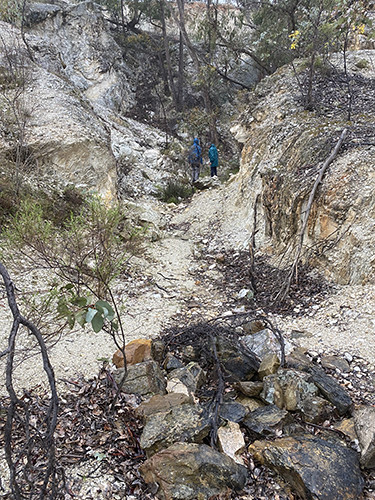
The photo below could be duplicated hundreds of times through our region: a tree sitting on a ‘pedestal’on the edge of a deeply eroded gully. When that tree was young, it was at ground level. So, where has all the soil gone?

Tree 'pedestal', German Gully: once this tree stood at ground level. Annual soil loss in most of Australia is estimated at one tonne per hectare, twice the rate at which it can be replaced by organic decomposition.


The obvious answer is, it’s been washed away downstream, eventually ending up in the Loddon, as a result first of nineteenth century mining works, and afterwards of a long process of erosion.  Here’s a report from the Mount Alexander Mail, August 27 1854:

‘The water in the Loddon was higher last week than it has been all the season. The puddling and sluicing on the banks of the stream have converted its once clear current into as muddy a state as many of its tributaries. It is said that the fish that were occasionally washed down Fryers Creek sunk to the bottom, as though suddenly deprived of motion, on reaching the earth-laden waters of the Loddon. Just now it is questionable whether any of the finny tribe can be found near the Junction.’

Almost all of our eroded gullies show a dual process: relentless erosion, and painfully slow build up of vegetation cover counteracting that erosion. In theory, land management policy encourages the second process to stop the first.

Continue reading

Posted in News | Comments Off on Ever wonder where the soil went?

Should prospecting be extended?

The State Government has directed the Victorian Environmental Assessment Council to nominate areas in six National and State Parks where recreational prospecting will be allowed. Details of the brief are here.

FOBIF has made a submission to VEAC, which reads partly as follows:

It is hard to believe that VEAC has been given such a brief without prior authority to investigate first the question, ‘should any additional areas be made available for recreational prospecting in our National and State Parks.’

Prospecting site, Castlemaine Diggings NHP: there appears to be no monitoring of prospecting in the Park. Ranger resources are too limited for any effective supervision, and there seems no way of controlling rogue prospectors.


Prospecting has been permitted in the Castlemaine Diggings National Heritage Park for about ten years. The Park’s Management Plan [2005-7] specifies that management ‘monitor the impacts of prospecting on cultural and natural values of the park’ and work with relevant groups to address the causes.’ [page 42]

It would seem logical that no decision about additional areas for prospecting should be made without first checking on the experience with the practice in this park.

What is the status of the monitoring of prospecting in the Castlemaine Diggings NHP? What conclusions can be drawn from it about potentially damaging practices?

Continue reading

Posted in News | Comments Off on Should prospecting be extended?

2013 Fungi program announced

One of Alison Pouliot's fungi images

Fungi expert, Alison Pouliot, has returned to Australia and will  be offering ‘a series  of seminars, workshops, forays and feasts’ in April and May. Most are reasonably close to Castlemaine – Glenlyon, Woodend, Trentham and Creswick.

So if you’re interested in finding out more about this curious kingdom, have a look at her 2013 program.

Posted in News | Comments Off on 2013 Fungi program announced

FOBIF loses at VCAT on Diamond Gully development

The objections by FOBIF and some local residents to current proposals to build a housing development at Diamond Gully were rejected at the Victorian Administrative Appeals Tribunal in December.

The VCAT decision was reported in detail in the Midland Express [December 11]. FOBIF made a submission, but was not represented at the appeal hearing, and the panel’s findings did not refer to our grounds of objection. These were, in substance, to do with fire and forest health.

It’s worth repeating that FOBIF has consistently made plain that we have no objection to a housing development in this area—consistent with protection of high quality bushland, and avoidance of high fire risk placement of housing.

Bushland near Castlemaine: evidence submitted to the Royal Commission showed that houses closer than 50 metres from the bush stood a 50-60% chance of being destroyed under extreme bushfire conditions.

Our submission read, in part:

‘The CFA had previously made an assessment of an adjoining subdivision west of this proposal [Friends of the Iron Bark Forests v Mt Alexander Shire [2011] VCAT 2181 (22 November 2011)]. The CFA assessed the vegetation here as being “Medium Forest” and hence requiring a defendable space of 50 or 60 meter…

‘With this proposal the surrounding forest to the west and the south is the same forest block as for the adjoining subdivision but here the CFA has required a defendable space of 30 meter …The defendable space for this subdivision needs to be at least 50 meter as it was for the adjoining subdivision.’

On this subject, the following comment on fire danger to housing by Macquarie University researchers is worth quoting:

‘The single variable that explains most of the vulnerability of a home to bushfire is its distance from the bush. Research conducted by Professor John McAneney and Dr Keping Chen in 2004 and 2010 mapped the location of houses destroyed in some major historical fires and their distance to the nearest bushland interface.

Continue reading

Posted in Fire Management, News | Comments Off on FOBIF loses at VCAT on Diamond Gully development