Seen any good flowering Ironbarks lately?

Ironbarks are flowering attractively along the Pyrenees Highway between Castlemaine and Chewton, but they aren’t what we’re looking for. These beautiful trees are Eucalyptus sideroxylon, Ironbarks native to country from northern Victoria through to Queensland. We believe they were planted along the highway some years ago by  Castlemaine Rotarians.
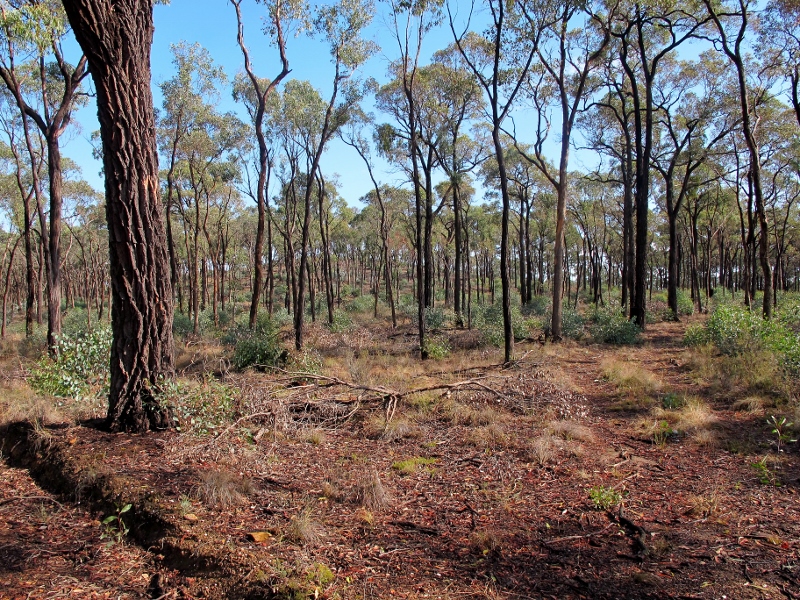
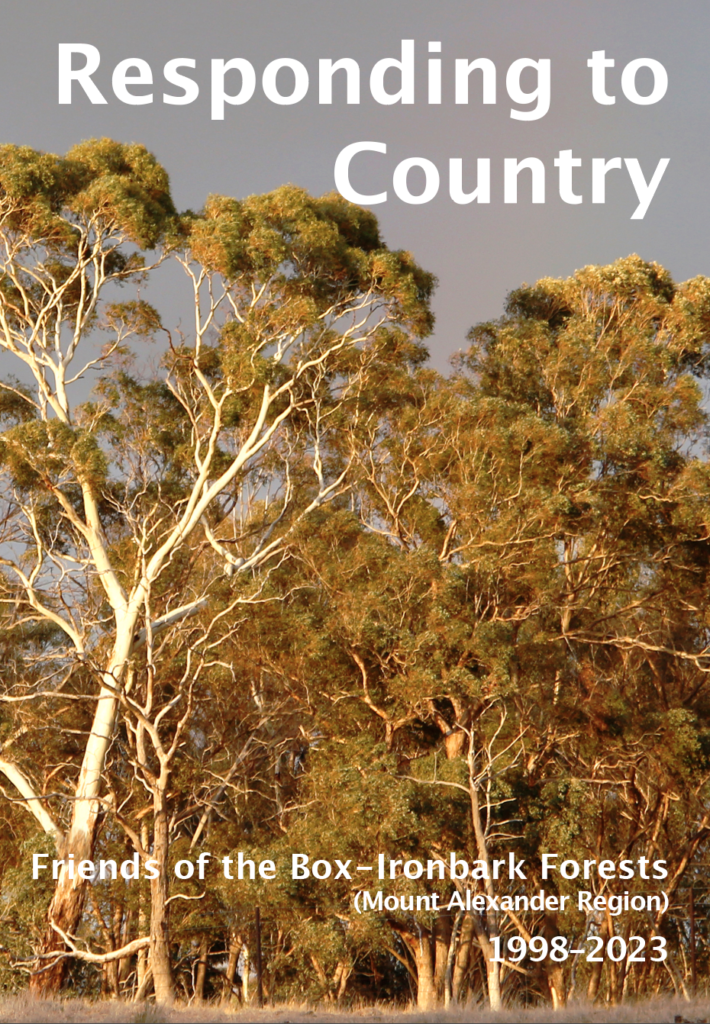
Eucalyptus tricarpa in the Muckleford Forest: a noble and characterful tree, but not an easy one to photograph

Eucalyptus tricarpa in the Muckleford Forest: a noble and characterful tree, but not an easy one to photograph

What we’re looking for are locally indigenous Ironbarks –Eucalyptus tricarpa—which are also supposed to be flowering now, but are a bit hard to find in that state…especially because we want trees with flowering branches conveniently drooping close to the ground. It’s not the flowers we’re mainly interested in, but the buds and fruits. We want to take photos of these features of the tree, to use in our ongoing project to produce a guide to local Eucalypts–and unfortunately for us, this particular tree has the noble habit of standing up very straight, making it hard for photographers to get close to its foliage.

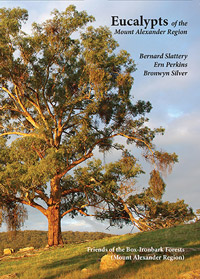
Our Eucalypt project is aimed at producing a guide which will be accessible to absolute beginners in what can be a very confusing field. It will cover Eucalypts native to the Mount Alexander region.

FOBIF was recently pleased to receive a grant via the Norman Wettenhall Foundation to finance this project. This, together with support from Connecting Country and the Castlemaine Field Naturalists, will enable us to produce a guide which will, we hope, be helpful even to complete beginners on the subject.

Any tips? Send us an email to info@fobif.org.au As a rough indicator, local Ironbarks have cream flowers, usually in groups of three.
Posted in Nature Observations | Comments Off on Seen any good flowering Ironbarks lately?

FOBIF school holiday program

FOBIF is running three nature-based events for primary school children in the upcoming school holidays.  Places are limited and booking is essential. Information about the program can be found on this FOBIF page.

Posted in News | Comments Off on FOBIF school holiday program

Amanda’s Track: Fire’s off

The 409 hectare fuel management burn planned for Amanda’s Track, at the southern end of the Castlemaine Diggings NHP, has been removed from DELWP’s operations plan. It’s been removed ‘based on a values assessment and field checks.’

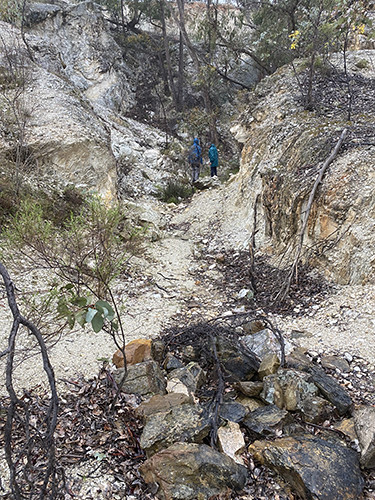
Moss covered hill near Middeleton Creek, in the Amanda's Track zone: it's time areas like this were subject to serious and transparent risk assessments.

Moss covered hill near Middeleton Creek, in the Amanda’s Track zone

We’re not exactly sure what the quoted reason means, but it seems like a good decision. This was one of the largest burns planned for this region. FOBIF has always been sceptical of its fire protection value, and extremely nervous about its destructive possibilities. The fire would have covered all the land south of the Wewak Track not already burned in the Department’s extremely severe to disastrous fires in the Tarilta Gorge and Loop Track over the last few years.

This section of the Diggings Park, centred on Brown’s Gully, is one of the jewels of the region,  for its relative isolation, heritage value and natural beauty. It’s never been really clear why this [and the adjacent zones] were in the Fire Operations Plan. It’s to be hoped that the State Government quickly adopts the risk management strategy recommended by the Inspector General for Emergency Management; and that under such a strategy management proposals for areas like this can be more transparent and convincing.

Posted in Fire Management | 2 Comments

Grooming Kalimna

As of today, Parks Victoria has started on a program of grooming vegetation in Kalimna Park along the town edge and Moonlight Creek. The program aims at eliminating mainly exotic weeds as a fire protection measure [creating a roughly 50 metre wide border along the town edge], and removing blackberries and other weeds along the creek .

Groomed area near Bull Street: the removal of vegetation is part of a package of fire management actions.

Groomed area near Bull Street: the removal of vegetation is part of a package of fire management actions.

Parks also intends to conduct a fuel reduction burn on Kalimna Point, but we’re not sure when or how this will be done. The Point is a problematic area: to quote from the website of the Friends of the park: ‘Kalimna Point is close to the town and from the early days was a destination for residents to visit as it allowed good views of the district. Between 1903 and the late 1920s the community planted a mix of European and Australian trees around the point and set up benches, a rotunda and a direction finder. Remnants of these avenue plantings and paths still exist.’

The views referred to are now blocked by Sugar Gums and other exotic planted trees. The Point is a bit of a sad relic of its former glory but is not without its charms, a colony of Eltham Copper Butterfly being one: and it’s still very popular with walkers. The Friends group has recently embarked on work on the Rotunda, and there’s definitely potential—with sensitive management—for a site of great recreational and botanical value there. See http://www.kalimnapark.org.au/friends-of-kalimna-park-castlemaine/

Posted in News | Comments Off on Grooming Kalimna

Mt Alex bike track on track, but land status uncertain

The 2015 State budget papers show that the Government’s Regional Infrastructure Fund is to be used to provide money to advance the design and construction of mountain bike tracks on the lower slopes of Mount Alexander.

As we have previously reported, the Mountain Bike Park is to be constructed in the Harcourt plantation, currently under management of Hancock Plantations, but soon to revert to public hands. You can find a map of the proposal here.

Previously, we had been led to believe that the plantation would be incorporated into the adjacent Mount Alexander Regional Park; it now appears that Parks Victoria is not keen on this move, and perhaps for good reasons. Legislation governing these parks includes the aims ‘to   preserve, protect and re-establish indigenous flora and fauna in the park’  and to ‘control exotic flora and fauna in the park.’ Given that we’re talking about a pine plantation, integration of the plantation would put park managers in a peculiar situation.

We’re not sure who will end up being responsible for the land–presumably it will be DELWP, once the plantation lease expires. The development proposal involves the construction of 16 trails totalling 34 kilometres, essentially around the contours of the site. We’ve been assured that the tracks will not spill over into the Regional Park. Currently there is some rogue bike riding on the steep upper slopes of the Mount. One of the challenges of track designers [and managers of the Great Dividing Trail] is to devise credible trails to divert riders away from destructive routes: and one of the challenges for Parks Victoria is to make sure the Park is protected effectively.

Posted in News | Comments Off on Mt Alex bike track on track, but land status uncertain