“Mum look out, don’t touch!”

A recent visit to our local patch and bush cubby saw a near miss for me and the realisation that the bush in Campbells Creek seems in distress. On our way up the trunk of our unusual, almost horizontal Candlebark ’friend’, my daughter said, “Mum look out, don’t touch!”

Her six year old eyes, sharper than mine, had spotted a Cup Moth caterpillar or Doratifera sp.

She was right in warning me, the caterpillars, often known as ‘stingers’ or ‘stinging joeys’ have  spines that can inflict a sharp and painful sting, rather like a nettle. When I looked around I noticed there were many caterpillars of the same species heading up the trunk and into the canopy, which appears much more open than usual, presumably they were heading for lunch.
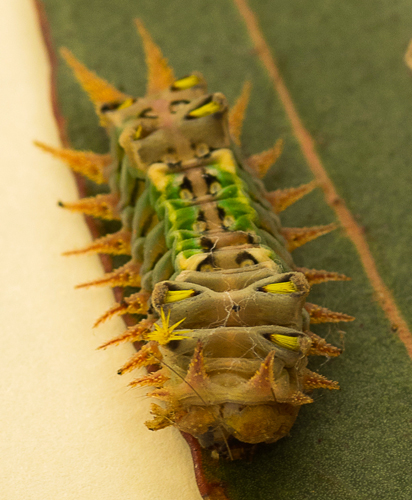
Cup-moth

Cup-moth caterpillar. Photo by John Ellis

Cup Moths are forest insects and at times have been responsible for severe damage to Eucalypts in Victoria. Sometimes they also become pests on garden trees, especially fruit trees such as apricots, apples and cherries. Back in August 2012 FOBIF reported finding the Cup Moth in a large tract of defoliation in the south end of the shire.  

Cup moths belong to a small group of moths that have unusual slug-like caterpillars with clusters of spines on their bodies that are often beautifully marked and coloured. Their name comes from the cup shaped cocoons made by the caterpillars when they pupate.

Young caterpillars feed by skeletonising the leaves while older caterpillars eat the whole leaf often leaving only the midrib.
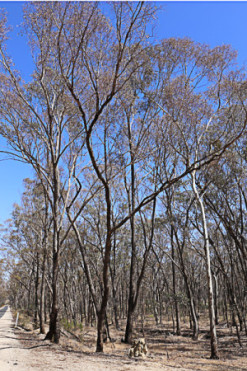
defoliated-trees-along-the-Castlemaine-Muckleford-Road.-IMG_0646

Defoliated trees along the Castlemaine-Muckleford-Road

It is the caterpillar (larval) stage that causes the damage. Many leaves are completely or partially eaten and many more are cut off and fall to the ground. Caterpillars are usually present in small numbers but sporadic outbreaks may cause severe damage with trees completely defoliated over a large area. However, unless attacks occur over 3-4 successive years the trees usually recover.  

Long time resident the late Doug Ralph responded to our 2012 post by recounting an outbreak ten years prior and a long break in occurrence in between. These recent attacks coupled with the very dry weather though may have a more serious effect on the health and survival of the trees.

Cup Moth caterpillars are very susceptible to viral diseases and sometimes entire populations are killed. Viral disease is the most common natural control of Cup Moth caterpillars. Outbreaks of disease usually occur when weather conditions are warm and humid and when there is overcrowding and shortage of food. Affected caterpillars stop feeding and the body swells with the body contents liquefying and the skin eventually splits and releases the contents over the leaves. Other caterpillars can then become infected.

Natural predators can include parasites, wasps, flies and occasionally, birds.

It is distressing to see the damage done by these animals. Coupled with an asset protection burn and drier weather, the bush in our patch at Campbells Creek seems to be really up against it. I wonder what changes my daughter will see as we continue to visit our cubby into the future.

This post was written by Naomi Raftery with most of the factual detail provided by Marie Jones. If readers have any further information on cup moths or would like to share their stories of personal encounters with them we welcome contributions.
Posted in News | 1 Comment

Befriending our frogs

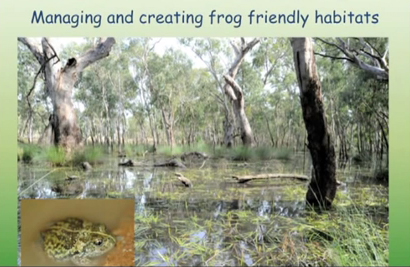
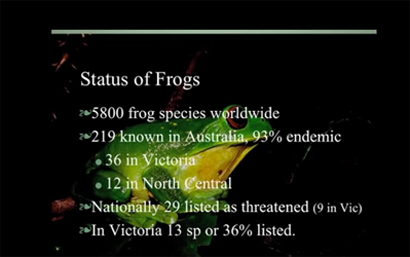
Elaine Bayes and Damien Cook who led our last FOBIF walk in Chewton have produced two terrific youtube videos:’Frogs and their Calls’  and ‘Frogs and their Habitats’. The information is well presented and relevant to our local area. Each goes for about 30 minutes. Click on each image below to view.

Elaine

Damien

Posted in News | Comments Off on Befriending our frogs

Geology excursion this Saturday

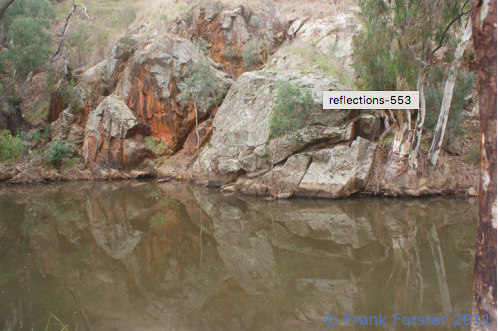
Muckleford Landcare has organised an excursion for November 14 which will take in Mount Gaspard and the Muckleford Gorge. FOBIF members might remember a fascinating walk we had in the Muckleford Gorge in 2011. The following text is taken from the Muckleford Landcare website:

There are still a few places left on the bus next Saturday for our geology excursion.

This should be a fascinating and revealing experience. Our first stop will be the summit of Mount Gaspard at the north of the valley. Mount Gaspard is on private land and the view is immense. Thanks to the generosity of the Huzzey family we will have access to a spectacular panorama of the whole valley and its larger geological setting.

We will travel down the Chinaman’s Creek valley until it connects with the main Muckleford valley and then follow the famous and significant Muckleford Fault south until we conclude our journey at the Muckleford Gorge. Once again we will have access to private land to view this beautiful and surprising place and for that privilege we thank the Garsed family.

To find out more about the day click here.

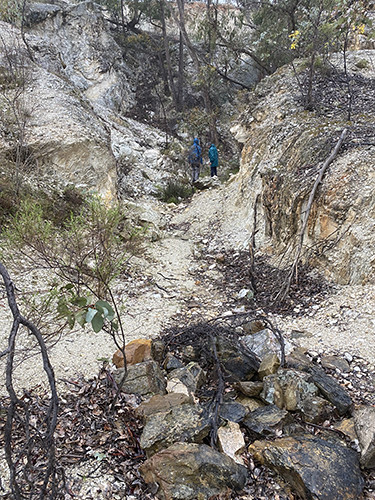
Frank Forster took this image of the Muckleford Gorge on the FOBIF walk in 2011. Due to the current drought we are unlikely to see much flow this year.

Frank Forster took this photo of the Muckleford Gorge on the FOBIF walk in 2011. Unfortunately with the current drought we are unlikely to see much flow this year.

Posted in News | Comments Off on Geology excursion this Saturday

Reprieve for ‘The Big Tree’

The Guildford Progress Association has received news that their concerns about the proposed work on The Big Tree have been heeded. The following is an excerpt from a recent letter to the Association from the Shire:

Due to the continued concerns of the Guildford Progress Association regarding the arboricultural works proposed by Council on “The Big Tree”, I wish to inform you that these works have been postponed.

 Council has commissioned an independent arboricultural assessment of the tree.  The consultant will provide Council with a report and any recommended works.  I will ensure that the Guildford Progress Association is kept informed of any intended works on or at the site of “The Big Tree”.

We will keep you informed about any further developments on this issue.

Posted in News | 1 Comment

Heritage: um, what about us?

Whatever its merits, VEAC’s draft report on heritage places is notable for one baffling deficiency: its failure to consider landscape as a heritage ‘place’. More specifically, it’s clear that the Castlemaine Diggings National Heritage Park is considered, in this report, to be a collection of mining sites, not a landscape.

How can we tell this?

Table 2.2 of the document lists heritage places by type. ‘Landscape’ is declared to have only one sample of this type. What is it? To find out, we go to Appendix 2, where the only example listed is Tower Hill State Game Reserve.

How has VEAC, whose responsibility has largely been in environmental matters, managed to exclude landscape from its considerations?

The answer is to be found on page 30, in a discussion of Indigenous views:  ‘It is important to note that although VEAC’s focus is on the management of specific places on public land, Traditional Owners customarily have a broader view that every part of the landscape is of significance, including landforms and the whole landscape itself, not only those places where associations are evident or documented.’

It seems that VEAC hasn’t been able to adopt something like this broader view itself. It looks like the Diggings Park, as a landscape, has slipped into the too hard basket.

This is a curious deficiency. The Park is described by Parks Victoria as ‘the largest non-indigenous protected cultural landscape in Australia.’ Its National Heritage listing, bland though it is, offers this: ‘Situated within regenerating box-ironbark forest, the mining remains and habitation sites immediately convey to the visitor a feeling of passed [sic] ways of working and living. The great number and extent of remains reinforces to the visitor the historical significance of the goldfield. The degree of alteration of, and intervention in, the natural landscape makes a strong impression on visitors. The Castlemaine diggings are a place of strong aesthetic significance. The attributes include the wide expanses of regenerating box-ironbark forest, the landforms of hills, ridges, gullies, creeks and rivers, together with the multitude of mining and habitation remains…’ The Victorian Heritage listing says: ‘The land and its regenerating Box-Ironbark forest is important scientific evidence in its own right in demonstrating a spectacular event of transformation of the pre-gold rush environment.’

Why does all this matter? Continue reading →

Posted in News | 1 Comment