The migratory birds of the Box-Ironbark Forests

In the Box-Ironbark forests quite a few bird species come and go with the seasons. Over many years a lot of people have contributed to surveys for the Birds Australia Atlas or Birdline and similar. These records have now been put together and presented in a variety of ways, including interesting animations of the migratory patterns of birds. This is all part of the Greater Eastern Ranges Initiative (GER). Although based in NSW, their web site presents useful information about bird migrations in our area as well.

Why do birds migrate? Lots of reasons such as food availability, weather and suitable nesting sites. How they actually manage accurate navigation is another issue altogether, with lots of research aimed at working out this puzzle.

So, let’s have a look at some of our local migratory birds.

Grey Fantail. Photo by Damian Kelly, December 2011

Although some of these birds seem to be resident all year, the majority move further north for winter. Click here to see how Grey Fantails move around.

Scarlet Robin. Photo by Damian Kelly, December 2011

Both the Scarlet and Flame Robins move in and out of this region with quite marked changes in area between the seasons. Click here to see where they go.

Rainbow Bird. Photo by Damian Kelly, 2011


A real long-distance traveller, the beautiful Rainbow Bird (or Rainbow Bee-eater) can travel from as far afield as Papua-New Guinea, the Solomon Islands and Indonesia down to Newstead and beyond. Their movements can be viewed here.


Swift Parrot. Photo by Deb Worland, 2008


And of course the box-ironbark area is well known for the Swift Parrot – a regular winter visitor, particularly around Muckleford. There is still a lot to learn about this species. Their movements can be viewed here.


Useful links if you want to contribute to a bird survey: BirdlineBirds Australia Atlas project and Greater Eastern Ranges Initiative.

Posted in Nature Observations, News | Leave a comment

Scottish, but not Scotch

The plant below is Spear Thistle, Cirsium vulgare, the most widespread plant in Victoria and, according to naturalist Ern Perkins, by far the most common thistle in this region. It’s commonly but wrongly called Scotch thistle. That ‘honour’ belongs to a vaguely similar looking plant, Onopordum acanthium which, interestingly, isn’t of Scottish origin at all, and is not even common in Scotland–unlike Cirsium, which is. Figure that out: or, if you can’t, check out the Viridans data base, which has some curious facts about the legend surrounding the name ‘Scotch thistle.’ [As far as we know, the Scots never refer to themselves or anything in their country--even whisky-- as 'Scotch', anyway.]

Cirsium was one of the earliest plants to be declared a weed in Victoria, in 1856. Our photo was taken in a management burn zone at the south end of the Diggings Park, where FOBIF members have pulled out many plants vigorously regrowing in the ash.

Spear Thistle, Wewak track, Castlemaine Diggings NHP, December 2011

Posted in Weeds | Leave a comment

The uses of fire

FOBIF has written to Parks Victoria to clarify some questions arising from the Quartz Hill, Chewton, Asset Protection management burn of a few weeks ago.

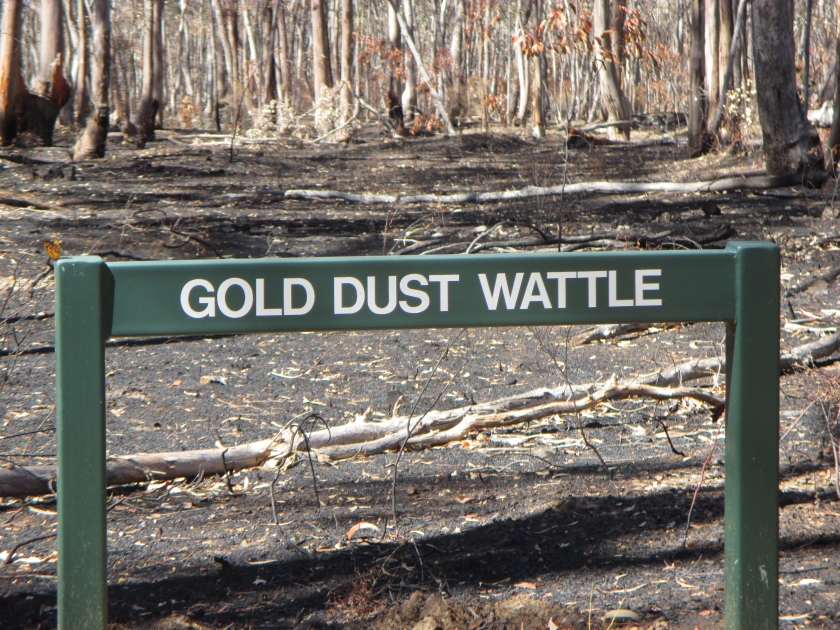
What interested us was that the burn was pretty severe on native undergrowth [as was indeed its purpose], but relatively feeble on the blackberries, gorse, bridal creeper and pampas which infests the area in question [see photo below].

Members who have read our post on DSE’s new code of conduct will know that we are at a loss to know why the Department cannot be more systematic in using fire to clear out what we all agree are unwanted–and flammable–elements in our bushlands.

Singed but not seriously: blackberry near the Quartz Hill track after the management burn. A couple of hundred metres behind the photographer, the native undergrowth is flattened.

In the case in question, the management fire burned deeply into Sailor’s Gully, but somehow failed to clear out gorse along the gully; and it completely failed to make an impact on large patches of blackberry in the lower gully. Obviously this is a function of the relatively low flammability of this vegetation at this time, but at the end of a hot summer this stuff is just as much fuel as a stand of Dusty Miller: we believe that the Department should be as enthusiastic to get rid of it now as it appears to be to get rid of native fuel.

We’ll publish Parks Victoria’s reply when we get it.

Posted in Fire Management | Leave a comment

Remnant Vegetation: the State Government responds to VEAC

The State Government has released its response to the Victorian Environment Assessment Council’s  Remnant Native Vegetation report [see our May 24 Post on this].

VEAC made 13 recommendations, all designed to improve ecological connectivity between small parcels of land, encourage community involvement in management, maximise knowledge of biodiversity values and protect waterway frontages. The Government has supported twelve of the recommendations ‘in principle’, the exception being recommendation 12, to investigate the creation of new protected area systems in the North Western Victoria, Gippsland and the Central Victorian Uplands. What the in principle support means in practice remains to be seen.

VEAC’s recommendations and the Government’s responses can be found here. All are of interest. Among other things, the Council recommended that within 10 years ‘at least 75 per cent of public stream frontages abutting private land be managed, under grazing licence or other arrangements, primarily for biodiversity and water quality’ via measures like fencing out of stock, revegetation, and management incentives.

The Government also accepted recommendation 6, that ‘Managers, contractors and on-ground workers are made aware of their responsibilities and appropriate work

Lichen--probably Xanthoria sp--on a Cassinia stem in the Guildford Bushland Reserve. Such small parcels of public land are often unknown or hard to find, and their values unrecorded. VEAC has recommended that their ecological value be identified, mapped and made public. Photo:Bernard Slattery, December 2011

protocols whilst working around native vegetation, and that mandatory formal education and training be incorporated into all accredited training courses.’  Such training programs already exist, though they are patchy in their effectiveness, if we are to believe the evidence of road works and other activities in our local bushlands: but we can hope that the State Government’s ‘in principle’ acceptance of VEAC’s recommendations will bring about some improvement in the culture of land management.


Posted in News | Leave a comment

VCAT decides on Diamond Gully subdivision

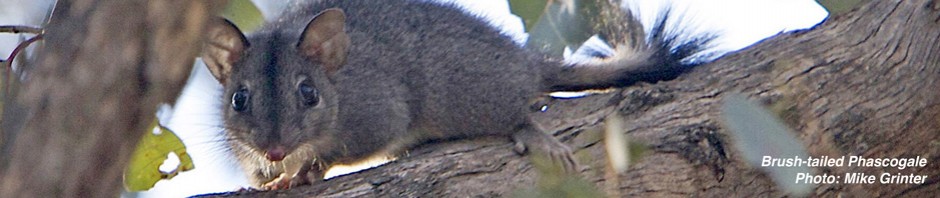
Local residents supported by FOBIF went to VCAT to review a Council decision to grant a permit for a 7 lot subdivision in high conservation bush at Diamond Gully (on the western edge of Castlemaine). The development will involve the clearance of 2.4 hectares of bush that has been recognized by the DSE as being used by the threatened Brush-tailed Phascogale. On the 22nd November, VCAT decided to support the subdivision but with conditions.
Recent VCAT decisions have tended to reject housing estate proposals for areas containing high conservation significant vegetation. In this instance the VCAT member decided to allow the subdivision to proceed, but applied conditions which he thought would produce positive environmental outcomes:
· The development is to be a cat free zone.
· The number of lots is reduced to 6.
· There is to be no internal fencing between lots, other than fencing off domestic areas. This is to encourage wildlife movement.
· Part of a Management Plan will be to install nesting boxes on the site.
FOBIF remains concerned that in this Shire, the only way to get permit conditions on a development proposal that respect the environmental conditions on the site, is to seek a review of a Council permit at VCAT.
Posted in News | Leave a comment

Sharing the same nesting area

Eroded creek banks, although a blot on the landscape in some ways, also have their upside. At this time of year two quite different species utilise the eroded walls to build their nests at the end of tunnels in the soil. Whilst checking out the Rainbow Birds the other day I also saw two Striated Pardalotes diving in and out of their nest, quite close to the larger tunnel of some Rainbow Birds. One of the pardalotes spent quite a bit of time with wings outstretched as in the photo. Not sure why, but it made for a nice shot.

Rainbow Bird. Photo by Damian Kelly

Striated Pardalote with wings stretched. Photo by Damian Kelly

Nearby another small bird was calling – the Mistletoe Bird. Small, but quite striking in coloration. These birds are probably more common than you might think, but because they flit quickly high up in the foliage they are often hard to see.

Mistletoe Bird. Photo by Damian Kelly

A raptor at Kalimna

At the other end of the size scale, this beautiful Black-shouldered Kite has been resident on the edge of Kalimna for the past few weeks, often to be seen early in the morning sitting up high surveying the grass for its next meal, and watching me as I water my vegetable garden.

Black-shoulderd Kite. Photo by Damian Kelly

Posted in Nature Observations, News | Leave a comment

Connecting Country to host new landcare position

Connecting Country is one of 60 organisations in Victoria that have been successful in their bid to host one of the new Landcare Facilitator positions. The new local facilitator will be part-time and will work with landcare groups in the Mount Alexander Shire.

Hosting this position will enable the work that the Connecting Country is already doing with landcare groups to be strengthened and extended.  Further details about the new facilitator will be posted on the Connecting Country website as soon as available.

For more information on these new positions see the media release from the Minister for Environment and Climate Change. More information

Posted in News | Leave a comment

How good is the new Code of Practice?

DSE’s new Code of Practice for Fire Management on Public Land has been out for consultation for some time now. The document can be found here. As we signalled in a previous post, we have had preliminary misgivings about the new draft.

Our misgivings relate to compliance matters [how can we be sure workers on the ground are going to observe the Code?], and about weakening of requirements for ecological management in Zone 2 burns. It is also unfortunate that the sensible requirement that priority be given to protection of human life has, it seems, been seen as a licence to sacrifice ecological values–which are also, in the long term, crucial to human life.

Our final submission on the Draft document is given below. The headings are the ones supplied by DSE as a template for all submissions:

1. Does the Draft Code provide an effective framework to achieve its purpose? [This purpose is set out in paragraph 3 page 1 of the Draft]

The question should be, Does the Code provide a sufficiently effective framework? Although there are good features in the draft, the framework throughout, especially in its fuel management chapter, assumes that we will act now [to ‘reduce fuel’] and find out later whether what we are doing is effective or counterproductive. It is significant that there is nowhere  in the document any reference to what DSE has found out about its fuel reduction programs over the last forty or so years. This is probably because the research required by the 2006 Code has never been done, that the long proclaimed policy of

Continue reading

Posted in Fire Management | 1 Comment

Put it on the wall

FOBIF and Connecting Country have produced a good quality colourful A2 poster containing 63 photos highlighting the beauty of our local bushlands. Members of FOBIF and/or Connecting Country can buy it for $15 from Connecting Country at The Hub 14/233b Barker St (entry through glass door on Templeton St— Please bring exact money). The poster is also available from Stonemans Bookroom and the Castlemaine Tourist Information Centre in the Market Building. Click here to see a larger version of the poster.


Posted in News | Leave a comment

Out of the ash

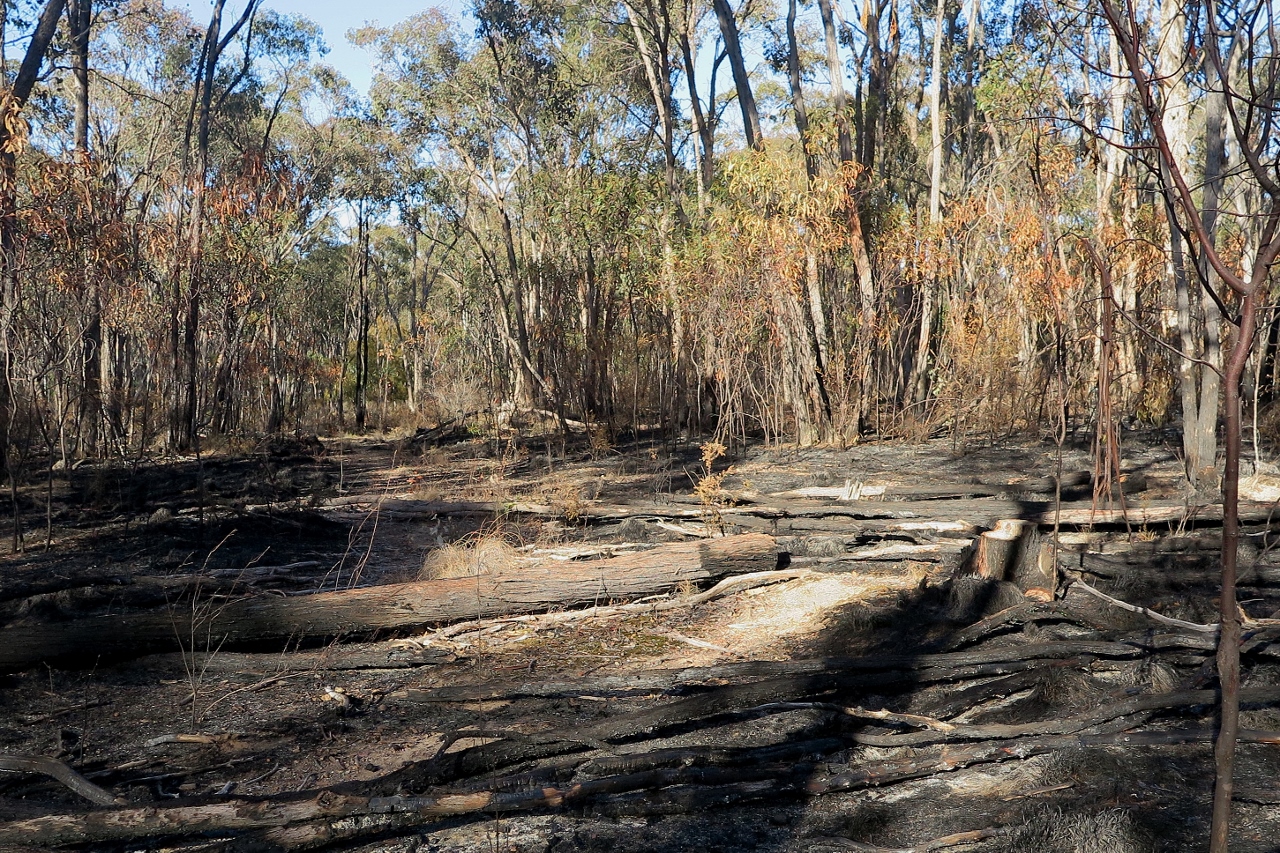
The asset protection burn conducted at Quartz Hill Chewton in late November has, as planned, produced a pretty bare landscape over about 140 hectares, plus what looks like some spotting outside the planned zone.

One reason to visit these burns is to observe how the landscape responds to them. And one indicator of burn severity seems to be outbreaks of the fungus Pyronema omphalodes. This appears as a pink or smouldering orange layer in the burned out remains of trees. It has the surface feel of plastic and, in its own way, is quite beautiful. Sometimes the fungus can cover the whole area of a fallen tree, so that you can see a ghostly orange outline on the ground where the tree has fallen. Such outlines were common in the Wewak control burn zone last year: click here to see images in our photo gallery.

Pyronema omphalodes at Quartz Hill track, November 30: the fungus is a direct response to fire. Photo:Bernard Slattery

Posted in Fire Management | Leave a comment