A management plan for Forest Creek?

A draft management plan for forest Creek, prepared by Max Shlacter for Connecting Country, in consultation with various community groups [including FOBIF], residents and agencies, is now in circulation. It can be found here

The informative and interesting plan divides the creek into four sections: from Expedition Pass to the Monster meeting site; from the Monster meeting site to Colles Road bridge; from Colles Road bridge to the Pyrenees highway; and from there to the confluence with Barkers Creek. It acknowledges that it is impossible–and probably undesirable–to restore the creek to a pre 1850s state,  but sets out ways this area can be improved. In doing this, it clearly canvasses the many challenges facing creek managers, in particular reconciling flood control, ecological health and fire issues.

Responses to the plan are invited: write to info@connectingcountry.org.au by December 4.


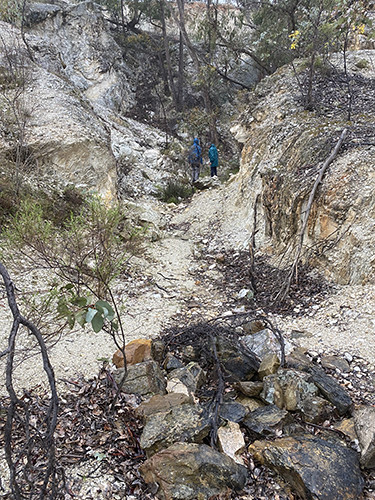
Forest Ck track, gouged by floodwaters, January 2011. The challenge is to develop a restoration policy which will protect the creek and surrounds while allaying fears about flood and fire. Photo: Bernard Slattery

Posted in News | Comments Off on A management plan for Forest Creek?

It’s hard to like them, but they’re quite at home with us…

The picture below is of a dead Redback spider, Latrodectus hasselti, found in a Castlemaine garden. The species is infamous for its alleged propensity to lurk on toilet seats, but is actually quite shy, though it has made itself comfortable in human environments. As the Australian Museum puts it, the redback ‘favours proximity to human habitation, with webs being built in dry, sheltered sites, such as among rocks, in logs, shrubs, junk-piles, sheds, or toilets.’ They’re not particularly aggressive, but obviously you’d want to be careful if you’re working in areas where they might be found.

Dead redback: they've adapted to human environments

The Museum’s detailed account of the spider can be found here . Its account of the spider’s mating habits is not pleasant reading, and sensitive readers—especially males— may want to stop now:

‘Male Redback Spiders do not produce a web, but may be found on the fringe of a female’s web, especially during the summer mating season. The male has to make overtures to the female to discover whether she is ready to mate, which can prove fatal if she mistakes him for prey. It has been found that in order to occupy the female’s attention during mating, the male spider offers her his abdomen by standing on his head and ‘somersaulting’ his abdomen towards her mouthparts. The female begins to squirt digestive juices onto the male’s abdomen while the first palp is inserted. If he is not too weak, he will manage to withdraw, and then insert the second palp. She will continue to ‘digest’ his abdomen. Most males do not survive this process, which seems to be unique to Latrodectus hasselti.’

Posted in Nature Observations | Comments Off on It’s hard to like them, but they’re quite at home with us…

Promises, promises?

Readers will remember our criticisms of DSE’s conduct of the Smutta’s track management burn early this year [see our posts of April 26 and May 2]. Specifically we were concerned by the destruction of a very large tree near Hunter’s track, and by the sloppiness of a control line which we believed could easily become yet another unnecessary and erosion prone track in the area, likely to be used by trail bikes and other vehicles.

We were assured by DSE District Manager Steve Nicholson that ‘DSE is committed to rehabilitating the control line as soon as possible after a burn is completed to minimise erosion and access by vehicles.’

FOBIF members visited the area on November 1, and discovered that nothing had been done to rehabilitate the track in question, and that it had indeed been taken up for vehicle use. This track is completely pointless–it goes from nowhere to nowhere else, and is duplicated by other tracks in the area. We will take up the matter again with DSE.


'Temporary' control line near Hunter's Track, several months after the management burn. These lines become permanent, erosion prone tracks unless rehabilitated. Photo: Bernard Slattery

Posted in Fire Management | Comments Off on Promises, promises?

Fire management: so what’s new?

DSE is in the process of reviewing its Code of Practice for fire management on public land. The review is being done in the light of the Bushfire Royal Commission’s recommendation 59. This recommendation required that the Code  ‘provide a clear statement of objectives’ in fire management, an explicit risk analysis model ‘for more objective and transparent resolution of competing objectives, where human life is the highest priority’, and the specific characteristics of fire management zones, including ‘burn size, percentage area burnt within the prescribed burn, and residual fuel loading.’

A draft Code has been produced, and is open for consultation. It can be found here

Members are strongly recommended to look it over and to make a response, which can easily be done by email to Fire_Code.review@dse.vic.gov.au Responses are due by December 9. Be prepared to grit your teeth, however: there’s rather too much bureaucratic language in it for our taste. An example: Strategy 91 is ‘implement interoperability improvements and partnership arrangements.’

FOBIF representatives went to a briefing on the draft Code in Bendigo on November 4. We will be  making a detailed submission on it in due course. In the mean time it is worth recording three points: the fact that the Code tends to be a nice document no one observes; the inability of the Code’s procedures to prevent sloppy or out of control burns; and the fact that the government’s five per cent burn target contradicts one of the Code’s important rules. To elaborate:

Continue reading

Posted in Fire Management, News | Comments Off on Fire management: so what’s new?

Next Moss and Liverwort Group activity

The Moss and Liverwort Group will be holding their third activity on 26 November at 10.30am at 8 Preshaw Street, Castlemaine. Cass Read is going to lead people through this session which will look closely at the 20 most common local moss species through microscopes.  New participants are welcome. If you have a moss you would like identified, bring it along. Also more binocular microscopes would be useful on the day. Ring Beth Mellick on 5472 1316 for further details.

Breutelia affinins


Posted in Moss and Liverwort Field Guide group, News | Comments Off on Next Moss and Liverwort Group activity