Spectacular orchid display on last FOBIF walk

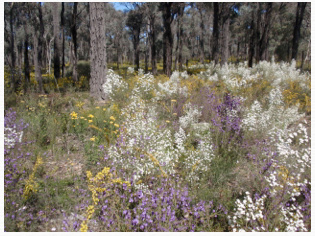
On 20 October Richard Piesse led the last FOBIF walk for the year in the Fryers Ranges. The day was hot and the walk quite strenuous but the wildflowers, particularly the spider orchids at the lunch spot, made the trip well worth it. Beth Mellick took the following two photos.

web-spider-orchids

Walkers picnicking on a hill, with a field of spider orchids behind them.

web.-consulting

Richard showing walkers where the walk would take them.

The first walk for 2014 will take place on 16 March. Details will be sent to members and postedon this website in January .

Posted in News | Comments Off on Spectacular orchid display on last FOBIF walk

Jaw breaker

Walkers in the local bush from Fryers Ridge to Porcupine Ridge and up to Castlemaine have recently been noticing a beautiful small moth hovering around spring flowers. Its very challenging name is Pollanisus viridipulverulenta–apparently we can blame the name on the nineteenth century French entomologist Felix Edward Guerin-Meneville. It’s common name is Satin Green Forester.

Pollanisus viridipulverulenta [try saying that quickly!] pn Wahlenbergia flower, Cobblers Gully, November 5 2013

Pollanisus viridipulverulenta [try saying that quickly!] on Wahlenbergia flower, Cobblers Gully, November 5 2013

It’s a day flying moth whose larvae feed on various species of Hibbertia.  It’s reasonably common throughout eastern and south western Australia, and this year seems to be a good one for the species. [Our thanks to Tony Morton for identifying this beautiful creature].

Day moths copulating, Sebastopol Creek, November 4: these moths are in abundant numbers in our region this Spring.

Day moths apparently copulating, Sebastopol Creek, November 4: Mating takes place in the afternoon, and apparently lasts till the next morning. These moths are in abundant numbers in our region this Spring.

Posted in Nature Observations | Comments Off on Jaw breaker

Acoustic Celebration of Box-Ironbark Country

The premiere of a new radiophonic work, Jaara Jaara Seasons, will take place in Fryerstown on Sunday 3rd November.

Internationally renowned Sound Artist, Ros Bandt, has been immersed recording the sounds of box-ironbark over a 12 month period, with the kind permission of Uncle Brien Nelson, Jaara Jaara Elder. Her radiophonic work will be spread through the bush and include sound recordings from underwater, in the air and the sounds of multi-cultural musicians.

Performers include Rick Nelson (Jaara Jaara voice), Kinja – Ron Murray (didgeridoo/stories) and Sarah James (violin/voice), Mary Doumany (harp/voice), Le Tuan Hung (dan tranh), Wang Zheng Ting (sheng), and Ros Bandt (tarhu, psaltery/slide whistles/recorders). Continue reading

Posted in News | Comments Off on Acoustic Celebration of Box-Ironbark Country

Bushfires: the why and the wherefore

The bushfire season is well and truly on for Australia,  as witness the destructive fires raging in NSW. The fires will no doubt be followed by discussion about prevention of such disasters. Readers interested in the subject could do worse than look at two articles from the website The Conversation this weekend.

The first, ‘Sydney fires caused by people and nature’, by Ross Bradstock, canvasses the bushfire problem generally—the nature of our landscapes, vegetation patterns, climate change, interaction of people and nature. It contains a good general overview of the problem. A sample passage:

‘The fires yesterday didn’t start in remote areas and move into developed areas; rather they’re actually fires that started in developed areas. For example the fire at Springwood seems to have started close to property, and similarly the fire at Lithgow.

‘These fires are a combination of natural and human factors. Without pre-empting the authorities, its likely that some of them are human-caused (directly or indirectly) rather than originating from lightning.

‘We know from spatial mapping of ignition patterns over the past few decades that most fires start close to human development or human transport corridors in the Sydney region. The way people live in the landscape now is influencing the fire regime, and that pattern is overlaid on additional natural ignitions from lightning.’

The second, ‘We know what starts fires, are we brave enough to prevent them?’ by Janet Stanley, deals more specifically with questions of prevention, in particular of arson. Here’s a representative passage:

‘Of the up to 60,000 bushfires which occur in Australia annually, it is thought that close to half of these are deliberately lit.

‘Arson is used here in a broad sense – about 30% are known or suspected to be deliberately lit; about 20% are accidental fires, often arising from reckless behaviour; and a large 42% have an unknown cause.

‘Indeed,  recorded incidents of arson have grown 2000% since 1974, doubling every eight years since 1964.’

About 40 % of arson events are caused by adolescents, Stanley claims: and a concerted effort at understanding the reasons for this would be one constructive approach to bushfire prevention. ‘Our knowledge about arson attacks and about how to prevent them is extremely poor.’

Posted in Fire Management, News | Comments Off on Bushfires: the why and the wherefore

DEPI responds to fire submission

We have received a detailed response from the Department of the Environment to our submission on the 2012 Fire Operations Plan. The response can be seen here.

DEPI’s letter clarifies a number of questions we posed in our submission, but is puzzling on others. In particular, we asked how sundry burns planned for the catchments of Tarilta and Middleton Creeks would ‘complement’ recent burns in that area, which we had seen as environmentally damaging. The DEPI response makes it clear that any ‘complementing’ would be in the matter of fuel reduction only. The burns in question are all ‘Landscape Management’ [formerly ‘Ecological Management’] zones: according to the Code of Practice they are supposed to have the  triple aim of bushfire protection, ecological resilience and forest regeneration/catchment protection. Unfortunately it is only on the first of these objectives that DEPI seems able to be specific.

Secondly, the lack of useful detailed information on how burns are conducted continues to be frustrating. We are assured that ‘DEPI conducts an environmental assessment for every planned burn’: we would dearly love to see these assessments, especially for large scale burns, but none of them are public documents, in spite of the Code of Practice requirement that such information will be ‘publicly accessible’. It’s to be hoped that continued public pressure, together with more detailed enquiry by the Royal Commission Implementation Monitor, will see these documents come to light.

Posted in Fire Management, News | Comments Off on DEPI responds to fire submission