Another hunting riddle: the state government and duck shooting

A couple of years ago we expressed surprise at the apparently supine attitude of the state Labor government before the hunting lobby. Its so called ‘deer strategy‘, for example,  was ‘more concerned to gratify the hunting lobby than to respond to an increasingly evident environmental mess. It is puzzling and depressing that the state government should be concerned to pander to this lobby, whose allies are actively campaigning against it in the state election.’

Another matter on which the government seems to be paralysed is duck shooting.

Recreational shooting of birds is banned in NSW, Queensland, WA and the ACT, but not in Victoria. FOBIF has lent its support to the letter below, signed by 42 conservation related groups:

****

At their November 2019 conference, the Victorian Labor Party committed to review recreational native waterbird shooting in Victoria.

We call on the Andrews’ Government to honor their commitment.

Here’s why.

Cruelty. Numerous studies including by ballistics experts, show at least one in four of the hundreds of thousands of birds shot each year in Victoria will not be killed outright. Many will flap away to die a slow painful death elsewhere. Many others will live to suffer permanent injuries.

Sustainability. Populations of our native waterbirds – many species unique to our country – have been decimated. Allowing recreational native waterbird shooting is irresponsible if we care about biodiversity or leaving the next generation any hope of enjoying the birdlife we do today.

Biodiversity. Significant numbers of threatened and protected species are killed as collateral damage of Victoria’s recreational duck shooting seasons including Australia’s rarest waterfowl, the Freckled duck.

Safety. It is not possible to monitor the thousands of public waterways where recreational waterbird shooting is allowed, placing our wildlife and the public at risk. More people live around the waterways now than they did in the 1950’s and many have expressed fears about their personal safety during duck shooting.

Economics. Studies show there would be an economic benefit in banning the activity in Victoria, as it has already been banned in other states. With rural communities crying out for a financial lifeline and 866,000 domestic tourists engaging in birdwatching last year, it makes sense to protect our natural assets not kill them off.

Democracy. Less than half of one percent of the population shoot ducks. Meanwhile professional polls continue to show that the majority of Victorians – city and country – want duck shooting to end.

Posted in News | Comments Off on Another hunting riddle: the state government and duck shooting

Zoom in to the FOBIF AGM

FOBIF has decided to have a Zoom AGM on Monday November 9 at 7.30. Members and supporters are cordially invited to attend. You’ll need to register to do this.

Those who register will be sent a log in link, in the manner of the many  Zoom meetings we’ve had to become used to over these last months.  To register, simply email a request with your email address to info@fobif.org.au

FOBIF’s financial report will be delivered at the meeting, as will the President’s report on the year’s activities. We have decided, however, not to have a guest speaker. We hope to be able to have a ‘live’ meeting early next year, where members will be able to share the same area, in the traditional way. At this meeting , we plan to launch one of our new publications: watch this space.

Nominations are now open for the FOBIF committee. A special form is not required: a sheet of paper containing the nominee’s name,  the signatures of two nominators (both FOBIF members), and the signature of the nominee accepting the nomination, is all you need. You can send it to Box 322 Castlemaine, give it personally to a committee member, or email us at info@fobif.org.au, and we’ll come and pick it up…assuming you’re in the Mount Alexander Shire.

Positions open are: President, Vice President, Secretary, Treasurer and ordinary committee members.

To vote at the meeting you will of course need to be a member.

If you have a special interest in our local bushlands, and a bit of energy to spare, we urge you to consider standing for the committee: there’s a place for you!

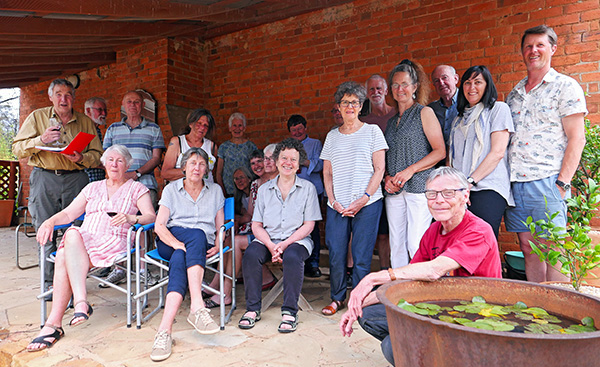
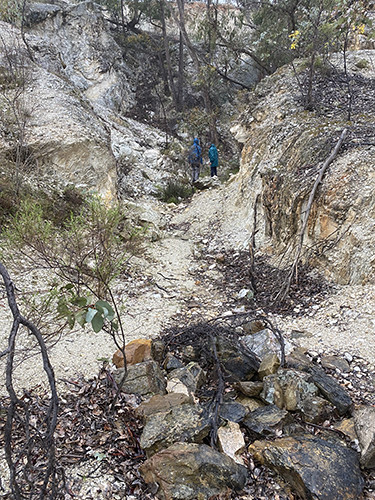
Our monthly FOBIF walks have now been going for more than 20 years. This is a photo of the March 2009 bushwalk led by local geologist Clive Willman. Liz Eagar is holding up the map and Margaret Panter, former walks organiser, is taking notes.. Clive is still leading walks for FOBIF but unfortunately his 2020 excursion had to be postponed. We hope to run it next year.

Posted in News | Comments Off on Zoom in to the FOBIF AGM

Last FOBIF walk for the year

Twenty walkers in two groups set off last Sunday for a delightful walk along the Coliban Water Reserve in Kennedy’s Lane where the old Harcourt Channel runs through remnant wetland on the outskirts of the Chewton Bushlands.

The pace was leisurely with walkers enjoying the many wildflowers in open bird-rich forest among old river red-gums. After leaving the Reserve walkers followed several Chewton Bushland tracks with even more wildflowers. Highlights included finding an uncommon native pea for our area, Creeping Bossiaea Bossiaea prostrata, an unexpected climbing Hill Flat-pea Platylobium montanum and a wonderful display of Hoary Sunray Leucochrysum albicans var. albicans at Antoinette’s home where one group had lunch.

Thanks to Antoinette Birkenbeil and Karen Baker for leading the walks and all the people who sent in their photos to FOBIF. Our next walk will be in March 2020 and new walk’s program will be distributed in January.

If you missed out this walk you might be interested in a wildflower walk in Chewton next Sunday on the track between Railway Street and White Gum Track also led by Karen and Antoinette. The walk starts at 11am. Contact Antoinette for more details: antoinettebirkenbeil@icloud.com

Posted in News, Walks | 2 Comments

New from old: an indigenous management plan for Kalimna

A new management plan for Kalimna Park will be released for consultation before the end of the year. The plan, part of the Balak Kalik Manya (Walking Together) project, is part of ongoing indigenous co management  in the park.

Not surprisingly, surveys have shown that Kalimna Park is mostly used for exercise and immersion in nature. Although rubbish dumping is a recurring problem, the park is relatively free of nuisances like rogue trailbike riders and destructive four wheel drive activity. This may be a function of the fact that the park is extremely popular, and it’s rare that you go there without seeing someone mooching about.

Well attended Zoom meeting on September 29 was briefed on progress so far on production of the management plan. Project co-ordinator Harley Douglas answered questions from attendees on issues including significant indigenous heritage sites, weed and fire management, the implications of a push to World Heritage status for the goldfields, and resourcing. The project has been funded from a grant designed to cover a similar management for Wildflower Drive in Bendigo.

The Balak Kalik Manya project forms an important part of the introduction of Indigenous co-management on public lands in Jaara country–itself part of Traditional Owner co-management statewide. The following article on this important trend is from the VNPA Parkwatch magazine, and is written by Phil Ingamells:

************

Victoria has been quietly undergoing a radical change in management arrangements for our finest remaining ‘natural’ areas. Most of our national parks now have formal, or sometimes informal, joint management agreements with Victoria’s various Traditional Owner groups. In August this year, the Victorian Government reached a settlement agreement with the Taungurung people of central Victoria. It gives the Traditional Owners the right to jointly manage one of Victoria’s oldest national parks, Mount Buffalo National Park, as well as part of the Alpine National Park and Kinglake National Park, all of Heathcote Graytown National Park, Lake Eildon National Park, Mount Samaria State Park, Cathedral Range State Park, and some smaller reserves.

Settlement agreements have now been reached with many Aboriginal communities across Victoria, and they have been engaged in the development of joint management plans for some time.

Continue reading

Posted in News | Comments Off on New from old: an indigenous management plan for Kalimna

Supermarket objection

FOBIF has submitted an objection to the planning  permit application for a new supermarket in Duke Street Castlemaine. Our submission is essentially a repeat of our objection to a previous version of this permit application. We said at the time that ‘ we have no opinion on the wisdom of a second large supermarket in the town, or its location, or its design: we have to trust to the competence of council on these matters.

‘Our objection is solely related to the proposed landscape plantings for the development’.

Our second objection states: ‘FOBIF objected to a previous version of this application in July, on the grounds … that the landscaping proposal included the planting of several environmental weeds, something we have enough  of already.

‘The new application seems to have deleted one of these plants—the Peppercorn—but left the others.

‘We therefore repeat our objection: this proposal should not be approved until the proponents accept a responsible practice on the matter of landscape planting. This should not be hard to do, and we’re at a loss as to why the proponents appear reluctant to do it.’

And we are at a loss. You would think that respect for ecology would be a basic part of the formation of a landscaper…but it seems this is not always the case.

Posted in News | 1 Comment