Too late, perhaps? Too little? We hope not

‘In 1980, there were an estimated 50,000 feral deer in Australia. By 2002, the estimate had grown to 200,000. In 2022, the population is likely to have reached 1–2 million in Australia.’

That’s from the recently released draft National Feral Deer Action Plan. You can find it here

If ever there was an illustration of the rule, ‘Tackle a problem early, don’t let it get out of hand’, those figures supply it.

Deer, Campbell’s Creek: no, it’s not cute, it’s a pest. Photo: Naomi Raftery, 2018

Exploding deer populations have been compared to the rabbit plagues of the past. They destroy crops, turn healthy streams into mud heaps, and are increasingly dangerous in peri urban areas:

‘Australia’s feral deer problem costs land managers and governments tens of millions of dollars every year. Land managers are paying more each year for measures to protect the land, through activities such as deer culling or exclusion fences. Transport departments are also increasing culling and fencing along highways and railways to reduce vehicle collisions with feral deer. Local governments are struggling to cull feral deer in urban and periurban areas, gardens and ovals.’

The draft strategy offers a number of approaches to deer control. It doesn’t discuss recreational hunting, but does say that this method of ‘control’ has failed. Further, it makes the point that ‘Landscape-scale management of feral deer can be hampered when neighbours have different, or conflicting management goals (game management or pest control).’

In other words, giving deer protected species status as game animals is an actual impediment to control. This puts a bullet, so to speak, into the Victorian Government’s incomprehensible policy of pandering to the hunting lobby on the deer problem. [You can check out our comments on this subject here, here and here]

FOBIF members sighted deer on the Porcupine Ridge Road last week: they’re increasingly common, and have been sighted in every corner of our region.

The draft policy is open for comment till March 20. Have a go. [You might want to take a look at a comment by the Invasive Species Council here.]

Posted in News | 1 Comment

Last days of FOBIF exhibition (11-13 March)

The FOBIF exhibition at Newstead Arts Hub will be running this Saturday, Sunday and Monday (Labour Day). The opening hours for Saturday and Sunday are 10 am to 4 pm. On Monday we will begin taking down the show at 2.30 pm to allow for people to pick up purchased photos. We will contact people before Monday to let them know if their photo will be ready by this time..

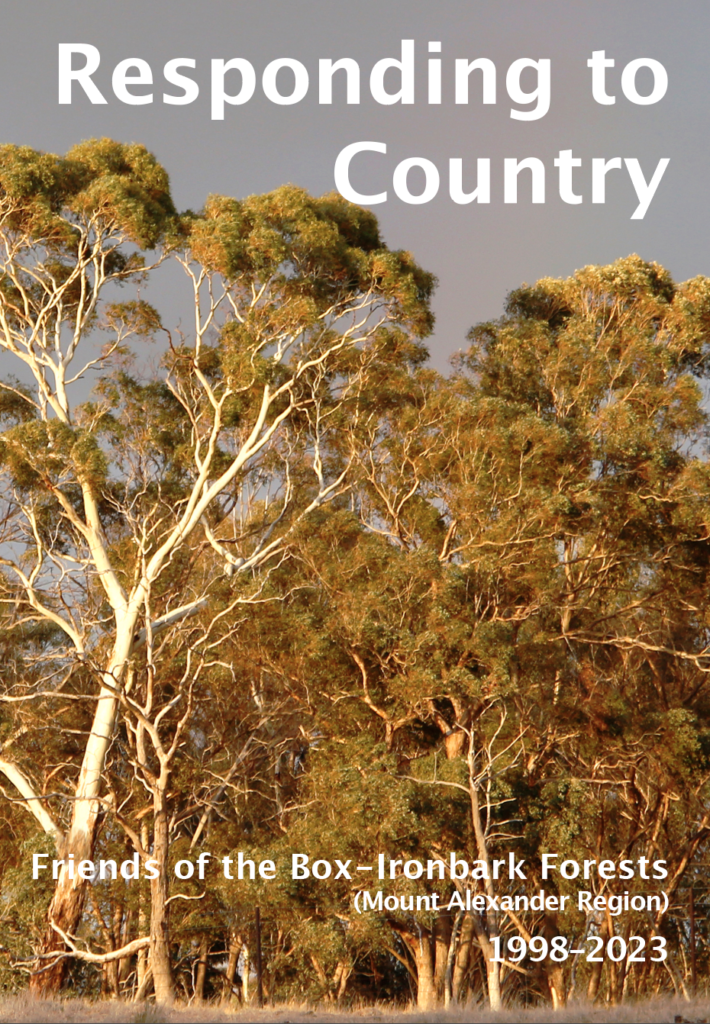
Our new book Responding to Country: Friends of the Box-Ironbark Forests 1998-2023 will be available for sale at the Hub. This 70 page catalogue has 25 photos with accompanying text by members and supporters, historical and geology sections, children’s art, and an essay by Alex Panelli, Of people and a forest – some personal reflections. The first few paragraphs of Alex’s essay can be viewed here and the book’s contents page here

Sample page from the book.

You can order Responding to Country on this site through Paypal or bank transfer for $15 plus $3 postage. It is also available at Stoneman’s Bookroom, the Castlemaine Visitor Information Centre and Bookish in Bendigo.

Posted in FOBIF turns 25, News | Comments Off on Last days of FOBIF exhibition (11-13 March)

What a difference a decade makes

Check out the two photos below, taken at the same point on the Porcupine Ridge road, 11 years apart:

The top photo was taken in August 2012, at the height of a Cup Moth infestation. The bottom photo was taken last week. Notice the difference?

In 2012 the charmingly attractive and very unpleasant Cup Moth (Doratifera sp) was laying waste to our bushlands, and especially the Red Stringybark eucalypts. The bush was pretty dismal, and it wasn’t hard to find people wondering if the forest was actually going to die.

As you can see from the above photos, predictions of doom were at least premature. Tree recovery has been good. You can still, however, see signs of the past crisis, in the number of  trees which have only partly recovered, and the number which didn’t survive the attack.

Porcupine Ridge Road, February 2023: skeletal branches and dead trees are reminders of insect attack ten years ago, but forest recovery has been good.

These observations are necessarily crude. What we’d really like is to see the detailed monitoring done by managers over the last 20 years as part of their fuel reduction program. This forest has weathered a long drought, serious insect infestations and management fire over this period. What has been the result, in detail? We don’t know, because we haven’t seen the abovementioned monitoring, if it exists.

The bush on the right of the photos above is scheduled for a management burn in the next couple of years [see our posts here and here].

Posted in News | Comments Off on What a difference a decade makes

New name, new…er…

In case you’re confused, DELWP has changed its name: it’s now the Department of Energy, Environment and Climate Action.

Posted in News | Comments Off on New name, new…er…

New FOBIF book!

FOBIF has just published a catalogue of our current exhibition at the Newstead Arts Hub. This 70 page book, Responding to Country: Friends of the Box-Ironbark Forests 1998-2023, includes:

  • Photos with accompanying words by 25 members and supporters,
  • Drawings by Chewton Primary School students,
  • A geology section with text written by Clive Willman,
  • Photos of FOBIF walks going back more than ten years,
  • An essay by Alex Panelli, Of People and a Forest – some personal reflections
  • Articles about two FOBIF founding members, Ern Perkins and Doug Ralph,
  • Two articles on the founding of FOBIF and its history by Phil Ingamells and Bernard Slattery.

You can buy the book for $15 plus $3 postage on this site. It is now available at Stoneman’s Bookroom and the Visitors Information Centre in Castlemaine and Bookish in Bendigo.

Sample page

Posted in FOBIF turns 25, News | Comments Off on New FOBIF book!