Vale Naomi Raftery

It is with regret and sadness that we report the death from cancer of Naomi Raftery, FOBIF committee member for several years, and secretary from 2014-2018. In that period Naomi was an important part of all of our work, including our publications, and especially in the running of our children’s programs. She exemplified the best qualities of an environmental activist: idealism and hard headedness, tolerance and firmness, thoughtfulness and good humour. Naomi was also involved in Connecting Country activities, and we fully endorse the following comments by Chris Timewell on her work in this area:

From 2011 to 2017, Connecting Country was extremely fortunate to have Naomi Raftery’s unwavering support and commitment towards achieving its conservation objectives – originally as a hardworking volunteer and member, and then also as a part-time staff member.  Naomi was the unsung hero behind the smooth running of field days, guest speaker events, committee meetings, restoration activities, and much more that Connecting Country undertook over this busy period.

In her humble way, she was invariably generous, friendly, patient, diligent, and insightful, and took steps to ensure that no-one would feel excluded or under-appreciated.  Naomi demonstrated a strong sense of fairness, social justice and ethical behaviour – and inspired her colleagues and others she met to raise their game.

Connecting Country, and many other organisations in Castlemaine and beyond, benefited from her passion for grassroots collaboration.  She knew the power of community groups to take meaningful steps at a local level towards making the wider world a better place.  Naomi was always among the first to put up her hand to offer help.

Her contribution and legacy is enormous, and she’ll be greatly missed. We extend our sympathy to her husband Sean and daughter Sophie.

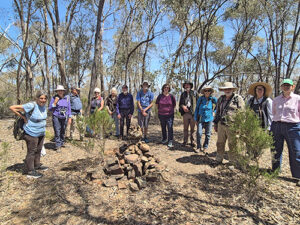
Naomi speaking at a FOBIF children’s walk in Kalimna Park, 2014.

Posted in News | 1 Comment

FOBIF spring walk, 15 September

Christine Henderson will be leading the 6-8 km September walk in the Fryers Ranges. We will be meeting as usual at 9.30 am at the Community House in Templeton Street, Castlemaine and travelling by convoy to Taradale. If you would like to start at Taradale, meet at 9.45 am opposite the Metro service station in the main street. Contact Christine on 0417 529 392 for more information.

Posted in News | Comments Off on FOBIF spring walk, 15 September

Fire: paying attention to the detail

Over 100 people packed into the Senior Citizens Hall last Tuesday to hear fire behaviour scientist Phil Zylstra question the science and logic behind current planned burning systems.

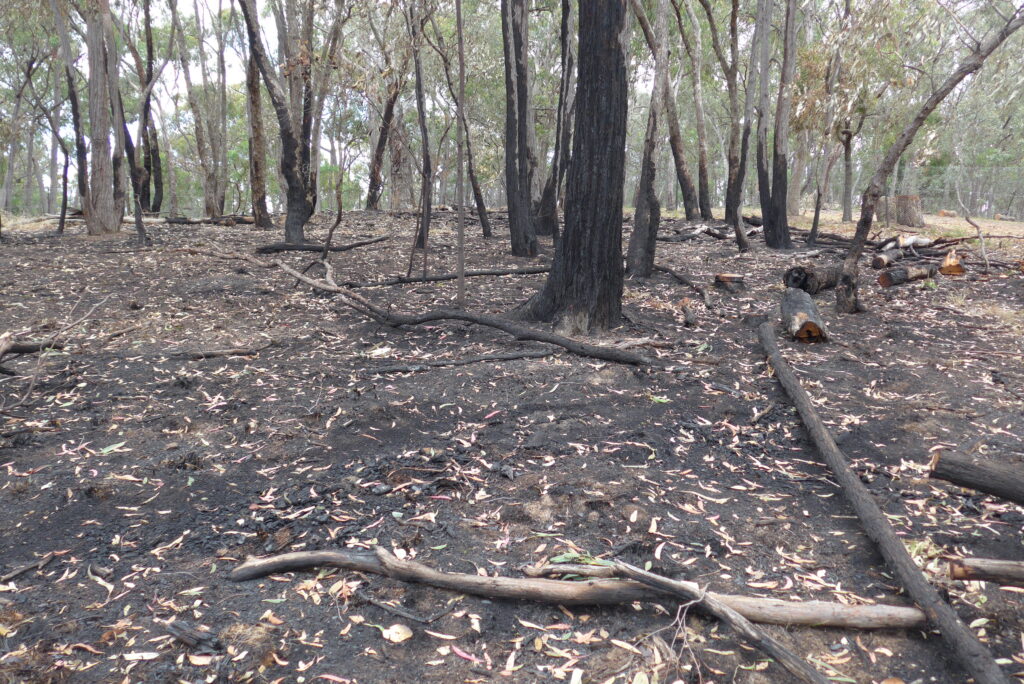
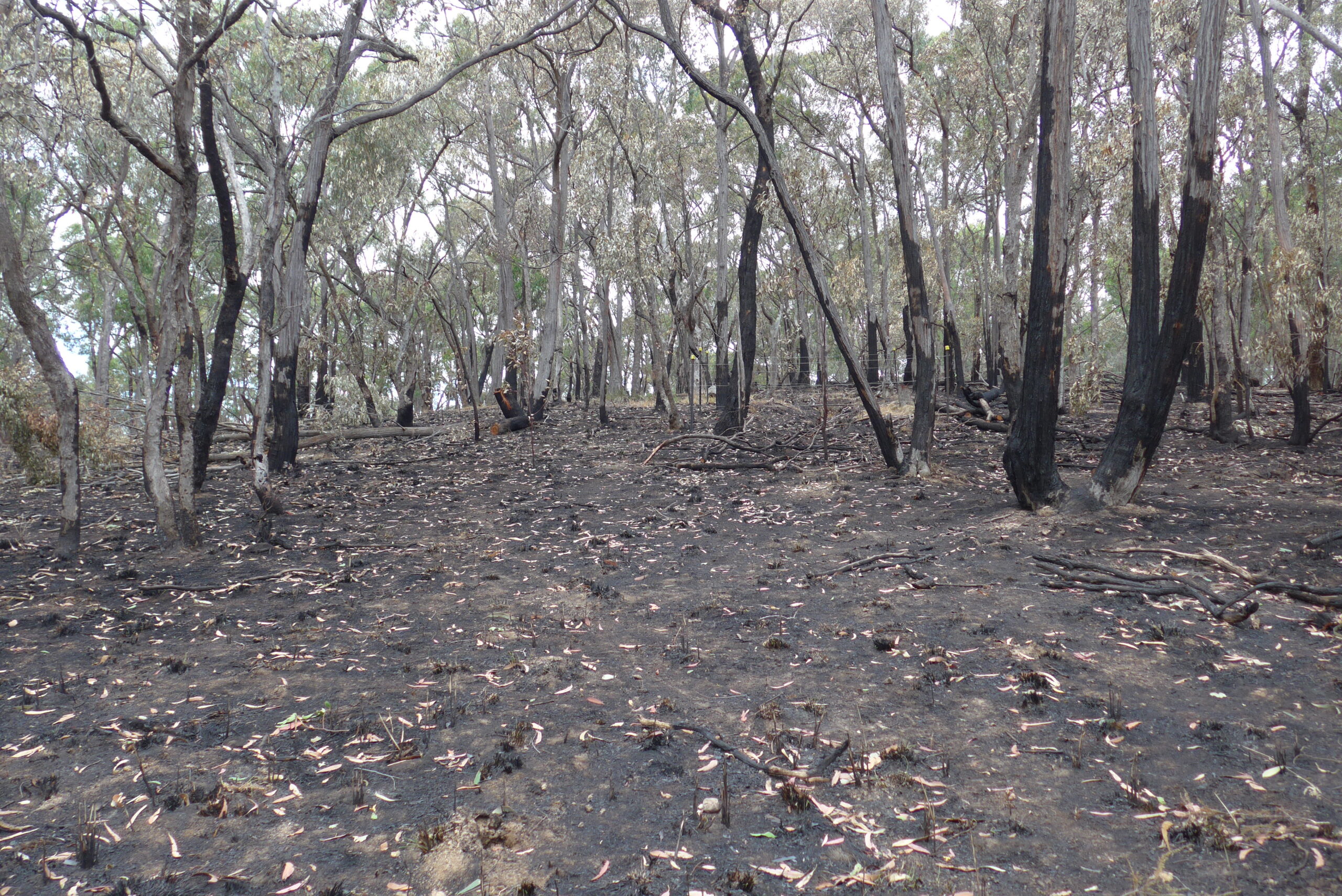
The talk focused on current programs centred on the reduction of leaf litter, considered as a major contributor to forest fire. Dr Zylstra set out to show that fuel reduction programs designed to reduce surface fuel neglect the role of the shrub layer. He argued that a forest left to itself provides its own protection against fire, and that concentration on fuel loads oversimplifies the fire challenge: fuel reduction burns may actually increase the area of wildfire.

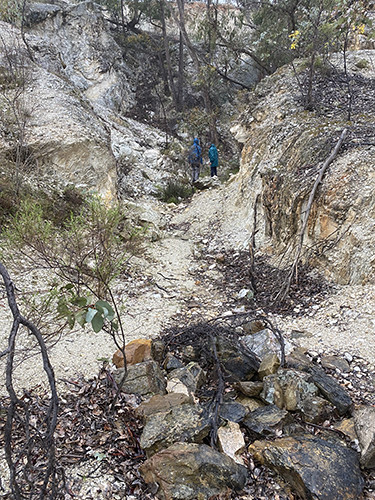
Wewak Track, Castlemaine Diggings NHP,  management fire zone, November 2010: concentration on reducing ‘ground fuel’ may be misplaced, and may even be counterproductive–as witness the photo below.

A feature of Dr Zylstra’s experience in fire management is his learning from Wurrundjeri Woi Wurrung elder Uncle David Wandin on the purpose and nature of indigenous fire, as contrasted with post settlement practices.

Wewak Track management fire zone, January 2012: prolific shrub and sapling regrowth can be a consequence of inappropriate fire.

Dr Zylstra’s research on fire behaviour and fuel danger is becoming increasingly relevant to forest managers. You can find his 2023 address (with Uncle Dave Wandin) to the Royal Society, ‘Decolonising fire science’ here. A shorter version of the talk is here

Accessible written accounts of his argument can be found here and here.

We  recommend that readers have a look at the detailed material in these links.

The talk was organised by the Kinglake Friends of the forests, in combination with FOBIF, Friends of Whipstick, and the Whroo Conservation Network.

Posted in Fire Management, News | Comments Off on Fire: paying attention to the detail

Wild discoveries: an exhibition of nature photography

Nature embodies breathtaking complexity, subtle and intricate relationships and ineffable beauty. Much remains hidden to the casual eye, yet much can be revealed through the photographic lens. Minute details of a feather or moss, connections in colour and texture, colours and vast plenty in the night sky invisible to the unaided eye. Four local photographers entranced by and enthused about nature present some of their most striking discoveries of the wild – visual testaments to and explorations of the natural world.

Hosted by Newstead Arts Hub, the exhibition will be launched by Geoff Park on Saturday 7 September at 11am. Everyone is welcome and refreshments will be provided. The show will be open every weekend in September from 10am to 4pm.

Milky Way aurora by Patrick Kavanagh

Powerful Owlets after a late Spring shower, Mandurang South by Daryl Fleay

Kalmina composition by Marte Newcombe

Foggy morning, Leanganook by Bronwyn Silver

Posted in News, Photo Exhibitions | Comments Off on Wild discoveries: an exhibition of nature photography

A Winter Walk in Black Hill Reserve

Our August walk took us further afield than usual, to Black Hill Reserve near Kyneton. Lionel Jenkins and Barb Guerin lead a dozen other walkers on a loop of just over 5km. The dominant tree species are Manna Gum, Messmate Stringybark and Yellow Box with an understorey of Silver, Black and Lightwood Wattles. In the ground layer we saw Prickly Starwort, Spiny-headed Mat-rush, two specimens of the threatened species Arching Flax-lily, and some ferns ringing the boulders.  A lightning strike in January 2015 caused a bushfire that went through 80 percent of the reserve, and it is still recovering.

A liverwort (Chiloscyphus species) on burnt log, by Bernard Slattery

From the 1960s to the turn of the century efforts at revegetation after gravel extraction and bushfires saw the introduction of non local native species (e.g. Sallow Wattle) but in more recent years any plantings done are of local native species in accordance with the three Ecological Vegetation Classes found within the reserve.

Huge, coarse-grained granite boulders are a feature of the walk, some monolithic in size. We enjoyed  morning tea in some “caves” (shelters really), and lunch on a grassy slope in the sun. Mosses were in abundance, and Joy Clusker pointed out and photographed for us several species of fungi, and gum exuding from Black Wattles:

‘Twas a very enjoyable walk on a beautiful Winter’s day. Thanks to Lionel and Barb ad the walkers who contributed photographs for this report.  There were not many flowers to be seen – a little bit of Common Hovea and Purple Coral-pea. It would be good to re-visit in Springtime when the orchids and other wildflowers are out (as featured on the beautiful interpretive signs in the rotunda near the main entrance to the reserve). 

Posted in News, Walks | Comments Off on A Winter Walk in Black Hill Reserve