Plant some understorey, check out a weed

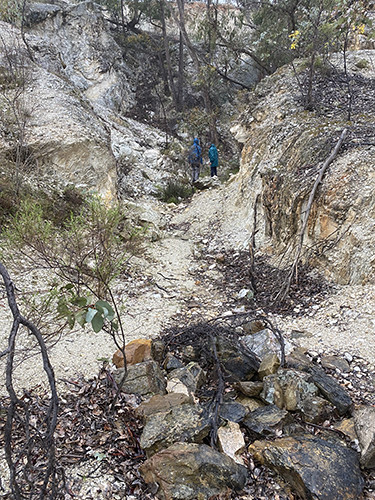
FOBIF is planning an understorey planting and weed attack working bee at the famous Chewton Yellow Box on National Tree day, Sunday July 29, from 10 am to 12 noon.

FOBIF foundation president Doug Ralph at the Chewton Yellow Box--it's definitely a monument worth looking after. Photo: Bronwyn Silver


The tree, one of the oldest in the district, is on the Great Dividing Trail near Fairbairn Street. FOBIF last year did some bridal creeper eradication work at the site, and this is a follow up effort. The site is about 100 metres from Forest Creek, near a small school pine plantation. The quantity and variety of weeds in this area is quite desperate, but the potential for restoration of a beautiful creek valley landscape offers plenty of motivation for workers to put a dent in the evil empire.

There’ll be more details closer to the event–but put it in your diary now!


Posted in News | Comments Off on Plant some understorey, check out a weed

Tall Greenhoods are flowering

Tall Greenhood, Poverty Gully. Photo: Bronwyn Silver, 10 June 2012

The Tall Greenhood Pterostylis longifolia is one of 16 local species of Greenhoods. Worldwide there are 120 species with about 100 of these endemic to Australia.

Along with other Greenhoods, this one lures insects, usually gnats, to the plant with pheromones. When the insect touches the lower lip of the orchid (labellum) it flings the insect back into the hood and closes over it. The movement of the insect as it attempts to escape assists in the pollination process. Once the insect escapes the ‘trap’ is reset.

Tall Greenhoods are one of the earliest species of Greenhoods to flower in this area. They are characterised by long leaves and multiple flowers on each stem. As with other Greenhoods the flowers are translucent which is thought to encourage trapped insects to move towards the light.

To view several other types of Greenhoods have a look at our FOBIF Flickr Gallery.

Posted in News | Comments Off on Tall Greenhoods are flowering

FOBIF photo show at Tog’s Cafe

The latest FOBIF Mamunya exhibition opened at Tog’s Cafe in Lyttleton Street, Castlemaine last Friday. It runs till the 13 July. The exhibition continues a tradition the Friends started in 1999 with their first Mamunya festival. This word comes from a Dja Dja Wurrung chant, ‘pata, mamunya, jirarunga,’ meaning, ‘wait a while, don’t touch it, growing up.’

This time twelve photographers have contributed their photos. The images highlight the often overlooked beauty and intriguing characteristics of our local flora and fauna. Five of the 26 exhibition photos are included in the slideshow below.

Posted in News | Comments Off on FOBIF photo show at Tog’s Cafe

Soil protector: unobtrusive, and undervalued?

FOBIF’s moss group met at the Castlemaine Botanical Gardens last Saturday to move the project further towards its target: to publish a field guide to mosses of the region in Autumn next year.

This is not an eccentric interest in a picturesque but unimportant corner of our environment. Mosses play a key role in repair of damaged land and protection of soil against erosion. DSE analyses for the Goldfields bioregion show the following interesting figures: in Heathy Dry Forest, 10% of understorey is bryophytes [ie, mosses and liverworts] and lichens, and 10% is ‘soil crust’. In Box Ironbark Forest, 10% of understorey is bryophytes and lichens, and 20% is ‘soil crust’.

That humble term ‘soil crust‘ covers a combination of life forms, including mosses and lichens: which means that your unobtrusive moss is covering a hell of a lot of ground in our region.

FOBIF moss group at work: moss is not just a green splodge...


The protective action of moss is easy to see. The following picture shows clearly how soil has been washed away from the area not covered by moss:

Road embankment, Castlemaine: soil has been washed away from the edge of the moss bed.


Moss and soil crusts are vulnerable to disturbance by trampling, or fire. Although mosses are not flammable, and therefore cannot be classed as fuel, they are often destroyed by ‘fuel reduction burns’. The following picture tells a story:

Continue reading

Posted in Moss and Liverwort Field Guide group, News | Comments Off on Soil protector: unobtrusive, and undervalued?

World Environment Day to be celebrated this Sunday in Castlemaine

To celebrate World Environment Day in our Shire, an community fair will take place in the Castlemaine Market Building from 9am-1pm on Sunday 3rd June. Whether people are interested protecting our diverse plants and animals, or sustainability initiatives and green technology opportunities, the fair will be a great source of information on what is happening locally.

The ‘mini expo’ format will give visitors an opportunity to talk to representatives from local environmental organisations, community groups and government agencies including: Connecting Country, Friends of the Box-Ironbark Forests, Landcare, Mount Alexander Sustainability Group, Trust for Nature, Parks Victoria, Mount Alexander Shire Council and Castlemaine Community House – Growing Abundance.

Among the attractions of the day is the opportunity to see a specimen of the rare and endangered Southern Shepherds Purse – a plant growing in the Mount Alexander Regional Park and nowhere else in the world!

The Castlemaine Farmers Market and Castlemaine Market Building Art Showcase 2012 will be on at the same time.

Kirsten from Trust for Nautre with Swifty the Parrot at last year's World Environment Day

Posted in News | Comments Off on World Environment Day to be celebrated this Sunday in Castlemaine