We’re all too familiar with fungi as murder weapons; it’s possibly less well known that without fungi, life as we know it would pretty quickly come to an end. Daylesford writer Alison Pouliot has an impressive record promoting the positive side of the Fungal Kingdom: her photos are powerful insight into the mystery and beauty of fungi; her popular science works [see for example here] are punchy, acerbic and eloquent accounts of the vital importance of fungi, and the strange lack of popular appreciation of its value.
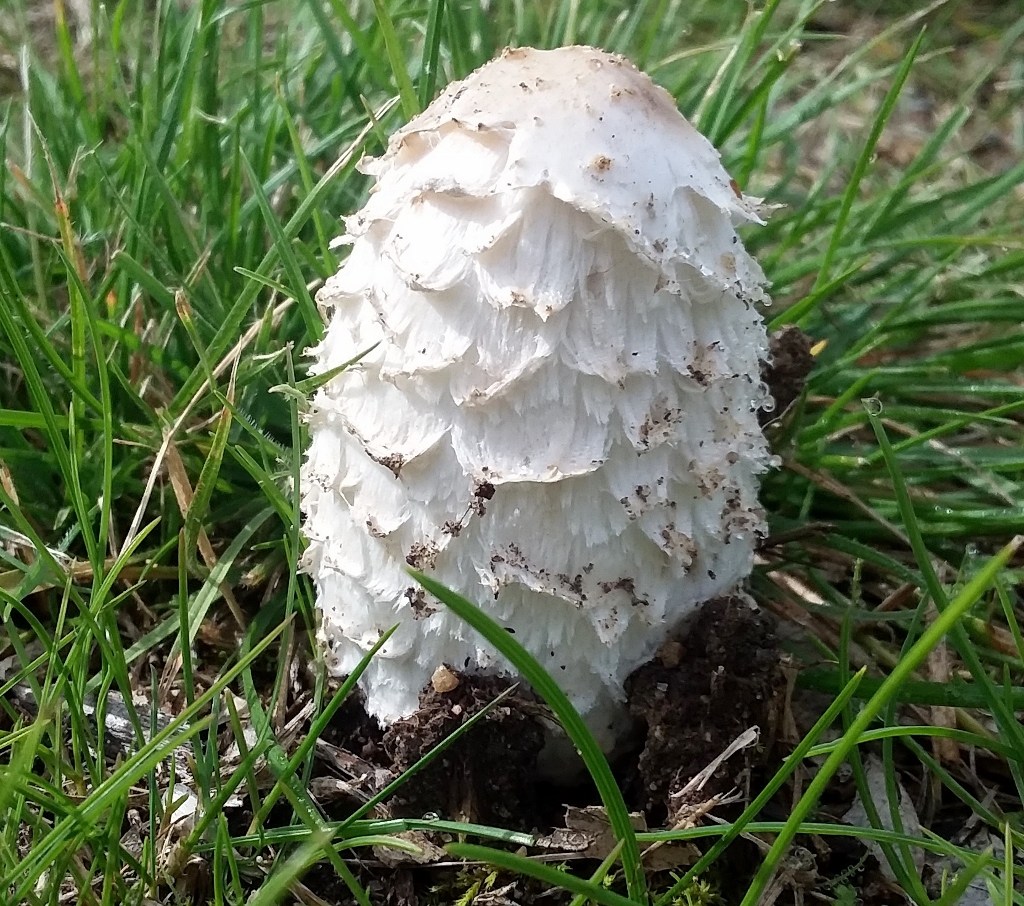
Lawyer’s Wig (Coprinus comatus), freshly pushing through turf, Victoria rd Harcourt. The species is tough enough to penetrate ashphalt! Then it, you know, kind of…
Pouliot’s latest book, Mushroom Day, contains 24 short but dense chapters, each devoted to a different species, one for each hour of the day, with excellent black and white line drawings by Stuart Patience.
Its small format and hard cover might tempt the hasty observer to see this as one of those bookshop quickies, fun and exotic and quickly finished. Actually the short chapters are packed with detailed scientific info, with an admixture of folk stories and historical observations, told in the kind of casual tone that makes hard information seem easy.
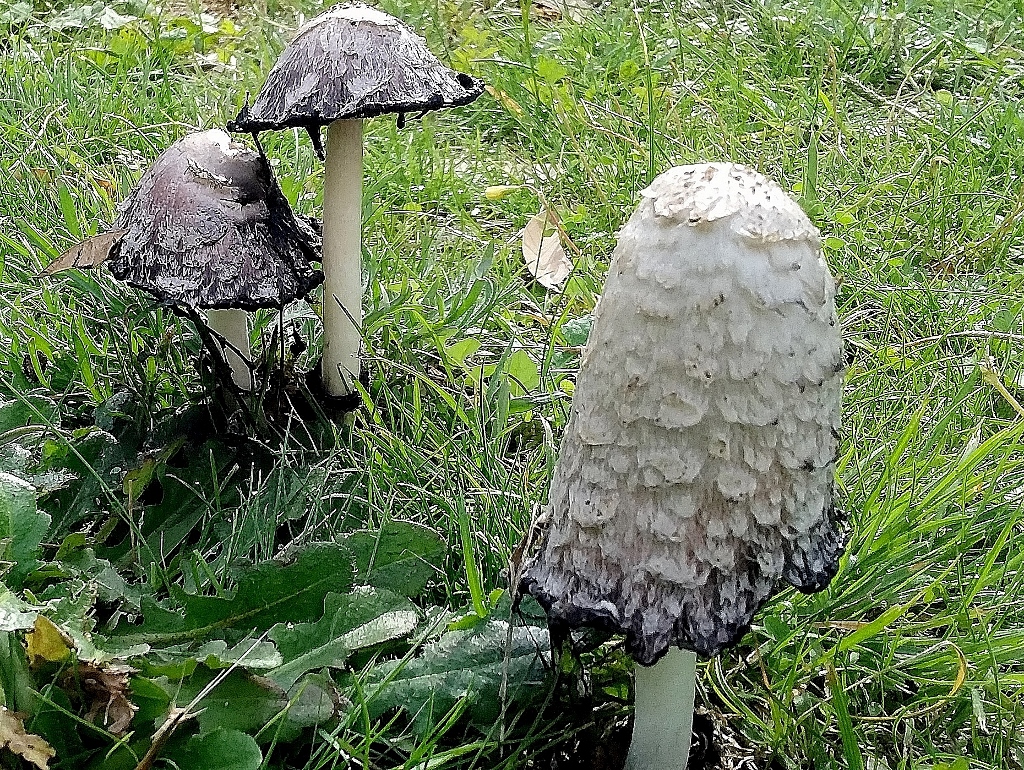
…eats itself! Note the fresh white caps decaying to an inky sludge. Oh, and one of its tricks is that it strangles worms…
Its variety makes this a hard book to summarise: there’s the Honey Fungus in Oregon that’s 2,400 years old; Chi-Ngulu-Ngulu farmed by termites in Africa; the spectacularly sinister and smelly Australian Anemone Stinkhorn; Ergot’s dual identity as a toxin and a beneficial pharmaceutical; and one of my favourites, the Lawyer’s wig, a common enough species in our region, remarkable for the way its nice fluffy whiteness disintegrates into an inky black mess (oh, and it strangles worms for a living). In all 24 cases, Pouliot takes the striking features of each fungus and explains how they enable the organism to function. And underlying each of the discussions is this theme: ‘co operation is the foundation of life’: the interdependence of living things.
Along the way we get stimulating insights into the way people can experience fungi. Take smell, for instance.
In a discussion of Aniseed Funnel (Clitocybe odora) Pouliot offers this intriguing reflection: ‘Today, many people in western cultures are less skilled at recognising certain odours and mask those they deem disagreeable. Humans’ intolerance of odours considered “off” and the resultant artillery of products to disguise them has reduced our reliance on this remarkable sense.’ Smell is an important factor in identifying fungi, and the fact that it is very subjective, and dependent on the observer’s personal idiosyncracies, makes it a tricky and possibly unsettling faculty. Pouliot points out that many Inocybe species smell like semen, but people often struggle to pinpoint that odour…
One of the words most often used in this book to describe fungi is ‘mysterious’: ‘‘The Kingdom Fungi is a mysterious realm full of unanswered questions.’ The text is peppered by phrases like, ‘it’s difficult to say’, ‘we’re not sure’ ‘research has not verified…’ But we do know enough to be fascinated by the weird variety of strategies fungi employ to survive and prosper. In fact, this short book provides more than enough material to provide the plot lines for a couple of dozen fantasy novels. All the same, it’s disturbing to be reminded that humanity is altering or destroying large areas of the earth’s surface without really knowing what is there…
Mushroom Day is published by the Chicago University Press. It’s part of the publisher’s Earth day series by various authors, which includes Tree Day, Frog Day, Snake Day and others.
–Bernard Slattery


 Click on image for info/order page
 Click on image for info/order page
 Click on image for info/order page