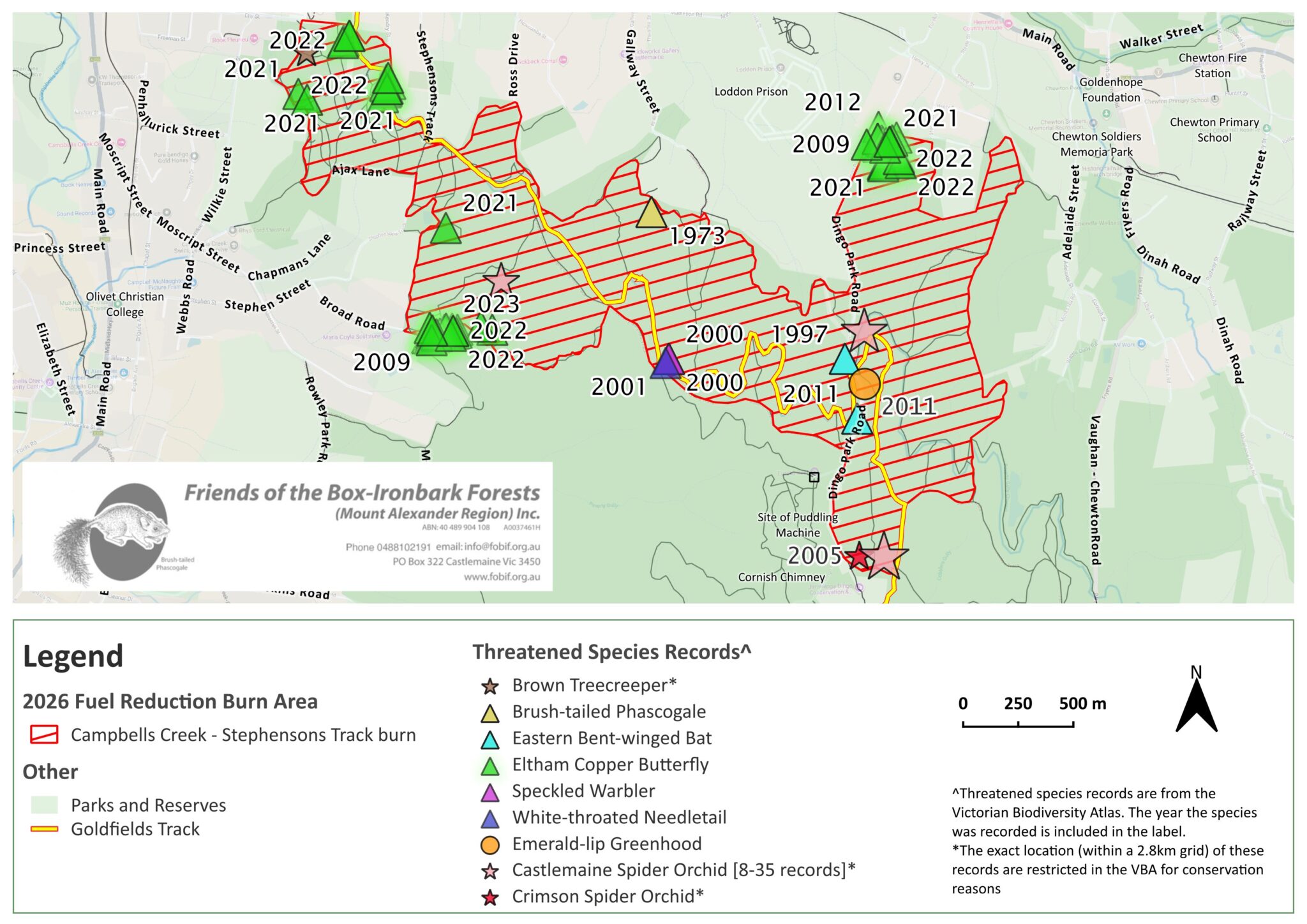
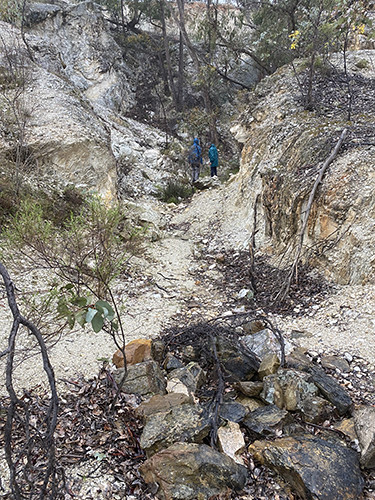
FOBIF has lodged a submission to Forest Fire Management Victoria (FFMV) regarding the proposed 239-hectare Campbells Creek – Stephensons Track planned burn in the Castlemaine Diggings National Heritage Park.
Among the concerns raised in our submission:
- The planned burn area contains populations of the nationally threatened Eltham Copper Butterfly (Paralucia pyrodiscus lucida), a species that depends on Bursaria spinosa shrubs and a close relationship with native ants to complete its life cycle.
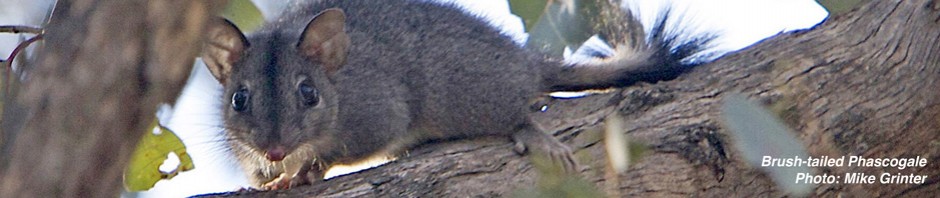
- The forest within the burn footprint supports numerous other threatened species, including the Castlemaine Spider-orchid (Caladenia clavescens), Emerald-lip Greenhood (Pterostylis smaragdyna), Brown Toadlet (Pseudophryne bibronii), Speckled Warbler (Pyrrholaemus sagittatus) and Brush-tailed Phascogale (Phascogale tapoatafa).
- Old hollow-bearing eucalypts occur throughout the burn area, providing nesting sites for wildlife but at risk of being killed when fire burns inside existing hollows.
- Evidence from recent burns nearby suggests fuel hazard can return to — or even exceed — pre-burn levels within just a few years, raising questions about the effectiveness of broad planned burns in Box–Ironbark forests.
- The burn footprint includes “The Monk” hilltop, a well-known butterfly hill-topping site where butterflies gather during the breeding season.
- Part of the Castlemaine Diggings Track passes through the proposed burn area, a popular walking and cycling route through the historic goldfields landscape.
You can read our full submission, with a map showing the site and threatened species previously recorded here
If this proposal concerns you, please consider sending your own submission to FFMV — even a short message explaining why this forest matters to you can help ensure community voices are heard. Community members can send submissions or comments to –
customer.service@deeca.vic.gov.au
mallee.engage@deeca.vic.gov.au
environment.compliance@dcceew.
mg.forestandfireplanning@deeca.vic.gov.au
with the subject line Campbells Creek – Stephensons Track planned burn.



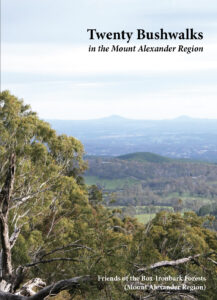
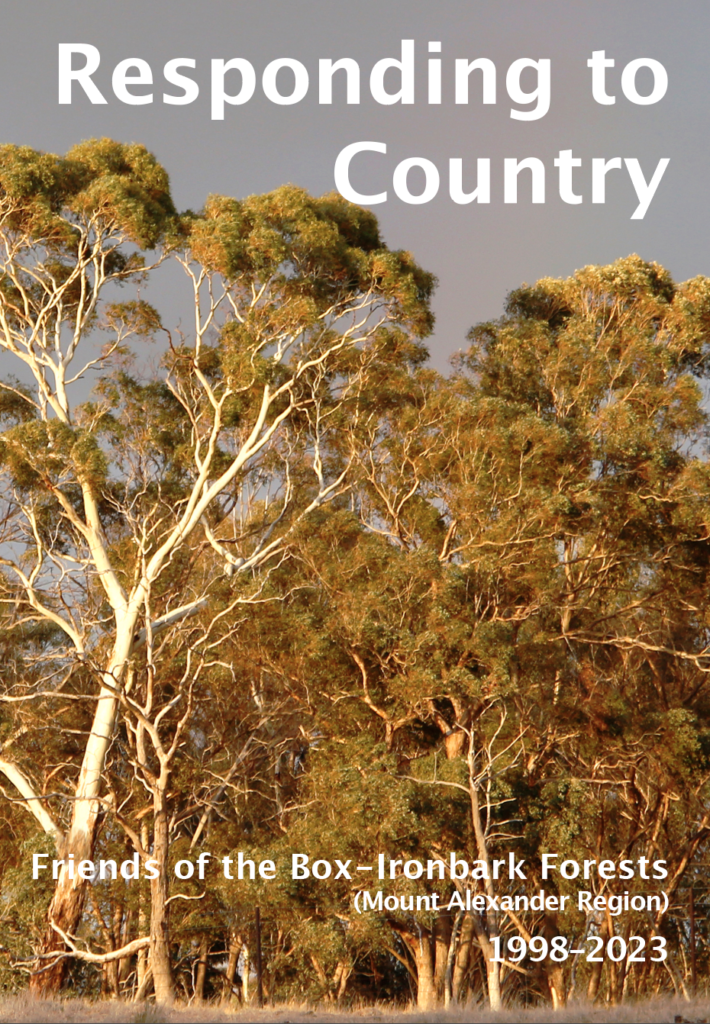
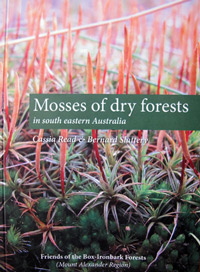 Click on image for info/order page
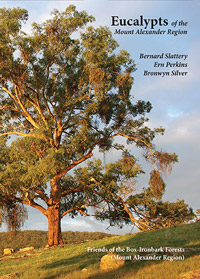 Click on image for info/order page
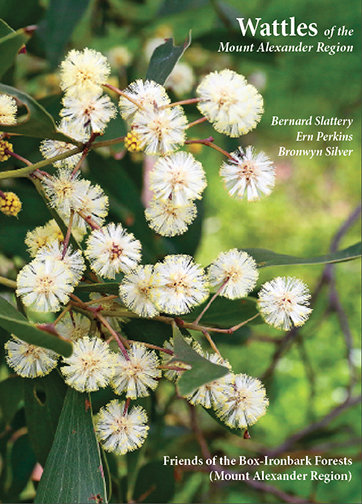 Click on image for info/order page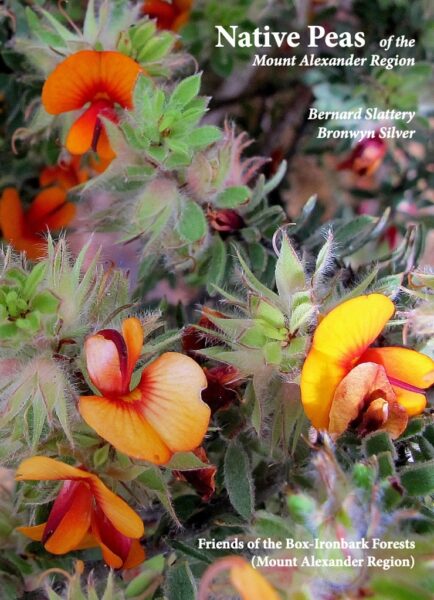






One thing is for sure; planned burns kill parasitic plant species that do not germinate again from fire but must be brought into a landscape by birds or animals. It takes time, maybe decades, before they add to any biodiversity within an ecosystem. Cassytha glabella has been recorded once within the planned burned area, in 2023 on inaturalist.com only. A burn will probably eradicate it from the area because it grows low to the ground amongst low-lying shrubs. There is almost no other recent account for this species on either VicFlora or inaturalist inside the planned burn area or locally outside of it for animals to bring it back. Although not listed as threatened statewide, the species itself could be considered locally threatened in this specific area if records, or lack of them, mean anything.