Presentation: The Secret Life of Mistletoe

There will be a presentation on Thursday 21 November at Newstead Community Centre, Lyons Street, Newstead at 8pm. The subject is ‘The Secret Life of Mistletoe’ by David M Watson. All welcome. A gold coin donation would be appreciated.

David M Watson is Professor of Ecology at Charles Sturt University and an international expert of mistletoes. In addition to the ecology of parasitic plants, his research focuses on large-scale connectivity conservation and developing innovative approaches to biodiversity monitoring and measuring ecosystem health.

Newstead Landcare Group is delighted that Prof. Watson is coming to Newstead to present a talk on this enigmatic group of plants. Lacking roots, depending on other plants for their survival and relying on animals for dispersal, mistletoes have inspired a range of beliefs throughout the world. Some people regard them as magical, endowed with special powers; others as destructive weeds that devalue native habitats. In his talk David will review two decades of his research on these plants and share his emerging view of these plants as beautiful native wildflowers that support wildlife and boost productivity.

Prof. Watson will have copies of his book for sale at the event, “Mistletoes of Southern Australia” published by CSIRO.  It is the definitive guide to all 47 species of mistletoe found in southern Australia. This new edition consolidates current knowledge about the natural history, distribution, biology, ecology and management of mistletoes in one convenient source. Illustrated with beautiful paintings as well as photographs of mistletoes and the animals that depend on them.

Eastern Spinebill on Box Mistletoe, photographed by Prof. David Watson

Posted in News | 1 Comment

Community-led deer monitoring via DeerScan

Wild deer are now listed as a high priority pest animal in many jurisdictions across Australia and more stories are emerging of landholders being increasingly impacted by deer, while members of the public are very concerned about deer damage in public land.

Peter West, National Coordinator of FeralScan and Invasive Species Officer with the NSW Department of Primary Industries, said the number of reports coming through DeerScan in recent months has helped to highlight problem areas and enabled us to develop detailed knowledge of where and how deer are using the landscape.

“This information is now allowing land managers and governments to better target management strategies to reduce deer impacts to farms and the environment,” Mr West said.

However, Mr West also reiterated that all data collected through DeerScan is managed securely and exact locations of deer sightings are not made publicly available.

Individuals and landowners can record sightings into DeerScan. To set up your community group within the program, visit the website or email feralscan@feralscan.org.au  for support.

To report deer sighting, their impacts and management, simply visit www.deerscan.org.au  or download the free FeralScan App from Apple and Google Play.

Quick facts:

  • FeralScan now has more than 22,000 users and 140,000 pest animal records.
    In its first 6 months DeerScan has had more than 1,700 records uploaded.
  • There are 379 groups registered within FeralScan consisting of members working together to share monitoring data and work together to manage pest species.
  • All deer information is managed discretely and exact locations of deer sightings are not made available to the public.
  • People who enter pest animal data, can elect to share their records with the public or keep them private.
  • Anyone can report sightings of pest animals into FeralScan by simply visiting www.feralscan.org.au
Posted in News | Comments Off on Community-led deer monitoring via DeerScan

Summer’s coming, and here’s evidence

The weather’s warming, and reptiles are out. It’s time to be careful wandering in grassy areas. And of course it’s time to pay attention on the highway, so as not to be part of the ongoing slaughter of our reptiles.

Midland Highway, October 22: dead reptiles are a far too common sight on our highways.

The photo above is of an Eastern Brown snake on the Midland Highway. It’s one of the country’s most venomous, but like any other creature it has its fascination: and it’s worth reading the fascinating information on the National Museum website. Here are a few excerpts:

‘The species’ known predators include birds of prey and feral cats. They appear to have immunity to the venom of a would-be predator, the Mulga Snake (Pseudechis australis), as well as their own species (one snake that had been swallowed by another Eastern Brown was regurgitated an hour later, apparently not too much worse for wear). However they are not so fortunate with the effects of cane toad venom and rapidly die from ingesting them…

Continue reading

Posted in News | Comments Off on Summer’s coming, and here’s evidence

Celebrate the butterfly!

Elaine Bayes has supplied us with details of a terrific program of activities designed to improve knowledge of the Eltham Copper Butterfly. Details are below:

If you would like to help protect Eltham Copper Butterflies or would simply like a purpose while walking out in the bush, then come and join us in finding where ECB are so that they can be protected from threats.

If you are just curious and want to learn more about ECB then come along to the ECB monitoring education session or Castlemaine Field Naturalist talk.

If you would like to become an ECB Monitor and carry out searches either with our group or on your own, then join us on the ECB Monitor Training Events, so that you can learn how to contribute to conservation of the amazing Eltham Copper Butterfly. Contact Connecting Country  to attend this years events, which are supported by the Norman Wettenhall Foundation and Mount Alexander Shire Council.

7.30 pm Friday 8 November 2019: ECB talk at Castlemaine Field Naturalist Club, Uniting Church (UCA) Hall (enter from Lyttleton St.) (General information on ECB biology, monitoring)

1.30-4 pm Saturday 9 November 2019   (Field trip to Kalimna Park, see ECB habitat and learn method of ECB search). Contact Castlemaine Field Naturalists for details at castlemainefnc@hotmail.com

12-4 pm Saturday 16 November 2019 ECB Monitor Training event. -Introductory Session. This is a training day on how to monitor ECB.  The following ECB training sessions will be carrying out ECB searches.

1-3 pm Sunday 17 November 2019 Butterfly Celebration Day, Botanic Gardens: Family event with art and music and ECB habitat tours of northern botanic gardens

2–4 pm, Sunday 1st, 15th and 21st DecemberECB Monitor Training event – Practical Session carrying out ECB searches as a group. – Contact Connecting Country.

Trained ECB Monitors are also invited to join Karl Just and Elaine Bayes on their searches throughout Nov/ Dec on the following dates (these may change depending on the weather, so contact us at elaine@rakali.com.au if you would like to be updated).

  • Friday 15 Nov 2019
  • Friday 29 November 2019
  • Thursday 19 and Friday 20 December 2019
  • Friday 27 December 2019
Posted in News | Comments Off on Celebrate the butterfly!

Strenuous effort, rich rewards

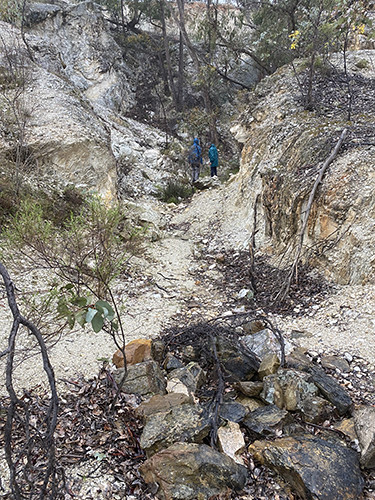
A strong contingent took on brisk weather and a couple of strenuous climbs on FOBIF’s October walk yesterday. The route took the group from the Railway Dam up to the Fryers fire tower, down to Fryers Creek and up again to ‘Hill 488’, the highest point between White Gum Track and the Railway Dam. The effort was significant, and the rewards were rich: terrific displays of Billy Buttons, Sticky Everlasting, Bendigo Wax and sundry peas, among many other things—not to mention impressive patches of Spider Orchids. The final stretch took the group through dense fields of Chocolate Lilies on the cusp of blooming…another week and ‘Hill 488’ will be even more spectacular.

Our thanks to Jeremy Holland for yet another imaginative and rewarding route. This was the last Sunday  walk for the year—but see here for details of the Matted Bush-pea excursion this coming Wednesday (the 23rd).

Posted in News, Walks | Comments Off on Strenuous effort, rich rewards