Alchemy of gold 1: Transformation into what?

The Alchemy of Gold, an event bringing together ‘experts, historians and the community to explore how the discovery of gold in the 1850s reshaped Victoria economically, socially and politically’ took place over the weekend of May 16-18. Its aim: ‘celebrate our goldfields heritage’.

The context of the event is the ambitious project to achieve World Heritage status for the Victorian goldfields.

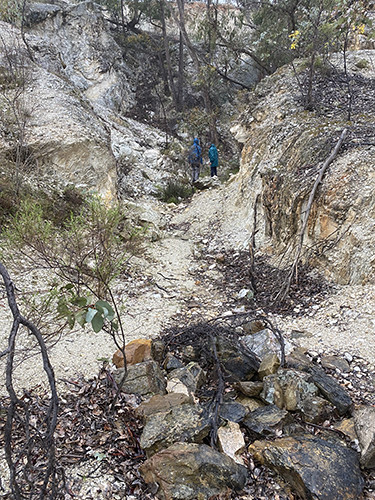
You only have to look at the above list of topics to realise that the title, ‘alchemy of gold’, and the aim, to ‘celebrate our goldfields heritage’, were contentious. From the beginning of the weekend, it was acknowledged that not everything in that era was to be celebrated: gold rushes worldwide have all been accompanied by dispossession of indigenous peoples; and the environmental destruction that accompanied Victoria’s rush was eloquently evoked during the event [see below].

The negative effects of the age of gold haven’t conveniently disappeared into the past, and a simple ‘celebration’ would run the risk of looking like a whitewash. This is particularly problematic when you consider the tendency of heritage experts to ignore or downplay the negative experiences of the past. And a World Heritage Listing, if improperly defined, could worsen the situation by solidifying the notion that the gold rush was all romanticism, grit and colourful drama (to be remembered over a nice cup of coffee).

So: how did Alchemy of Gold go? Like all events in which there were numerous speakers (well over thirty, in this case), it was a mixed bag. Beautifully organised, smoothly run: but leaving us with difficult questions.

Posted in News | 2 Comments

Alchemy 2: should the ‘new golden age’ be like the last one?

One question inevitably arising in such an event is: how have the events of the gold rush shaped the society and place we live in now? The answers are familiar: egalitarianism, a cosmopolitan society, democracy…but one feature of our society which usually doesn’t make this list is: a tendency to exploit nature without heed for the future.

With influential observers touting a ‘new golden age’ in Victoria, it’s important to avoid repeating past mistakes: and we know that some of the less desirable practices of the gold rush have not disappeared.   The Victorian Auditor General reported in 2020 that many current or recent mining and quarry sites ‘have been poorly rehabilitated or not treated at all. If not addressed, these sites also present risks to Victorians and the environment.’ The estimated cost to the taxpayer of fixing this was at the time $361 million or more.

Currently the state government is considering a proposal to increase fees payable by mining companies for rehabilitation by 234%, because ‘commissioned independent analysis in 2022 indicated that fees recovered from the resources sector do not cover the costs of regulating it.’ [A consultation on this proposal is open now on Engage Victoria. Curiously, this consultation seems to have the aim of figuring whether the proposal is good for business or not. It doesn’t ask whether the idea is good for the environment, or the public. You might want to check the consultation out here. It closes on June 23].

The question arising out of all this is: which practices in our gold rush heritage do we want to celebrate and promote, and which ones do we want to soberly assess and avoid repeating?

Posted in News | Comments Off on Alchemy 2: should the ‘new golden age’ be like the last one?

Alchemy 3: repairing the mistakes of the past

There were some very good presentations at the weekend’s event, but we’ll focus on one theme only: environmental history. Standout speakers here included Susan Lawrence, co author of Sludge– disaster on Victorian Goldfields (a book which should be compulsory reading for all heritage buffs), and local ecologist Paul Foreman. Paul’s presentation began bluntly:

‘…It is timely to reflect on the Gold Rush’s full legacy – not just the claim that the Victorian goldfields were the cradle of modern Australia economically (i.e. wealth generation) and culturally (i.e. mass global immigration, in part the origin of the Australian ‘fair go’ and so on), but also that the gold rush “obliterated” the natural environment (ECC 1997) and further entrenched Aboriginal dispossession, vilification and oppression (Cahir 2012). Now I should say the word “obliterated” is not my words – it’s a direct quote from a systematic environmental assessment by a Government Statutory Authority in the 1990’s). Even if it is a given that people accepted these sorts of consequences as an inevitable price to pay on the frontier and indeed today, it is also true that the full impacts remain largely misunderstood and/or ignored.’

After documenting the damage referred to above, Paul ended on a positive note, which we believe should underpin any World Heritage bid:

‘I think it is important not to gloss over the less savoury and inconvenient short and long term environmental and cultural impacts of a the Gold Rush; a seismic event that unleashed global humanity on an unsuspecting traditional society and delicate Gondwanan ecosystems with little understanding, consideration or constraint.

‘Accordingly, if we have learnt anything from history, the concept of redress (indeed justice) should become central to the World Heritage bid; not just an add on or rhetoric. (FOBIF emphasis)

‘Continuing to ignore these impacts – and in fact continuing to see them as an intractable part of the ‘historic fabric’ of the landscape – should no longer be an acceptable or prudent perspective.

‘Today we have the knowledge and wherewithal to act to address these crises, both because it is the right thing to do, but perhaps more importantly, because it would finally be in line with the vision of ‘forever’ that, if we are honest, we all take for granted but know in our hearts is really in jeopardy.

‘Thus it behoves us – this generation – to act!

‘The future of course isn’t set in stone so we have an opportunity to create a new trajectory of recovery for the Box Ironbark Forests and Woodlands so severely impacted by the Gold Rush.

‘Arguably restoration should have commenced a long time ago, but it’s never too late..   Consequently, I would like to call for a campaign to leverage resourcing on the back of the World Heritage bid to further develop and scale up effective landscape restoration solutions that complement the bid’s  broader aims.

‘I think the World Heritage bid represents a great opportunity to build a more positive environmental legacy from here on. . One that is completely in line with the primary aims of awareness, education and thriving regional communities and towns. I look forward to the discussions, collaborations and transformative (indeed healing) actions ahead.’

Posted in News | 1 Comment

Fire in the Maldon Historic Reserve

Forest Fire Management burned a biodiversity rich section of the Maldon Historic Reserve, near the Railway Track, on May 9. Conditions were described as ‘ideal’, with no wind, and appropriate moisture levels.

Readers will remember we have reported on this fire proposal before—see our posts with links to a map of the site here

The Department’s aim was a low intensity burn to remove 4cm of ground fuel and prevent elevated bushfire hazards. A preburn fire was lit to create smoke so that small animals could get away. Three exclusion zones were created to protect nominated plant species.

In the burn zone: no large habitat trees seem to have been destroyed; but in an area dominated by spindly regrowth eucalypts, the loss of even medium sized trees is to be regretted.

Local environmentalists met with fire management both before and after ignition, and a further onsite meeting is planned for about 8 weeks time.

The fire was described by fire officers as low intensity; staff and students of Melbourne University had placed probes around the site to measure heat levels. In fact, the fire intensity varied widely, with some areas severely burned and others barely touched, achieving a mosaic effect around the site….but managers are considering returning to the untouched areas for another go.

There’s no doubt that managers are making serious efforts to reconcile environmental concerns and current ideas about fire danger. In the present case, the exercise seems to have been pulled off without bringing down any large habitat trees, a significant improvement on past exercises; yet a number of medium sized trees was destroyed—a regrettable result. Though this area is rich in understorey and ground cover plants and orchids, the tree cover is largely spindly regrowth eucalypts, and can ill afford loss of trees of good size.

As we’ve said before, moreover, there’s an apparently irreconcilable clash of views when it comes to that 4 cm of leaf litter: does it constitute a ‘very high to extreme fuel hazard’ (Fuel Hazard Assessment Guide), or is it a precious environmental asset? According to Arthur Rylah research, ‘litter plays an important role in nutrient cycling, and provides important habitat for invertebrates and small vertebrates. Frequent burning (for example, 3-5 year intervals) will disrupt natural processes in the short-term and may eventually lead to a depletion of soil nutrients and loss of habitat.’

Exercises like the one under discussion are in fact experiments. Part of their value depends on what kind of monitoring and research is done before and after them—and as we know, there’s little or no credible research arising from many such burns. As the Auditor General put it in 2021, ‘DELWP cannot demonstrate if, or how well, it is halting further decline in Victoria’s threatened species populations.’


Posted in News | 2 Comments

Pre-1852 Eucalypts of Maldon Walk

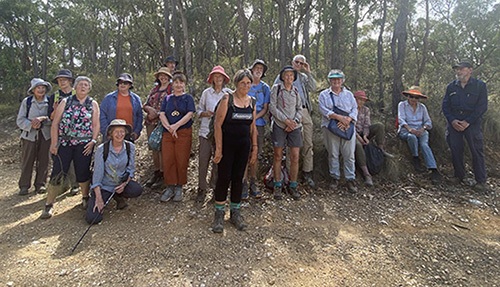
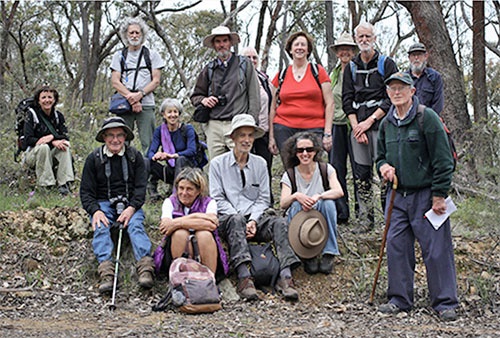
Today’s FOBIF walk was in the Maldon township on a chilly, windy morning. We are grateful to Bev Phillips from MULGA ( Maldon Urban Landcare Group) for her informative and interesting talks, as we walked and gazed in wonder at the ancient trees. We now might be able to tell the difference between Grey Box, Yellow Box, Red Box and Long-leaved box trees, but as Bev kept reminding us, don’t just rely on the bark to identify a tree! (Bev acknowledged Frances Cincotta for that point of emphasis).  Specimen samples of some of the trees were provided so we could look closely at the leaf shape and fruit. It was a wonderful walk seeing the 500 year old tree and some of  the 300 & 200 year old trees, all catalogued on private and public land and being protected by MULGA.

Thanks to Linda Hickey for this contribution.

Posted in Nature Observations, Walks | Comments Off on Pre-1852 Eucalypts of Maldon Walk